Frame saws


Frame saws
EXPERT KNOWLEDGE FRAME SAWS
What are the components of a frame saw?
The basic construction of all frame saws is similar: the blade is tensioned within a frame to prevent it from bending during use. A frame saw consists of the following components:
A. Two arms
B. Crossbar
C. Two handles (also known as horns)
D. Saw blade
E. Tensioning cord, wire or screw

The blade of a rip frame saw is approx. 40 mm wide and 700–900 mm long, filed for cutting along the grain. It is used for producing joints such as mortise-and-tenon. It can also be used for general cutting and crosscutting tasks.
The crosscut frame saw
This saw is approx. 600 mm long with a blade width of around 30 mm. It is used for finer cuts across the grain, primarily for cutting tenon shoulders. It features fine tooth pitch and crosscut filing. It can also be used for finer rip cuts, for example when cutting dovetails.
The turning saw
The turning saw is the smallest type of frame saw and is used for curved cuts. Blade length ranges from 300 to 400 mm, with a narrow blade width of 4–10 mm to allow tight radii. The blade requires stronger set and higher tension to prevent twisting and wandering.
For internal cut-outs, the blade can be removed after releasing the tension and threaded through a pre-drilled hole.
The buck saw
The buck saw is a large frame saw with a length of 700–800 mm. It is used for rough crosscutting of squared and round timber, as well as for cutting firewood, and performs well even in green wood.
Its distinguishing feature is a symmetrically filed tooth pattern, cutting on both the push and pull stroke. The tooth angle is approx. 45° rather than the usual 60°, requiring a specialised file for resharpening.


Frame saws with traditional tooth patterns are typically sharpened by the user. The blade is clamped in a saw vise and filed on the push stroke of the file, depending on how aggressively the saw is intended to cut.
The bevel angle can also be adjusted:
- steeper for cleaner crosscuts (image on the right)
- flatter for longer edge life (image on the left)
Frame saws with Japanese blades
We also offer frame saws fitted with Japanese saw blades for rip, crosscut or universal tooth patterns. Japanese blades are extremely sharp, cut quickly and cleanly, and offer exceptional edge retention. However, they cannot be resharpened.
How to use a frame saw correctly

Frame saws should be stored without tension. Before use, the blade must be tensioned.
On saws with a tensioning wire or screw, this is done by tightening the wing nut; on saws with a tensioning cord, by twisting the cord.
To keep the marking line visible on both sides of the blade, the blade can be set at a slight angle by rotating the handles. Check that the blade is straight and not twisted by sighting along its back.
To control the weight of the saw more easily, it can be held by one of the handles when starting the cut. If the saw is guided by the arm, the handle should rest against the wrist for stability.
Once the initial kerf has been established, continue sawing with firm, even strokes, using the full length of the blade.
Frame saws with traditional tooth patterns are typically used on the push stroke. However, their design allows the cutting direction to be reversed at any time simply by turning the saw.
Frame saws fitted with Japanese blades should generally be used on the pull stroke. At the start of the cut, however, these blades can be prone to grabbing. This can be reduced by starting the cut on the push stroke, although this makes the cut slightly harder to control.
⚠️ Safety when starting a cut
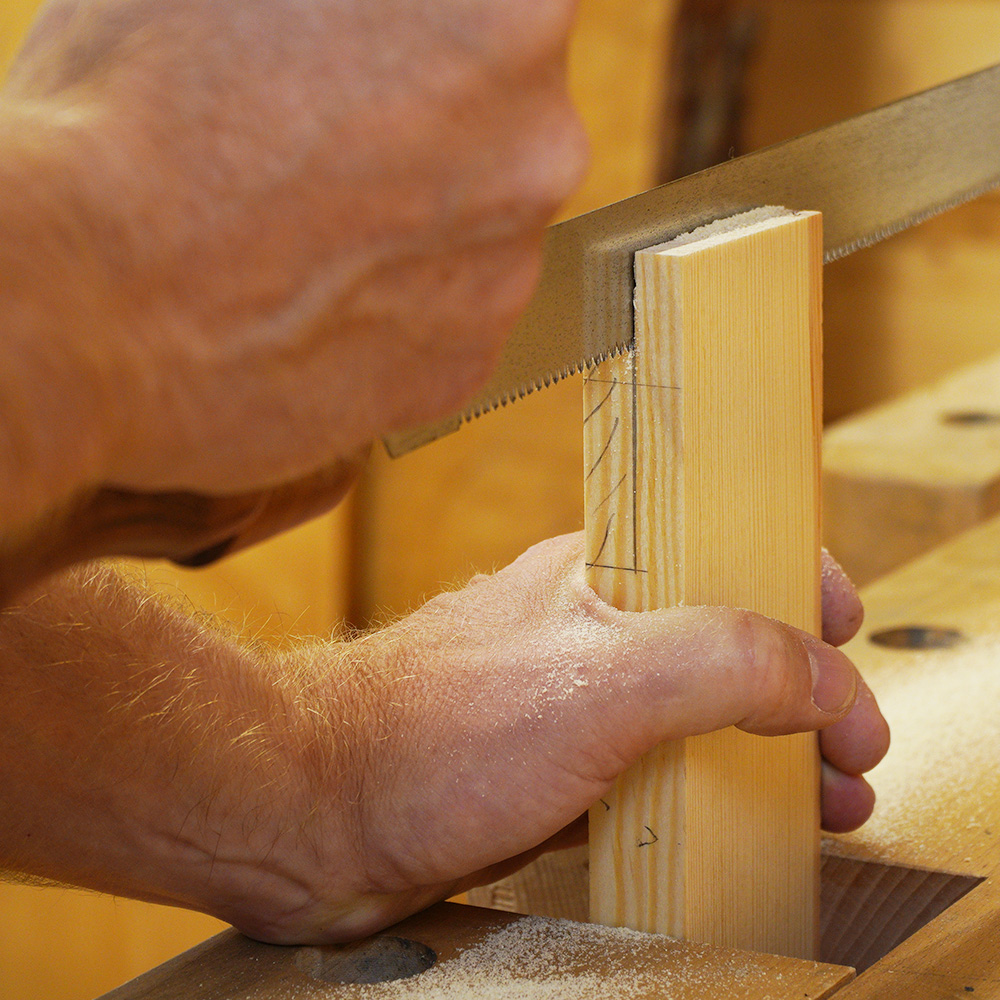

Depending on the tooth pattern, some saws tend to vibrate or jump when starting the cut. The initial kerf should therefore be created with a few light strokes against the intended cutting direction.
Because the saw is often guided with a finger of the other hand (image on the right), there is a significant risk of injury if the blade slips. Even more serious injuries can occur if the workpiece is unnecessarily held by hand and the supporting hand is positioned below the cut line (image on the left).
The workpiece should always be securely clamped in the workbench.
Correcting the cut

If the cut begins to wander, the direction can be corrected by slightly tilting the frame in the direction of the deviation. However, the scope for correction is limited by the blade width and the amount of set. Avoid overcorrecting.
Practical tips for working with frame saws


Other types of tensioned saws
Frame saws belong to the group of tensioned saws. This category also includes bow saws, coping saws and metal frame saws.
In all these designs, the blade is tensioned between two points within a frame or bow. Unlike backsaws, it is not reinforced by a spine, and unlike Western handsaws, it does not need to be particularly thick.