
Mitre saws


Mitre saws
EXPERT KNOWLEDGE MITRE SAWS
Looking for a powered mitre saw?
If you are considering a powered mitre saw or compound mitre saw, the following points will help you choose the right solution for your needs.
Power tool or hand tool?


With a powered mitre saw, mouldings can be cut quickly and even larger timbers can be mitred with minimal effort. For mobile use, some models are also available as cordless machines.
Hand tools, however, offer several advantages: they are more affordable, require very little space, are easy to transport and produce a narrow kerf, resulting in less material waste.
How to cut mitres by hand

Most mitre guides provide preset angles via fixed stops.
Manual mitre saws
In a manual mitre saw, the blade is tensioned in a frame similar to a frame saw. The frame is guided at the desired angle by an adjustable guide mechanism, while the workpiece is supported against a fence on the saw table.
When choosing a mitre saw, ensure that the guide allows sufficient clearance for thicker material and that the angle settings can be reproduced accurately. Lower-cost models are often limited to thin mouldings and may lack precision.
Mitre box sets with Japanese saws
We offer two types of mitre box systems, each supplied with a matching Japanese saw:
- a precision mitre box with fixed angles of 90° and 45°
- a larger system with fully adjustable angle settings
The precision mitre box is ideal for cutting mouldings square or at standard mitre angles. The larger system allows free adjustment and can be tilted in two axes (horizontal and vertical), enabling compound cuts.
These products can be found in the category »Saw guides/mitre boxes«.
Saw guides for Western saws
In guides for Western saws, the blade is typically held in position by integrated magnets. All guides provide fixed angle settings, usually 45° and 90°, as well as predefined angles for cutting dovetails.

Mitre guillotines
Another alternative to a mitre saw is the mitre guillotine. This tool is widely used by cabinetmakers, joiners and professional frame makers for cutting mouldings with extreme precision.
The mitre is first roughly cut with a saw and then trimmed exactly to size using the sharp blades of the guillotine.
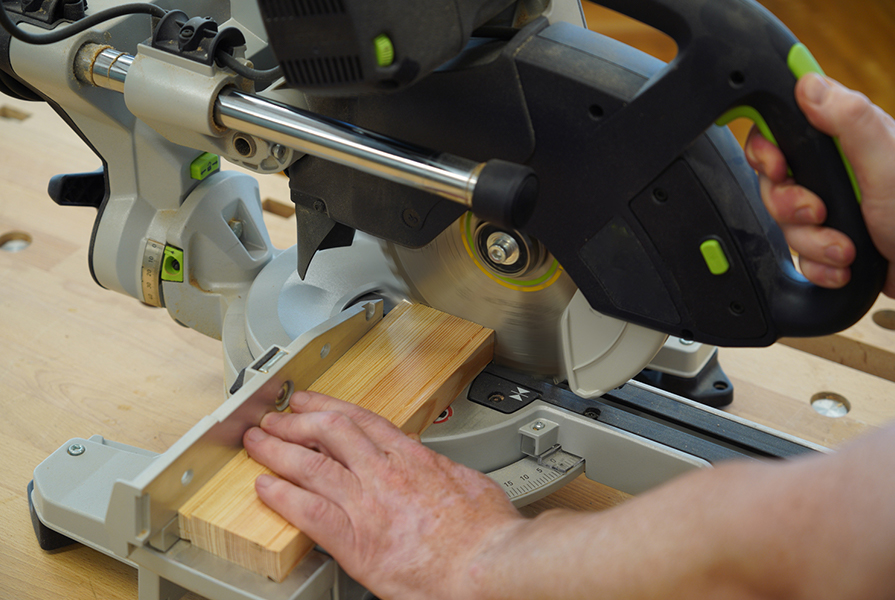
Choosing a mitre saw – what to consider
When selecting a mitre saw, crosscut saw or pull saw, consider the type of work you carry out most frequently. This will determine the features you need and the level of investment required.
Professional workshops have different requirements from private users. In general, mitre saws are used whenever workpieces need to be cut to length quickly and with a high degree of accuracy.
