
Veneer and flush-cut saws


Veneer and flush-cut saws
EXPERT KNOWLEDGE VENEER AND FLUSH-CUT SAWS
The traditional Kugihiki is a highly specialised Japanese saw. Essentially, it is a small kataba designed for trimming protruding wooden dowels, pins and tenons flush to the surface.
The blade is extremely thin, typically between 0.3 and 0.5 mm, and correspondingly flexible, allowing it to lie flat against the workpiece during cutting. To protect the surface and prevent scratching, the teeth are unset.
Tips for using flush-cut saws
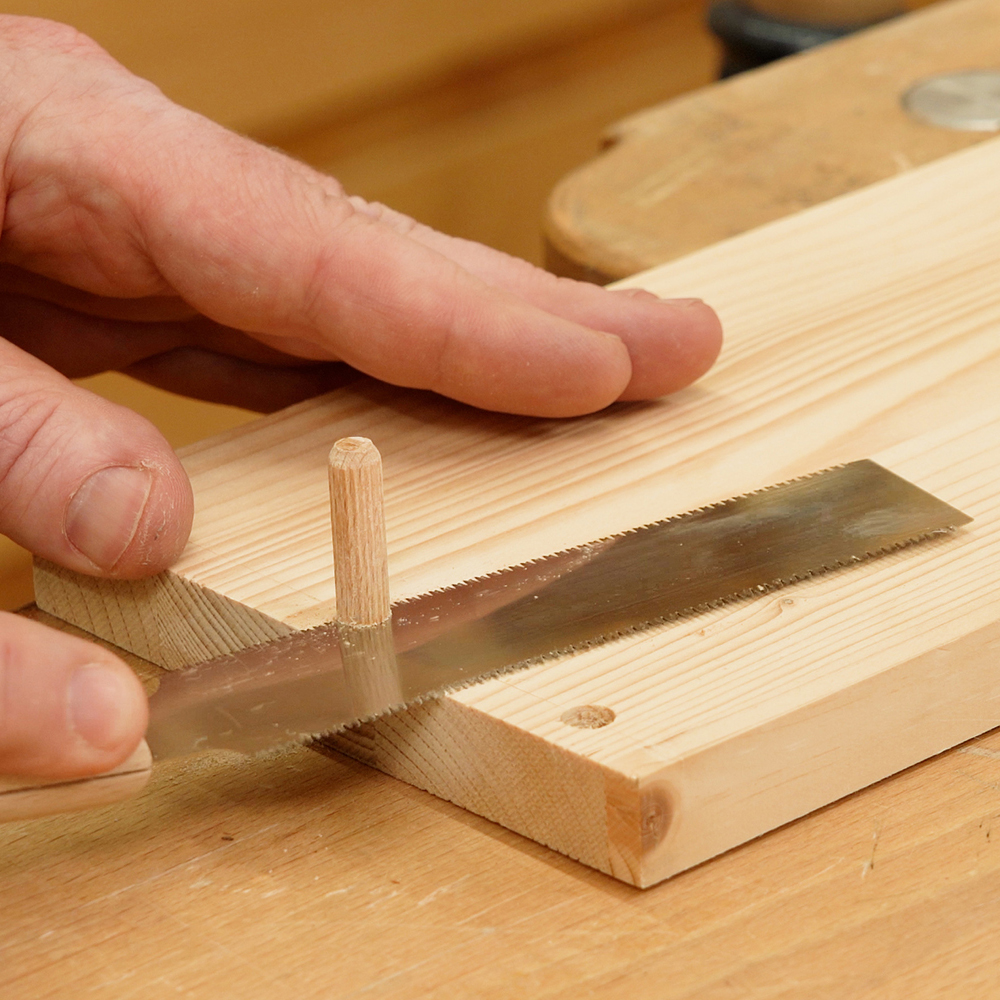
All flush-cut saws are Japanese pull saws. Their fine blades require a certain level of control and familiarity. Avoid applying downward pressure. Lateral movement or twisting will cause the thin blade to bend easily.
Avoid scratches: Do not drag the saw across the surface. Instead, place it directly against the dowel or pin. Although the teeth are unset, the blade edges can still mark the surface. Ensure that the blade lies flat both in front of and behind the dowel. Whenever possible, cut parallel to the grain, as minor marks will be less visible. For particularly sensitive surfaces, such as finished or painted workpieces, a sheet of paper can be used as protection. Also be aware that the handle itself may scratch the surface.
Cut with light pressure and hold the protruding part firmly to prevent it from breaking off prematurely.
What are flush-cut saws suitable for?
The primary purpose is clear: trimming protruding wooden dowels flush to the surface. But what else can this Japanese fine saw be used for?
Most Kugihiki saws are filed for crosscutting and are therefore suitable for both softwood and hardwood. Models such as the Ryoba Restauro 125 and the Mini-Kugihiki from Z-Saw feature double-edged blades with a universal tooth pattern, allowing cuts both along and across the grain. The cuts are exceptionally fine and precise, with very smooth surfaces.
As a result, the Kugihiki is particularly well suited for short, delicate cuts. Restorers often use it to carefully separate joints such as mortise-and-tenon, thanks to its thin blade. As a pull saw, it also allows flush cuts close to edges, even in internal corners.
However, this saw is not suitable for deeper cuts or thicker material. Cutting performance decreases as the cross-section increases, and the blade may begin to wander. This is due both to the lack of set and to the fine tooth pattern, which offers very little space for chip clearance during longer cuts, especially when cutting along the grain.
