
Sanders & grinders for wood


Sanders & grinders for wood
EXPERT KNOWLEDGE SANDERS & GRINDERS FOR WOOD
Which Sanders & grinders for wood to buy?
The range of sanders & grinders for wood is huge and the differences between the various devices are enormous. To give you an overview here, we have divided the sanders into stationary machines and power tools and briefly explained which sander is suitable for which tasks.
Stationary sanders & grinders for wood


-
Belt sander / long belt sander. The standard in many craft businesses. A long endless sanding belt runs between two rollers, the workpiece lies on a moving table underneath. The sanding shoe is attached to a movable rod and presses the belt onto the surface of the workpiece. The belt sander is mainly used for sanding large surfaces, e.g. carcase parts, flat and furniture doors. Working on the belt sander requires practice and concentration. As the sanding depth is not limited, there is a high risk of sanding parts and sanding through veneered surfaces.
Even with small bench belt sanders , the Material removal is comparatively high. Here, the workpiece is placed on the Abrasive surface size by hand and guided. Small belt sanders are suitable for adjusting and reworking workpieces and for rounding off corners and edges. An open roller enables shaping sanding or concave shapes (e.g. for curved chair legs). Belt disc sanders and disc sanders are often combined in one machine. -
Wide belt sander and (Flat) cylinder sander. It is similar in design and function to a thickness planer. Instead of a cutterhead, the wide belt sander has at least two pairs of rollers arranged one above the other, over which a wide sanding belt runs. Instead of a cutterblock, a cylinder sanding machine has one or two sanding cylinders, onto each of which a sanding sleeve is pushed. The material removal can be precisely controlled on both machines, which is why they are even better suited to sanding large surfaces than a conventional belt sander.
-
Edge sanding machine: In professional use, this is used as a supplement to the surface sanding machine (belt or wide belt sander) and is used for sanding narrow surfaces and edges, frames and mouldings. Most models are belt sanders with an endless sanding belt that runs or oscillates over two vertical rollers.
-
Grinding wheels sanding discsare glued or attached with Velcro to a vertical sanding disc. The support table in front of this can be tilted on most disc sanders for sanding certain angles (e.g. chamfers on furniture edges). Disc sanders are used, for example, for reworking mitres, finishing mortised or tenoned corner joints and for rounding or chamfering.
- Professional models are similar in design to a bench grinder, but rotate much more slowly. Depending on the task, sanding cylinders of different diameters can be used. Depending on the model, the sanding movement is either rotating or oscillating, and the sanding cylinder often also moves slowly up and down in order to utilise the Abrasive paper sandpaper more effectively. Cylinder sanders / Spindle sanders are mainly used for sanding edges (with additional stop) and concave edges that are curved inwards (e.g. furniture legs, door and window arches) and for moulding.
Power tools for sanding wood
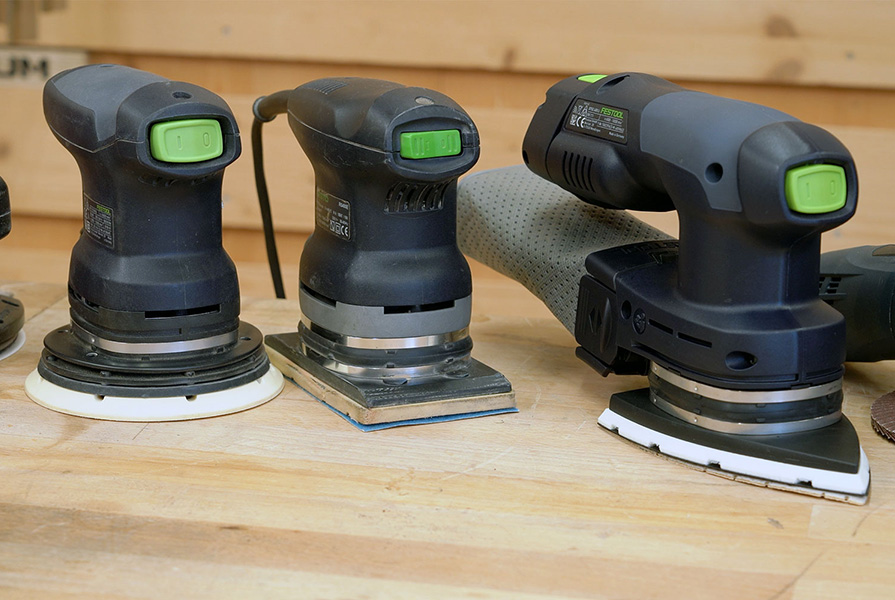
On hand-held sanders such as Oscillating sanders or Gear-drive random orbital sanders, the sanding disc or sanding pad is located under the motor block and is driven by it directly or via a gearbox. Depending on how the abrasive (sanding belts, grinding wheels sanding discs) moves, there are differences in the sanding pattern and material removal.

Overview of grinding movements for power tools: 1. linear and unidirectional (belt grinder), 2. circular-oscillating (Random orbital sanders/Delta sanders), 3. oscillating and rotating (Random orbital sanders), 4. rotating (Angle grinders) and 5. so-called "curved path" (geared grinders)
-
Belt sanders or hand belt sanders, like their larger counterparts, work with sanding belts that are moved linearly by a drive roller. The sanding belt rests on the workpiece on the pressure plate in the centre of the sander. Compared to other hand sanders, the abrasive is moved very quickly. As a result, hand belt sanders work very effectively and remove a large amount of material. They are ideal for working on large surfaces and removing a lot of material, e.g. old paint. Some models are supplied with a holder so that they can be used as a stationary sander.
-
Oscillating sanders orbital sanders and Delta sanders: In both devices, the motor block sits above the sanding pad, which is set into circular oscillation by an eccentric gearbox. Compared to the belt sander, the sanding movement is quite short, which is why it is also referred to as a sanding stroke or oscillating circuit. Depending on the model, Oscillating sanders orbital sanders have an oscillating circle/stroke of 2 to 5 mm. The material removal is much easier to control than with a belt sander. While the sanding plate on orbital sanders is usually rectangular, the sanding pad on delta sanders has a triangular shape with slightly curved sides. Due to the shape of the sanding pad, delta and Oscillating sanders orbital sanders are also suitable for sanding close to the edges of rebates and in corners. Sanders with a large stroke of 5 mm are suitable for sanding larger solid wood and veneered surfaces (furniture carcasses, doors, etc.) or the controlled removal of layers of varnish, for example. Orbital and Delta sanders with a 2 mm orbital stroke are ideal for fine or intermediate sanding. Lightweight machines are practical for renovations and sanding mounted parts (e.g. door frames, window reveals), as they allow you to sand vertically or overhead for longer periods of time.
-
Random orbital sanders are a further development of the Oscillating sanders orbital sanders and have a similar design, but their sanding disc is mounted on a rotating bearing and the circular vibrations also cause it to rotate around its own axis. This rotational movement ensures more even material removal and a better sanding result. The sanding movement is larger overall, which ensures better removal of the sanding dust and less heat generation. Random orbital sanders also have oscillating circuits of different sizes, so that there are also machines for coarser and finer sanding work.
-
Gear-drive random orbital sanders: In contrast to normal random orbital sanders, the rotation of the sanding disc is not random, but is controlled by a gearbox and can be switched on and off. The combination of both movements results in up to three times larger stock removal. As the rotation of the sanding disc can be controlled or switched on and off, Gear-drive random orbital sanders are very versatile and very suitable for coarse sanding work (with rotational movement), fine sanding (without rotational movement) and for polishing paint (with rotational movement).
-
Multi sanders are not, strictly speaking, sanders & grinders for wood. With this multi-function tool, the tool movement is oscillating, i.e. the tool (saw blade, sanding plate, cutting disc) moves back and forth. A multi sander or multitool is often a good problem solver for complicated situations (e.g. cutting close to edges, sanding in narrow slots), but sanding is only one of many functions and the results cannot be compared with other hand sanders.
- Angle grinders are suitable for cutting materials as well as for sanding and polishing. With the appropriate sanding attachment (sanding disc or flap disc), it can also be used to sand wood. The sanding motion of the Angle grinders is circular and enables a large amount of Material to be removed. With different sanding attachments, it is suitable for a wide range of sanding tasks from very coarse (milling and rasping) to very fine (sanding and polishing). The Angle grinder is versatile and can also be used for cutting, grinding and polishing stone and metal.
