
String height gauges / thickness gauges / bridge fitting tools


String height gauges / thickness gauges / bridge fitting tools
EXPERTENWISSEN ABZIEHLEDER

Measuring method: Touch probe thickness gauges
A thickness gauge with a probe is a classic measuring device that can measure the thickness of the material using a sensor that presses directly onto the surface of the material. Manufacturers such as Käfer offer models that impress with their durability and accuracy. Mechanical thickness gauges work with a pointer display, while digital models show the measurement results on a display and often offer additional functions such as data storage or interfaces for the computer.
The strength of the calipers lies in their accuracy, which can be as low as 0.01 mm. This makes them ideal for flat and easily accessible components, such as guitar tops or violin backs, where the uniformity of the material is crucial for sound transmission. However, they require direct contact and are therefore less suitable for sensitive surfaces or cavities that are difficult to access.
Measuring method: Magnetic thickness gauges
Magnetic thickness gauges, such as those from Mag-ic, measure without damage and are ideal for sensitive instruments or those with complex internal structures. The measurement technology is based on a magnet that is attached to the inside of the material. The sensor, which is guided on the outside, measures the thickness based on the magnetic force. These devices score points for their versatility, as they can also measure in hard-to-reach places without damaging the material.
Magnetic devices are particularly useful for hollow-body instruments such as guitars, cellos or lutes, where precise measurements of the material thickness are crucial for resonance. Although the accuracy is around 0.1 mm and is therefore not as high as a thickness gauge with a probe, the material-friendly measuring method makes this type of measuring device a popular addition.
Edge thickness gauges and their significance
Edge thickness gauges are specialised tools that focus on measuring the material thickness at the edges of workpieces. These areas are often particularly sensitive, but have a major influence on the stability and vibration characteristics of an instrument. As a rule, edge thickness gauges have smaller Throat depths, which makes them easier to use on smaller instruments such as mandolins or ukuleles.
The throat depth of a thickness gauge - i.e. the distance between the measuring probe and the holding arm - should be adapted to the size and shape of the instrument. Throat depths of 50-100 mm are sufficient for smaller instruments, while devices with throat depths of 150-300 mm are required for larger instruments such as cellos, guitars or double basses. Manufacturers such as Käfer offer specialised models that are also suitable for delicate work.
Comparison of Manufacturers: Beetle and Mag-ic
Both Manufacturers - Käfer for push-button devices and Mag-ic for magnetic devices - are recognised in the industry and stand for precision and reliability. Käfer is characterised by robust and durable mechanics that guarantee a long service life even in workshops with heavy use. Mag-ic, on the other hand, scores with innovative technology that is specially tailored to the requirements of sensitive and complicated measuring environments.
Measuring ranges:
The Measuring range of the thickness gauges at DICTUM varies, with most thickness gauges being suitable for materials in the range of 0.1 mm to 12 mm.

1. beetle thickness gauge (Shape D, Throat depth 200 mm) - It measures in a range from 0.1 mm to 12 mm

2. edge thickness gauge - covers a range from 0.2 mm to 2.5 mm
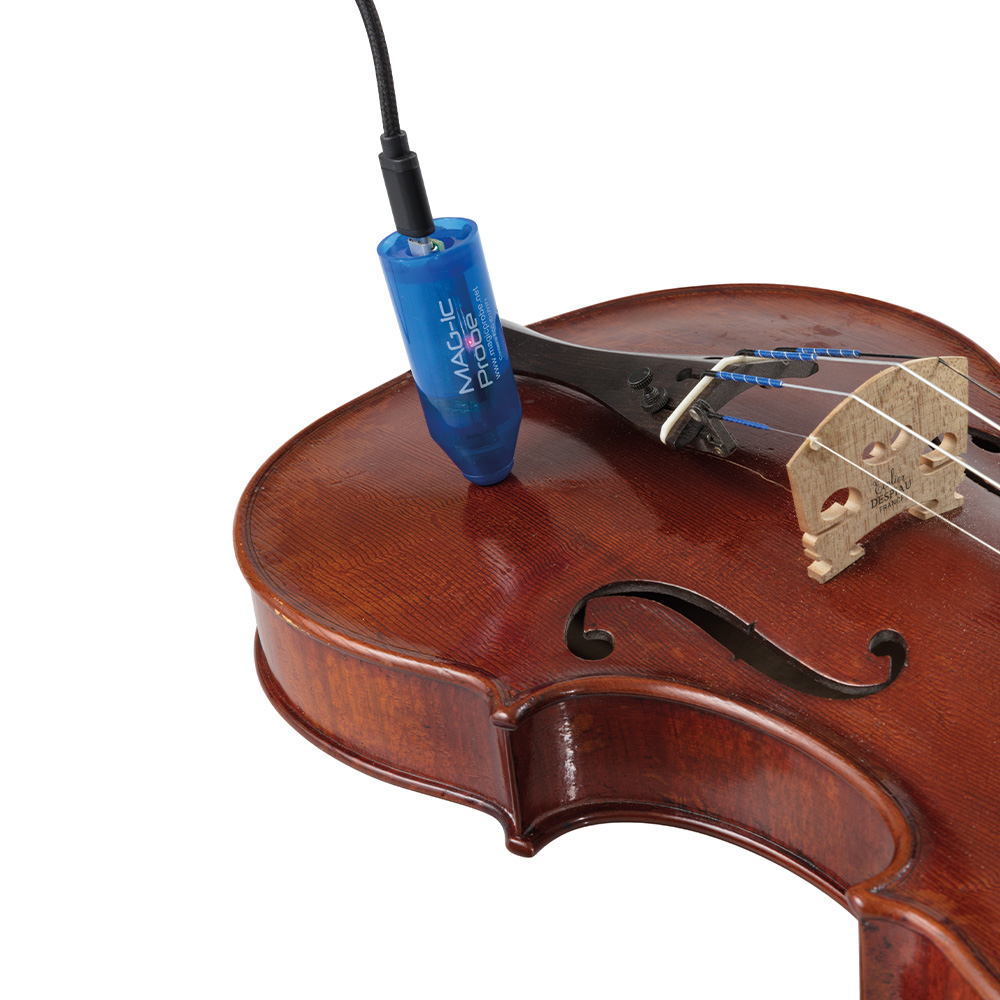
3rd Mag-IC-Probe thickness gauge - This has a Measuring range of 0.1 mm to 12 mm
Areas of application in instrument making
Instrument makers use thickness gauges to check and optimise the material thickness of wood, metal or plastic. In the case of violins, for example, the thickness of the top and back is precisely adjusted to achieve the desired resonance characteristics. For wind instruments such as flutes or trumpets, a uniform wall thickness ensures a clean sound and durability.
For guitars, measuring the thickness of the top and back is essential, as they influence the fullness and projection of the sound. Especially for acoustic guitars, whose sound depends heavily on the resonance of the wood, all parts must be perfectly matched.
The right choice for maximum precision
Thickness gauges are indispensable for any instrument maker who values quality. Caliper devices such as those from Käfer offer maximum accuracy for Flat and easily accessible areas, while magnetic devices from Mag-ic enable non-destructive measurements in hard-to-reach areas. Edge thickness devices and the right choice of Throat depth round off the range to give every instrument the perfect sound base.
