
Violin strings


Violin strings
EXPERT KNOWLEDGE VIOLIN STRINGS
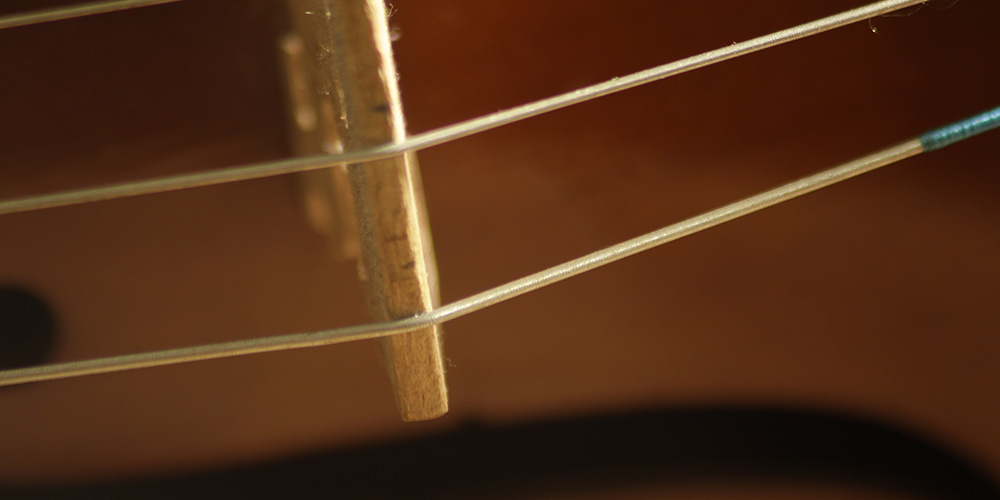
Which violin strings are right for my instrument?
The choice of strings for string instruments has become enormous. And unfortunately, there is no standard recipe for finding the ideal violin strings for your violin. Every stringed instrument is individual in its resonance behaviour and sometimes you simply have to take a set of violin strings and try them out to see if they produce the desired result. However, there are certain characteristics of the different string types that you can use as a guide when making your choice.
The different materials for strings
Gut strings:
Violin strings are traditionally produced from the intestines of hoofed animals, primarily sheep from barren and dry regions. The gut is cut into strips, twisted, dried and then polished.
The gut strings on the market today are wound, i.e. they are wrapped with a metal material such as aluminium or silver. This increases the mass of the string, making it heavier and therefore deeper sounding. Without this winding, the string would be considerably thicker at lower pitches. You could also put it another way: Rewinding allows much thinner strings to be produced without compromising elasticity and handling. ENJOY strings generally have a relatively soft and warm sound, but are very sensitive to temperature fluctuations and react strongly to changes in humidity. They have the property of attracting water from the air (hygroscopicity) and begin to swell. This reduces the tension. The break-in period, i.e. the time it takes for the string to stay in tune, can also take one to three days with gut strings. The lifespan is limited, professionals change the strings every one to two months, but normally they last about a year.
Gut strings have a powerful tone, are pleasant to the touch, have a natural elasticity and can be played with a differentiated response. As with the other string types, there are different gauges, for example soft, medium, strong or dolce, medium, forte.
Strings with a synthetic core:
The term synthetic strings is misleading, as bare synthetic strings are not used for stringed instruments. Such strings are probably known from the strings of classical guitars (e, b, g). What is produced from plastic is the string core, which is then wound with a metal cover. Various materials are used for this, e.g. nylon, perlon or polyester, which influences the thickness of the violin strings and the sound characteristics.
Particularly resistant materials from aerospace technology are also used. In terms of sound behaviour, a synthetic string has certain similarities to a gut string (although it has never quite achieved its characteristic properties). Violin strings with a synthetic core are now so sophisticated that they are used by beginners and virtuoso professionals alike. Synthetic strings are also ideal for a wide variety of musical styles. They have a number of advantages over gut strings: They hold their tuning very well and are insensitive to fluctuations in temperature and humidity. Violin strings with a synthetic core develop a sound that is usually described as round, clear, soft and rich in overtones. They are relatively soft to the touch and the possibilities for sound modulation are very good.
Steel strings:
Steel strings are more familiar from plucked instruments. The lengthy decay of steel strings is what gives them their characteristic sound. However, it is precisely this characteristic that you want to avoid with string instruments. The resonance of the strings can be suppressed by damping the steel core. This damping is achieved on the one hand by spinning a metal wire or strip around the core, and on the other hand by a braided layer of silk or synthetic threads underneath.
The first steel string to become established on the violin was the plain E string. Acceptance was easier to achieve here because there were always problems with the thin E gut strings, which broke very easily. In the meantime, the E-string made of steel has become standard on the violin, even when strung with gut strings.
However, the E-string can also be wound, which makes it a little easier to grip and also better matches the sound of the other violin strings. The advantage of steel strings is their tuning stability and long service life. Steel strings are very popular for beginners and for lessons. They are characterised by a powerful sound, although the cheaper models are often rather hard and metallic.
Different gauges:
Violin strings are available in different gauges, although the gauges specified by the various manufacturers are not necessarily comparable. Common designations for different gauges are: soft, medium, strong or dolce, medium, forte or light, medium, heavy. A thin violin strings comes closest to the ideal string in terms of its physical vibration behaviour. It has a good response and is very rich in overtones, but its sound is rather quiet due to its low dimensions. With a thicker string, the response may be worse, but it has a fuller sound.
Stronger violin strings are recommended for violins with thicker walls, a high arched top or a low bridge. A simple test involves tuning down the strings that are strung on the violin. If you like the sound better, you can put on thinner or lighter strings. Conversely, thicker strings will probably sound better. If you do not yet have a clear idea of the sound, it is advisable to start with the medium gauge (medium).
Notes on ball mounting
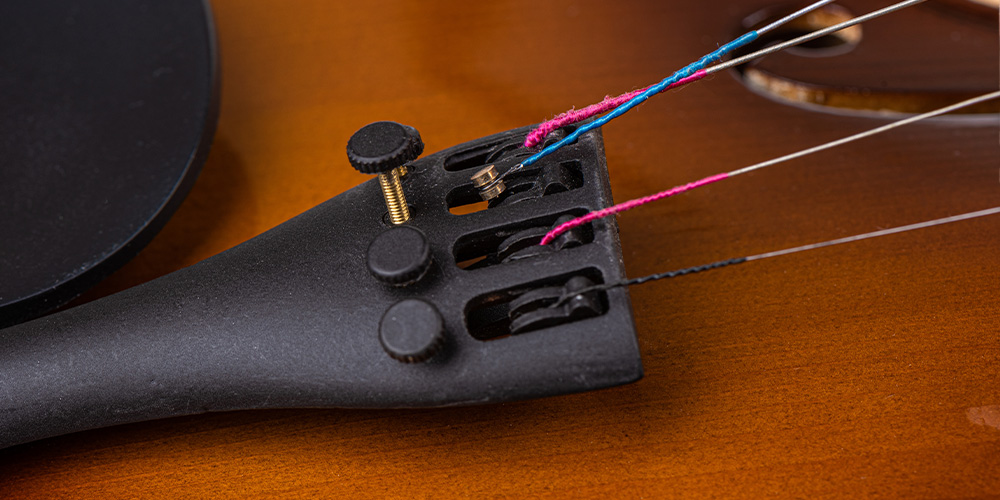
The ball attachment is particularly practical and is standard on most modern violin strings. On the one hand, it ensures stability, as the ball holds the string securely in the tailpiece, and on the other hand, most tailpieces and string adjusters fine tuners are designed for ball mounts.
However, some players prefer loop mounts, especially for gut strings or historical instruments. Make sure that your tailpieces are designed for the Type of attachment of your chosen violin strings.
How can you optimise the break-in time of new violin strings?
The break-in period for new violin strings is an important process. Each string develops its final sound characteristics during this phase, depending on the Material, tension and brand. A careful approach facilitates the process and leads to an optimal result.
Reasons for playing in new violin strings
New violin strings need time to adapt to the specific conditions. This process includes:
- Mechanical stabilisation: The core material and the windings settle under the applied tension.
- Tone development: The string adapts to the resonant vibrations of the violin, often changing the sound from initially bright or harsh to warm and balanced.
- Tuning stability: New strings expand during the first few days and only then achieve a constant tension and reliable tuning.
Changes in the sound during the recording time
- First lessons: The sound can be rough or metallic. The strings also lose their tuning very quickly at first.
- After 1-3 days: Synthetic and steel core strings stabilise, the sound becomes rounder and softer. Gut strings still need more time to develop their full potential.
- After a week or more: Most strings have reached their final sound.
Measures to optimise the recording time
- Play regularly: Daily intensive playing for 30 minutes to an hour helps to stabilise the strings evenly.
- Varied playing techniques: Playing different pitches, dynamics and bowing techniques on the violin promotes even strain.
- Careful tuning: The tuning should be checked regularly and gently readjusted to avoid unnecessary strain.
- Adjusted bow tension: New strings are sensitive to excessive bow tension and excessive use of rosin. An even bow stroke supports the sound development of the new violin strings.
- Stable climatic conditions: Even temperature and humidity conditions are particularly important for good strings.
