
Buying a mitre saw - what you need to know
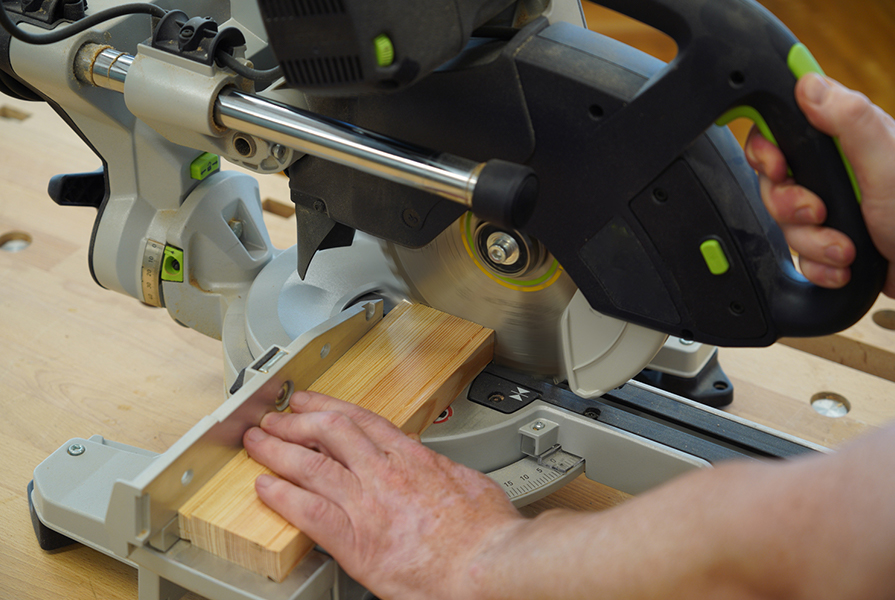
- Crosscut saw, mitre saw and mitre saw - what's the difference?
- Cross-cut saw - more than just a circular saw
- Mitre saw - precise angle cuts
- Pull saw - saw head can be moved
- How a cross-cut and mitre saw works
- Special shape: cross-cut rail saw - particularly flexible cutting
- You can process these materials with a cross-cut and mitre saw
- What you should consider when buying a cross-cut saw, mitre saw or pull saw
- What a professional cross-cut saw costs
- Chop and mitre saws - top models for professionals
- These alternatives to mitre saws are available
- How to calculate the mitre angle and make the mitre cut
- Chop saw maintenance: remove dust with compressed air, check the saw blade
Are you looking for a suitable cross-cut, mitre or pull saw for your workshop? Then you should visualise the tasks that you usually have to perform. On this basis, you can decide what features the saw needs to have and how much you want to invest. This is because different machines are needed in a workshop than in a private workshop. Basically, you always use cross-cut saws, mitre saws and pull saws when you want to cut workpieces to length quickly and precisely.
Pull saw, cross-cut saw and mitre saw - what's the difference?
The first thing you should do is familiarise yourself with the three different types of saw - cross-cut saw, mitre saw and pull saw. Based on your work tasks, you can then make a decision in favour of one model or the other.

Chop saw - More than just a circular saw
A cross-cut saw is similar to a circular saw. The difference is that the saw unit (saw blade) of a cross-cut saw is attached to a joint. The workpiece rests firmly on the fence table and the unit is simply swivelled downwards for sawing. This allows you to cut workpieces relatively accurately at a right angle. It should be noted that most cross-cut saws can only be used for workpieces up to a certain thickness due to their design.
Mitre saw - precise angle cuts
A mitre saw differs from a cross-cut saw in that it has an additional joint that allows you to adjust the cutting angle. This enables more flexible mitre cuts. Depending on the machine, the mitre angle can be changed from 45 to 60 degrees, which is important for certain work steps, for example if boards or beams are to be cut at a special angle (so-called mitre cuts) or frames are to be joined at the corners with a mitre. Most mitre saws have predefined notches for frequently required angles, for example 22.5 degrees, 30 degrees and 45 degrees.

Pull saw - saw head can be moved
A pull saw (sometimes also referred to as a panel saw) differs from a chop saw in one detail of its design. The saw head, to which the saw blade is attached, is not only connected to the frame via a joint. Instead, it is located on a rail that allows you to move the head. When cutting with the pull saw, the unit is swivelled downwards and the saw blade is pulled forwards through the workpiece. This allows you to process workpieces with a larger cross-section. Depending on the design, they have a significantly greater cutting length than simple cross-cut saws.
How a cross-cut and mitre saw works
The operation of a cross-cut, mitre and pull saw can be explained by looking at its structure.
All other parts of the machine are mounted on the saw frame. It forms the basis for the machine and should therefore be as robust as possible. In some cases, the saw frame can also be handled very flexibly. The workpiece is placed on the saw table or turntable.
Most machines also offer the option of fixing the workpiece here so that you can work precisely and safely.

The joint to which the mitre saw is attached allows you to move the head with the saw blade up and down so that you can cut through the workpiece. Mitre saws have a second joint that allows you to swivel the saw unit sideways. Some mitre saws can also be tilted vertically so that angled cuts can be made in two axes, so-called mitre cuts.
The power of the motor determines which material thicknesses are possible with the respective model. The machines are usually powered by a cable, but high-quality battery-powered solutions are now also available.
The saw blade is connected directly to the motor. The speed is usually controlled by electronics. To protect against injury, the saw blade is usually covered by a swivelling cover that opens automatically when the saw is cutting or conceals the saw blade when the unit is at rest.
Special design: cross-cut rail saw - particularly flexible cross-cutting
The cross-cut rail saw is also known as a plunge-cut saw with rail and can be used instead of standard cross-cut and mitre saws. It is not permanently mounted on a table, but can be placed on suitable rails. The rails are placed on the respective workpiece and aligned. This allows cuts to be realised quickly and precisely. Special cross-cut saws, in which a cross-cut rail with angle stops is firmly connected to the circular saw, even allow freestanding work without a support.
You can process these materials with a cross-cut and mitre saw
Regardless of whether it is a cross-cut, mitre or pull saw, a range of different materials can be processed. The prerequisite for this is always the right saw blade. Generally speaking, cross-cut and mitre saws are very good for producing components with identical dimensions, for example when it comes to laying a floor made of wood, prefabricated parquet or laminate.
In addition to the use of cross-cut and mitre saws for wood (they can also be used to cut firewood), these saws are also used to process metal or plastic on construction sites or in workshops.
What you should consider when buying a chop saw, mitre saw or pull saw
If you have decided on one of the three types - cross-cut saw, mitre saw or pull saw - then you have already taken the first step. Now it's time to look at the details of each machine. Important points here are
Cutting values of the saw: The cutting depth of a cross-cut and mitre saw is usually up to around 110 mm. This means that the workpiece can be up to 11 cm thick. This depends on the size of the saw blade. Pull saws usually have a significantly greater cutting depth. The cutting length can be a good 300 mm.
Motor: The harder the material to be cut, the greater the power reserves the motor should have. The usual power range starts at around 1000 watts and goes up to over 2000 watts. If you frequently have to cut hard wood, you should also make sure that the idle speed is as high as possible. Some machines rotate the saw blades at a speed of 5,000 revolutions per minute. The idle speed can also be adjusted.

Saw blade: The diameter of the saw blade determines the cutting depth and therefore also the maximum height of the workpiece. Depending on the model, diameters of 30 cm or more are possible. The type of saw blade is also crucial. There are different saw blades with customised saw teeth for processing different materials. You can use a fine-tooth saw blade, for example, for clean and precise cross cuts in solid wood as well as coated or veneered panels. If you are looking for an all-round solution that covers as many areas of application as possible, then choose a universal saw blade. There is a range of special saw blades for particularly demanding cutting work on hard materials. Only ever use saw blades with a suitable diameter and a suitable centre hole. Pay attention to the manufacturer's instructions.

Weight: The total weight of the saw can vary greatly; a difference of 40 % or more between the lightest and heaviest models is not uncommon, depending on the manufacturer. So pay attention to the intended use. If the machine is mainly used stationary, a heavier model is recommended. If it is to be used frequently on the move, a slightly lighter model may make sense. For mobile use in particular, you should also look for good carrying handles that allow you to transport the mitre saw with little effort.
Power supply: If you are not restricted to working with a cable, then you should opt for this option. This is because these machines usually have a higher output. Otherwise, choose a battery-powered machine with long-lasting power storage.

Saw table: The support surface of the saw table can be enlarged on some models. A table extension / table extension allows you to adapt the saw table to special workpieces.
Stop rail: Make sure that the model has a stable stop rail to facilitate precise cutting.
Clamping function: You can fix the workpiece in place with a clamping device. You can also use the additional adjusting screws on a mitre saw to fix the angle. High quality workmanship is important here to ensure that nothing wobbles.
Suction function: Some saws have special suction devices that make working much more comfortable and safer, as they keep the air and workpiece dust-free. Otherwise, dust containers fulfil a similar function.
Cutting aid: Good cross-cut and mitre saws offer you built-in cutting aids that indicate the cutting area on the workpiece with lasers or LED lights.Locking device: The ability to lock the saw blade at the touch of a button is very valuable in practice. This not only helps you when changing the saw blade, but also during transport.
What a professional crosscut saw costs
The price range for this type of saw is very wide. This is because the differences in quality between professional tools and less robust cheap products are at least as great. However, if you go for quality, you will get a machine that can be a reliable companion for decades. And then the investment, which is around 800 euros for a well-equipped professional saw with a pull system, is also worthwhile.
Chop and mitre saws - top models for professionals
Professional users place the highest demands on the robustness, workmanship, handling and features of their mitre saw, but a high-quality machine can also make sense for use in the home workshop. Do you want to enjoy your machine tomorrow? Then go for quality.
Festool cross-cut saw KS 60 E KAPEX
Extremely stable and yet comparatively easy to transport: the Festool cross-cut saw fulfils the highest demands when it comes to mobile work on construction sites or in the workshop - including ergonomic carrying handles, cable rewind and transport lock. With a mitre angle of up to 60 degrees and a tilt angle of up to 47 degrees, this machine will help you with a wide variety of tasks. The power is 1200 watts and the idle speed is 1300 to 3500 rpm. When cutting at 90 degrees, the cutting values are 305 x 60 mm. The saw blade is guided precisely via the double columns.

The equipment package is complemented by an LED light for the cutting line display and an angle beveller. The machine is ideal for you if you frequently have to carry out assembly work or cut boards to length or mouldings. You can also use this machine for many other tasks.
Nothing beats the perfect guidance offered by this fixed-tool cross-cut saw. The carriage remains securely on course thanks to ball bushes on both sides. The columns are extra large and particularly stable. Double line laser and millimetre-precise fine adjustment allow you to work with particular precision. The cutting depth at 90 degrees is 305 x 88 mm; 60 x 120 mm is also possible with the integrated special cross-cut position. The power consumption of the machine is 1600 watts, the idle speed is 1400 - 3400 rpm. Fastfix saw blade change and quick brake complete the extensive range of features. Whether you are fitting mouldings, cutting boards to length or edging cornice profiles: If you are looking for extra class that you can work with reliably for many years, then this is your choice.

MAFELL cross-cut saw KSS 50 cc
Depending on the work task, a cross-cut saw can be a sensible option - especially if you are looking for maximum flexibility, for example in interior work. The weight of this Mafell cross-cut rail saw is just over 5 kilograms. The cutting depth is up to 58 mm and the machine can be combined with different rails depending on the length requirements. The swivelling range is up to 45 degrees. The power consumption of the machine is 1300 watts and the idle speed is 5700 rpm. You can use it to cut solid wood and panel materials just as well as insulating materials. The machine is ideal for all types of rip, cross, plunge and cut-outs.

These alternatives to mitre saws are available
Are you looking for an alternative to cross-cut and mitre saws? In some cases, you can also use other machines to complete the corresponding tasks.
Hand-held circular saw: Which is better? Circular saw or chop saw? It really depends on the tasks you want to fulfil with the machine. Circular hand saws are much more flexible than chop saws. They are therefore ideal for mobile work. However, the contact surface of circular hand saws is significantly smaller than that of cross-cut and mitre saws, and the cutting depth is generally also smaller. It takes practice to achieve clean, straight cuts with the circular handsaw. You can use guide rails to assist you when working. Circular handsaws or plunge-cut saws with guide rails are more versatile than cross-cut or mitre saws. They can also be used for trimming, sizing and making wood joints. The advantage of cross-cut and mitre saws is that they are optimised for their task and the time required for set-up and adjustment is minimal. Compare different professional hand-held circular saws here.

Circular table saw: Stationary circular table saws are large and heavy and are therefore usually only used in the workshop. If you need to cut large, bulky workpieces, then go for a circular table saw. Lighter, semi-stationary machines that can be transported are more interesting for private use. As with a heavy circular table saw, the saw blade is fixed in the table construction and protrudes from the table via the opening. The cutting angle can be adjusted on many machines so that mitre cuts are also possible here. To ensure safety when working, various safety devices are usually installed, such as a riving knife and a chip bonnet. Current top models of circular table saws have additional features such as safety sensors. Find a selection of different circular table saws here.

Would you like to acquire additional knowledge in the operation of circular table saws? Then book our course Safe working with mobile circular table saws.
Underfloor circular pull saws: These circular table saws have a sliding saw blade. As with a pull saw, the saw unit is pulled through the workpiece, which rests firmly on the saw table, for cross-cuts and short sizing cuts. In contrast to the classic pull saw, however, the motor, saw blade and riving knife are located under the saw table, just like on a circular table saw. Underfloor circular pull saws can be used like a normal circular table saw.

To calculate the mitre angle and perform the mitre cut
- Use a mitre gauge / protractor to determine the internal and external angles, for example on walls.
- For two identical components, halve the angle for the mitre cut, otherwise calculate the mitre angle using a tool (online calculator).
- Set the mitre fence to the halved value and place it on the workpiece. Transfer the angle value with a pencil.
- Set the mitre angle on the mitre saw.
- Ensure that the workpiece is firmly fixed.
- Saw the mitre angle.

Chop saw maintenance: Remove dust with compressed air, check saw blade
If you want to clean your chop saw, you should avoid using cleaning agents and excessive moisture if possible. A compressed air spray is helpful for removing dust from the machine. Otherwise, cleaning with a simple cloth that is moistened as little as possible is usually sufficient. Important for all cleaning work: Pay attention to safety. In other words, unplug the machine, remove all batteries and observe all manufacturer's safety instructions.
To ensure that workpieces and the saw unit glide better on the rail or saw table, you can clean the gliding surfaces with Silbergleit. This also prevents resinous chips from sticking.
Also important: Check the sharpness of the saw blade at regular intervals. Blunt teeth not only take longer to cut, but also put more strain on the machine. If possible, take the saw blade to a professional for sharpening. And if that is no longer an option: Invest in a new blade, you won't regret it!


