

DICTUM axes


DICTUM axes
EXPERT KNOWLEDGE DICTUM AXES
What does "open-die forged" mean?
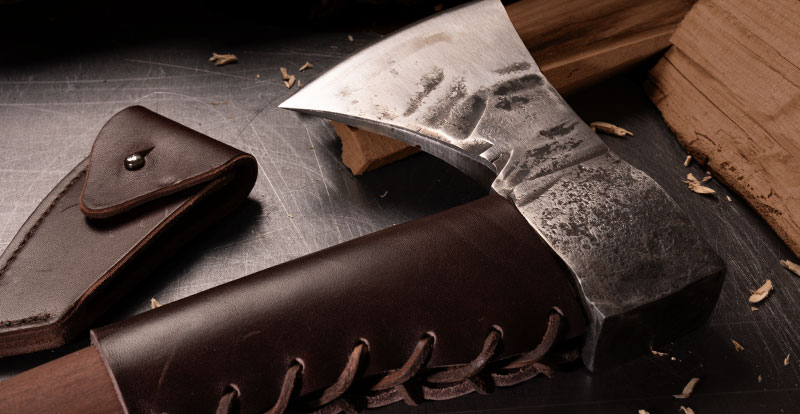
Our high-quality axes with a functional design are open-die forged in small European forges using traditional forging techniques. The axe heads are forged "free eye" without a mould or die under a spring or air hammer. Only experienced blacksmiths can produce high-quality tools using this technique. The most common practice in axe production is die forging. Here, the axe head is pressed into an existing shape with one or two blows on large industrial hammers. In semi-industrial production, several hammer mills are "connected in series" and the axe heads are produced in series with a few forming strokes using partial dies.
What is special about C60 carbon steel?
As a rule, heat-treatable steels such as C45, C55 and S55C are used. These steels combine high strength and wear resistance with toughness. The carbon content of the steel can usually be determined from the designation. For example, C45 has a carbon content of 0.45%, C55 a content of 0.55% and so on. The higher the carbon content, the higher the achievable final hardness of the subsequent cutting edge. A hardness of approx. 54 HRC can be achieved with C45 Steel, with C60 Steel 60 HRC is possible. However, these values are highly dependent on the respective degree of forming.
How are DICTUM axles forged?


Note: Forging is a complex craft. The following information on the forging process depending on the Steel used is a simplified representation.
Each time the axe blank is heated, the steel loses carbon. If the axe shape is complex and therefore has to be forged in several passes, the carbon content and thus the possible Hardness decreases. For example, a C60 Steel loses only a small amount of carbon during minor forming (e.g. into a hand axe) and reaches a possible final hardness of approx. 60 HRC, while it loses a lot of carbon during complex forming with multiple heating (e.g. into a broad axe) and would then only reach 55 HRC or less. If the steel has to be heated several times due to a complex head shape, carbon is added when the axe head is heated to compensate for this loss. The blacksmith refers to this as "carburising".
Accordingly, a steel with a lower carbon content can be used for simple drop forging work than for open-die forging work with complex head shapes. In addition, the required final hardness of approx. 56-57 HRC can only be achieved for complex head shapes with steels that have a correspondingly high carbon content.
However, high degrees of forming also have a major advantage. With each forging pass, the steel structure is compacted and the axe becomes stronger. If C45 or C55 is used for an axe, heated only once and then industrially "pressed into shape", the axe head may have the same hardness as a C60 steel axe head, but it will not have the same strength. Repeated heating and manual forging costs time and therefore money, which is why industrial axe production is often dispensed with. DICTUM axes and hatchets are open-die forged from C60 carbon steel in several forging passes. The steel structure is highly compacted due to the slow moulding process.
This increases the strength of the axe and enables the formation of a fine-grained, break-resistant cutting edge. The final hardness of our axes is approx. 56-57 HRC. A higher hardness could certainly be achieved with the C60 steel used, but this would not be practical for this tool type.
As the axe house can become deformed during forging, it is then realigned by hand on the anvil using a mandrel. The axe head is then heated again in the forge to approx. 800 °C for hardness and then quenched in an oil bath by rapid immersion. The subsequent tempering reduces the tension built up in the metal structure during forging and hardness.
Are DICTUM axes sharpened ready for use?

The blade is pre-sharpened on a metal belt grinder with a Grit of 60. Thanks to years of experience, the blacksmiths are able to precisely maintain the cutting angle of each axe type. We then switch to a water-cooled grinding wheels sanding discs for the fine grinding. We then polish the axe head. The mirror polishing of the front cutting edge area provides additional corrosion protection and reveals the unique sharpness of hand-forged, compacted C60 steel.
What wood are the axe handles made of?

Our handles for axes and hatchets are made from ash or robinia wood and are manufactured on Copy milling cutters using a sample handle. Complex handle shapes, such as our broad axes, are then reworked by hand. All DICTUM axe handles are given a natural Urushi finish to protect them from dirt. After treatment, the handle is Waterproof, food-safe and resistant to Alcohol content and solvents. The surface remains elastic in the long term and even becomes more beautiful with use. For a secure hold, the handle is fitted with a wooden wedge and an additional diagonally driven metal wedge.
How do I protect the cutting edge during transport?
Most of our axes are supplied with a Leather sheath made from robust cowhide or a Felt sheath. Our Leather sheaths are made from high-quality, vegetable-tanned leather. Leather sheaths are available separately for our carpenter's axes.
