
Bandsaws


Bandsaws
EXPERT KNOWLEDGE BANDSAWS

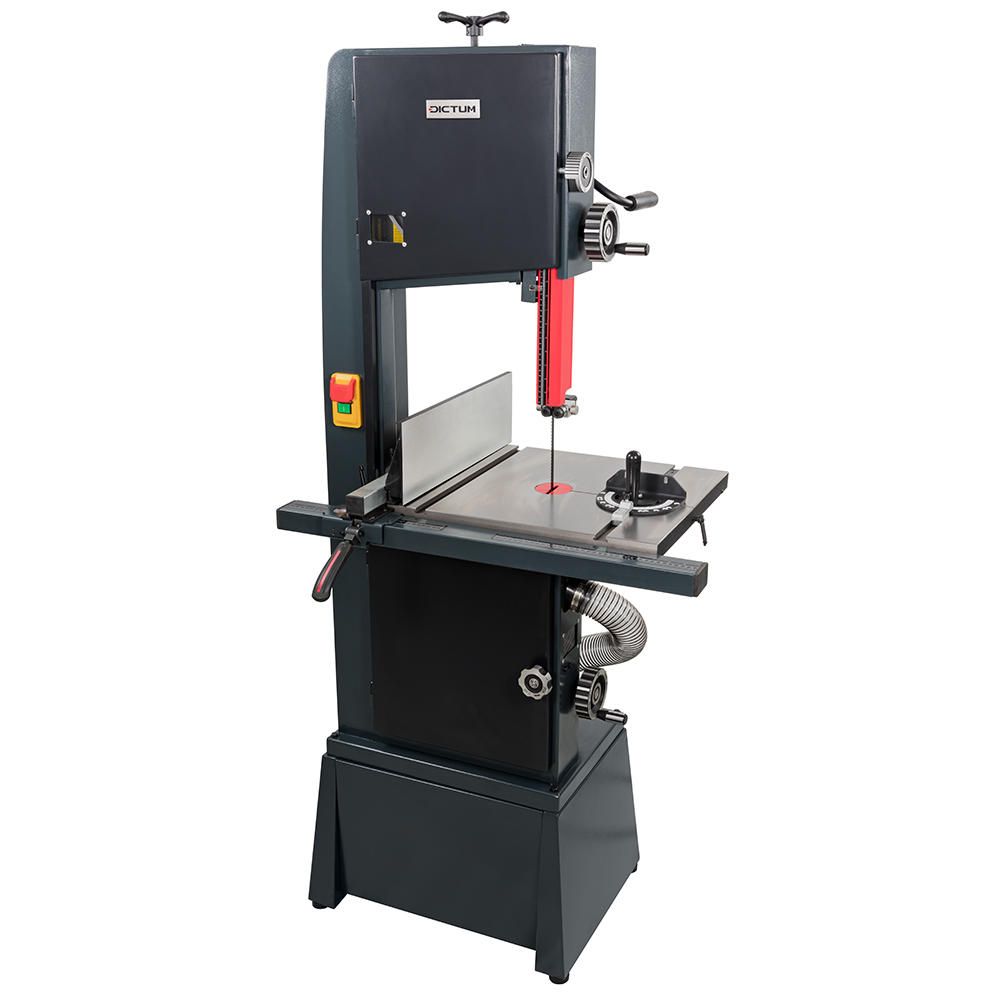
Bandsaws come in different sizes
Possible applications of the Bandsaws (vertical bandsaws)
Bandsaws are ideal for working with solid wood, panel materials and plastics. Some vertical bandsaws can also be used for processing aluminium and non-ferrous metals, and special metal bandsaws can also process steel. The manufacturer Mössner KG, for example, produces a vertical version of a metal band saw.
Thanks to the variety of Bandsaw blades available, a bandsaw can be used to perform a wide range of cuts such as lengthwise, crosswise, curved and even circular cuts. In contrast to hand-guided saws, the stationary machine table allows the workpiece to be guided precisely with both hands. Many bandsaws also have swivelling tables, which extends the range of application and even enables the sawing of wooden joints such as dovetails.
Bandsaws are particularly suitable for curved cuts, as the narrow, flexible saw blade can cut tight radii. Bandsaws with special guides and saw bands with a blade width of just 1 mm can even cut radii of less than 5 mm. With special devices, Sanding belts can even be inserted in place of the saw blade to convert the Bandsaws into a belt sander.
In addition to the very precise cuts that can be made with narrow saw blades, saw blades up to 25 mm wide (depending on the size of the bandsaw) can also be used for the straightest possible cuts, such as ripping round or solid wood or cutting off tree edges.

Which band saw size is the right one?
The choice of the right Bandsaws depends primarily on the planned use and the available space. In addition to the quality features described below, you should be aware of the dimensions that a Bandsaws must or may have before making a purchase.
The dimensions of the bandsaw, to which the working and movement radius should be added, are primarily defined by the size of the workpiece and the space available in the workshop. The machine may also need to be mobile so that it can be stowed away when the work is done, or small enough (without a base frame) to be placed on a workbench. If larger or heavy workpieces are being processed, the Bandsaws should have a high dead weight, a large machine or work table and a sufficiently powerful motor. In addition to the dimensions of the bandsaw, the workpieces or the workshop, however, an important aspect is the choice of possible saw blade widths. Bandsaws with blade widths of e.g. 3 mm up to 25 mm cannot be used on the same machine. Most bandsaws have a limited range when it comes to saw blade widths. Smaller table band saws, for example, cover a blade range of 3-12 mm. Matériau du manche follow up to max. 16 mm, max. 25 mm, etc. If very tight curved cuts and fine contours are required, very narrow blade widths must be used. Some wood band saws have fine cutting band guides that allow the use of saw bands just 1 mm wide. Wide saw bands are used if straight cuts are required, e.g. for ripping blocks of wood, producing sawn veneer or similar. The wider the saw blade needs to be, the larger the machine should be.

Another selection criterion is the maximum Cutting height, which in turn is related to the machine size. If you are processing rather Flat workpieces, such as plywood, the Cutting height of most machines will be sufficient. However, if you have special requirements, such as cutting turning blanks for Shawls, the Cutting height is particularly important.
What characterises a good wood band saw?
The Bandsaws as a machine is just one part of a system that can only function perfectly when combined with the right saw blade and the right Use by the user.
Nevertheless, there are machine-specific features that you should look out for when buying a Bandsaws.
The more solid and stable the machine, the more vibrations are avoided or absorbed by the machine. The machine frame should therefore be torsion-resistant, preferably reinforced and made of sheet steel. Heavy machines with cast iron frames are rarely offered. The machine table is also of particular importance. This should be made of solid, vibration-damping cast iron, levelled and with milled T-slot guides. Machine tables made of sheet metal or aluminium are unsuitable for stationary use, they vibrate and are usually not exactly flat or can bend over time. To ensure that a machine stands securely, it should have a base frame with height-adjustable feet or a solid plinth.
To ensure that the saw blade runs precisely, the blade guides above and below the machine table must be adjustable. Additional frictional heat, possibly caused by incorrectly or too tightly adjusted guide rollers or jaws, should be avoided.
Optimum tension for the Bandsaw blades

A frequently asked question that is not so easy to answer.
A precise cut along a scribe mark requires the correct tension of the Bandsaw blades. Many bandsaws are equipped with a tension indicator that allows the exact tension to be set depending on the saw blade width. This tension indicator is particularly useful for ensuring reproducibility when changing the saw blade, as it takes experience to set the optimum tension depending on the work task.
Too high a tension increases the risk of band breakage, especially at the weld seam. Too little tension allows the rollers to slip and contributes to the instability and twisting of the band saw blade. Particularly with fine band saw blades with a small cross-section, which are often used on small machines with small rollers (= small bending radius), the stress on the weld seam due to the constant bending and the small weld seam cross-section is a challenge.
Excessive tension reduces the service life of the saw bands or can lead to breakage under certain circumstances. Too little tension has a negative effect on the cutting result, efficiency and quality.
Why does the cut on the Bandsaws run?
If band saw blades cannot be guided along the scribe mark, this may be due to various factors. In most cases, it is due to insufficient band saw blade tension. Incorrectly adjusted blade guides above and below the machine table can also influence the cutting result. Material properties such as the grain of solid wood or knots can also have an influence. The cutting speed as a function of the machine speed and the feed speed must be adapted to the saw blade (e.g. set, tooth pitch) and the material. Selecting a bandsaw blade that is not optimally suited will result in the cut running. Blunt or incorrectly or one-sidedly set bandsaw blades lead to imprecise kerfs. Perfect interaction between all components - from the machine table to the blade guide, the right Bandsaw blade and tensioning to the way the Use works - is essential for clean, precise cutting results.
Protective equipment and accessories for safe working on the Bandsaws

A number of tools should be used to increase personal safety, efficiency and precision and to guarantee all machine functions.
Angle and rip fences as well as a push stick and push log are part of the basic equipment of every Bandsaws. Feeder drawers, pressure spring and pressure lips as well as separate stops for straight ripping cuts, devices for firewood or circular cutting and table extensions not only increase precision and working comfort, but also improve work safety.
Influence of the saw blade width on the cutting radius
The cutting radii to be cut with the Bandsaws are an important Size for determining the optimum saw blade dimensions. In addition to the band length, which is determined by the machine size and cannot be varied, the band width is decisive for clean kerfs and efficient work with curved cuts. The smaller the cutting radius, the narrower the band saw blade.
If a workpiece radius of40 mm is required, this would not be possible with a 16 mm wide band saw blade. The saw blade would wedge too much in the kerf when turning the workpiece and get stuck. The saw blade would also heat up too much (reducing the service life of the saw blade) and the kerf could turn black due to the resulting frictional heat.
The table below shows the minimum possible cutting radii in relation to the saw blade width.
In order to achieve optimum cutting performance and cutting results, care should also be taken to ensure that the saw blade is sufficiently set and sharp.

