


Paring chisels


Paring chisels
EXPERT KNOWLEDGE PARING CHISELS
Whether you are finishing wood joints, re-piercing fits, contours or chamfers - the result of the work depends largely on the quality and sharpness of the Paring chisels. It must hold its edge, be easy to sharpen and easy to guide.

< With regard to the designation, we distinguish between Paring chisels for light to medium use, which are particularly suitable for re-piercing wooden joints. They are usually pushed by hand and therefore do not have a reinforced steel ferrule at the stapling end.
> Western chisels, on the other hand, are driven with a striking tool (Wooden mallets for Western chisels, Genno for Japanese chisels). They are therefore stronger in terms of the cutting edge and have a ferrule at the end of the handle to prevent the handle from bursting due to the hammer blows.

Matériau du manche colloquial terms, which all refer to the same cutting tool, but sometimes provide information about minor differences in terms of use and Intended use, are: Skew chisels, chisels, chisels or chisels.
Paring chisels are standardised in terms of Blade width and include the following widths: 4, 6, 8, 10, 12, 16, 20, 22, 24, 26, 28, 30, 32, 35 and 40 mm.
Paring chisels are often purchased in sets, e.g. 6-piece sets in 6 / 10 / 12 / 16 / 20 / 26 mm increments, suitable for all common woodworking applications. However, in addition to chisels (with reinforced ferrule) in sets (6-piece or 10-piece), many woodworkers often only use a 6 or 10 mm chisel for re-piercing tine joints.
A sub-form of the Paring chisels is the English-style chisel. The shortened design with a Total length of 220 mm to 235 mm, which is particularly popular in England and America, offers the advantage of working close to the workpiece. In fact, these chisels can even withstand being struck with a mallet thanks to the large pommel at the end of the handle. The handle is produced from impact-resistant wood, a classic example being the hornbeam handle or handles made from oak or ash.
The advantage of laterally bevelled paring chisels

To minimise lateral friction during chiselling work and prevent the chisel from jamming or twisting, the Paring chisels are slightly wider on the mirror side than on the bevel side. This slight widening of the blade on the mirror side ensures that the tool can work more efficiently and without unnecessary friction. The bevelled edges (also known as side bevels) make it easier to insert and position the tool precisely. This not only increases the precision and cleanliness of the work carried out, but also the service life of the tool, as it experiences less wear due to lateral loads.


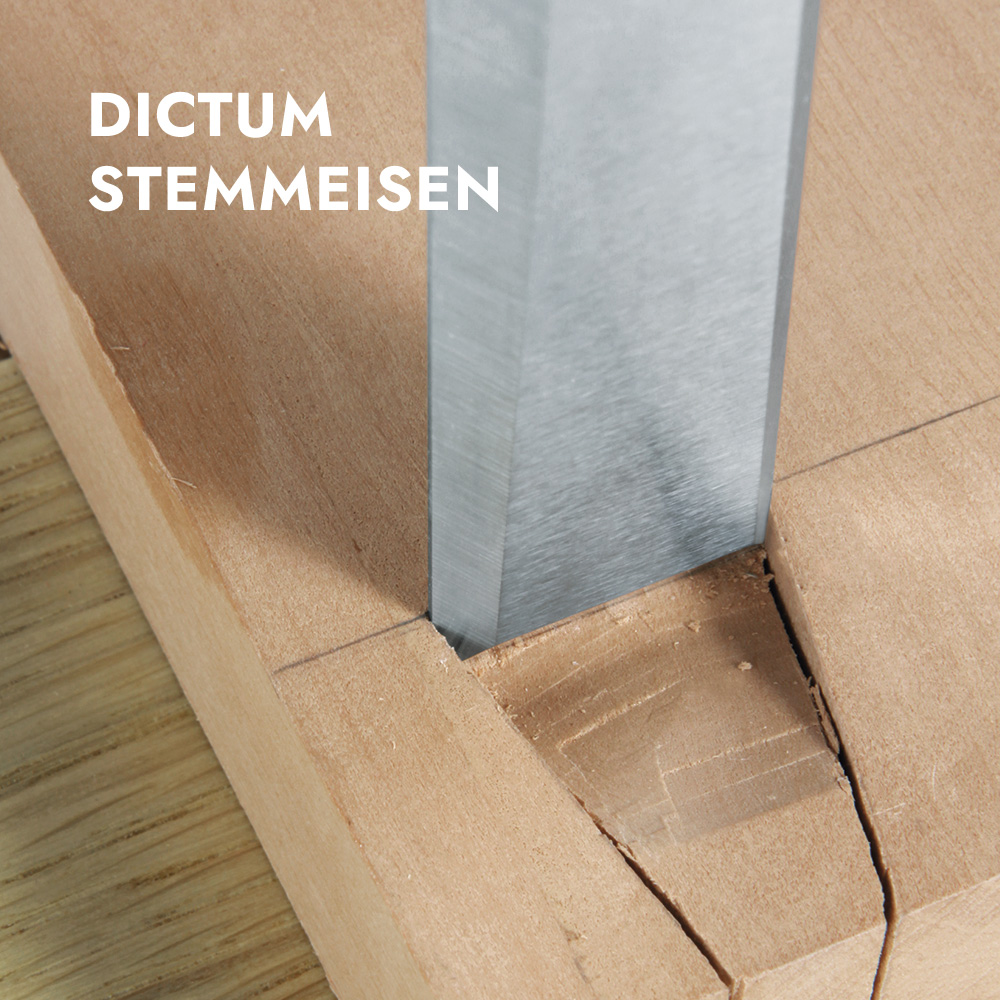
According to DIN 5139, there are two main types of blade cross-sections for paring chisels:
Shape A has straight edges in cross-section, i.e. the cross-section is rectangular. This shape is only suitable for rough work and can be ignored here. Similar shapes are used in the sculpting sector for chisels, e.g. by Kirschen, Pfeil or Stubai. While the common gouges are mainly used for sculptures, this shape is mainly used in notch carving.
Shape B, on the other hand, has bevelled edges in cross-section. As mentioned above, these bevelled edges have advantages in terms of precision and durability.
With some paring chisels, e.g. DICTUM or Veritas, the edges taper to almost zero. This is a decisive advantage, especially when re-piercing tine joints.
Sharpening Paring chisels
Paring chisels are sharpened in the same way as chisels, with a 25° Angle on the bevel. Sharpening is carried out on a fine Sharpening stones / Grinding stones.
Price differences for Paring chisels
The large price differences in paring chisels are the result of very different factors. One key aspect is the quality of the steel used. High-quality steel offers an ideal compromise between impact resistance, edge retention and sharpenability. As these properties have a negative impact on each other, many standard steels that fulfil one or two of the properties, but never all three, are only suitable to a limited extent. Special alloys that differ from conventional tool steel drive up the price.
Another decisive factor is the processing of the paring chisels. You might not realise it at first glance from the simple tool, but precise and careful production requires complex techniques. The biggest differences in quality can be found in the precise grinding of the side flanks and the cutting edge, the evenness of the mirror side and the uniform hardness. A chisel blade usually undergoes seven grinding processes before further processing. There are major differences between DIY store products and high-quality tools, particularly when it comes to the hardening process. The average hardness should be 60 HRC. Over-hardened cutting edges break out easily, while under-hardened cutting edges fold over when working. Of course, these criteria are also significantly influenced by the choice of steel.
If the irons are hand-forged, as is often the case with Japanese chisels, for example, higher costs must of course be expected than with drop-forged mass production.
To summarise, it can be said that elaborately crafted paring chisels made from high-quality steel are always a worthwhile investment. They generally have a longer service life and therefore need to be sharpened less frequently. In addition, the initial sharpening effort required to prepare the chisels is significantly lower.
