


Chisel sets

Chisel sets
EXPERT KNOWLEDGE CHISELS SETS
3-piece, 6-piece or 10-piece - which combination makes sense?
A Chisels set usually not only has a price advantage. It also contains all the common sizes you need for everyday use. The most common is the 6-piece set, consisting of 6, 10, 12, 16, 20 and 26 mm wide chisels. With a 6-piece chisels set, for example, the price advantage is on average 8-12%comparedto buying the individual irons (depending on the quality of the roller bag or wooden box).

The main purpose of chisels is the production of a tine joint. However, the tine width is not always the same, but depends on the thickness of the wood. For this reason, a chisel set is useful. As a rule, 1/3 of the wood thickness is assumed. This means that a 20 mm thick board (e.g. for a drawer) requires a chisel width of approx. 6.5 mm. A 6 mm wide chisel is used for this width. If you are mortising a bed frame, you would use a 30 mm thick board. A 10 mm chisel would be ideal here. However, not only the prong recesses are mortised, but also the dovetails. These recesses are already wider than the tine recesses at the narrow point. A 16 or 20 mm wide bar is therefore ideal. 12 or 16 mm would be suitable here.
Mortise and tenon joints are also often produced with chisels. Here, the wood thickness is also usually divided into thirds, so the 6 and 10 mm wide chisels are often used. That leaves the 26 mm chisel. Garde should be without a wide chisel. It is used to chisel protruding parts flush and also allows a firm and secure fit on wide surfaces.

Chisels for special uses do not usually require a full 6-piece set. Individual chisels or even 3-piece sets make sense here.
10-piece chisel sets offer the full spectrum. In addition to intermediate widths, they usually include a 4 mm tool for very fine tines with Material thicknesses of around 10 mm. These chisels can also be used for other wood joints that are difficult to access. The largest tool (36 mm, 38 mm or even 40 mm wide) is often used in joinery or for carpentry joints, e.g. to rework hand-sawn overlaps.
A chisel set made in Japan (Nomi) typically contains tools in the sizes 6, 9, 12, 18, 24 and 30 mm. Some English-speaking manufacturers (for example Henry Taylor and Lie-Nielsen) produce their chisels in inches. The common dimensions of a set are ¼, ⅜ , ½ and ¾ inch, which corresponds to 6.4 / 9.5 / 12.7 and 19.1 mm.
In contrast to this, a Chisels set, which is put together especially for carpenters, naturally contains larger irons, e.g. 15, 24, 30, 42 and 48 mm for European designs. Correspondingly 18, 24, 30 and 42 mm for the Japanese Chisels set.
In a roll case or in a wooden box?
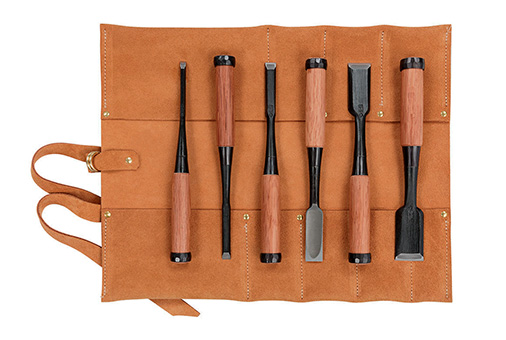

Depending on the version, each set of chisels comes with either a bag or a wooden case (also known as a wooden box or wooden crate) to store the chisels carefully and transport them easily.
In the past, a wooden box was made by the carpenter himself. Even in Japan, the handmade wooden box for tools of all kinds is still highly valued. Today, most wooden boxes are made of finger-milled laminated wood. The wooden cassettes are more robust and easier to store in toolboxes due to their standardised sizes. The disadvantage is that they can only be used for certain chisel shapes and tool widths.
A roller pocket is much more flexible. Similar tools such as knives can also be easily stored in it. A small grinding stone for sharpening, which is often found in sharpening stone sets, can also be carried in this way.
Conclusion:
You are more flexible with a set in a roll-up bag. If you want more robust storage for your tools, you should choose the wooden case.
Brief overview of the type of chisel, Steel and Handle material
There are many terms relating to Chisels Sets, which are briefly explained here:

Chisels or chisels:
- most common shape for woodworking in general

Paring chisels:
- for precise reworking
- more pronounced side bevel
- are not driven with a hammer (mallet)

Mortise chisels
- Robust version
- special iron for deep mortises

Skew chisels, wood chisels, wood chisels:
- Colloquial term for Chisels or chisels

Steel selection:
- Specifications such as tool steel or special steel are common here
- behind this is chrome/vanadium steel
- good compromise between sharpenability, susceptibility to rust and service life

Handle Material:
- the most common is the hornbeam handle
- Hard enough to withstand being struck with a hammer (mallet)
- Matériau du manche common hardwoods: copper beech, oak and maple
Sharpenability
Sharpenability varies depending on the steel used. Western Chisels are usually made of high-alloy tool steel, e.g. chrome/vanadium steel with a hardness value between 60 and 62 HRC. Many manufacturers, including Pfeil, Kirschen or Stubai, do not specify the steel designation, but use terms such as "special tool steel". Japanese chisels made from low-alloy carbon steel have a value of 62-63 HRC. Chisels made from HSS (short for High Speed Steel) have the highest hardness and toughness with a hardness value of 63 to 64 HRC. To put it simply, the greater the hardness, the longer the iron stays sharp, but the harder it is to sharpen.
