


Mortise chisels
EXPERT KNOWLEDGE MORTISE CHISELS
Mortise chisels widths
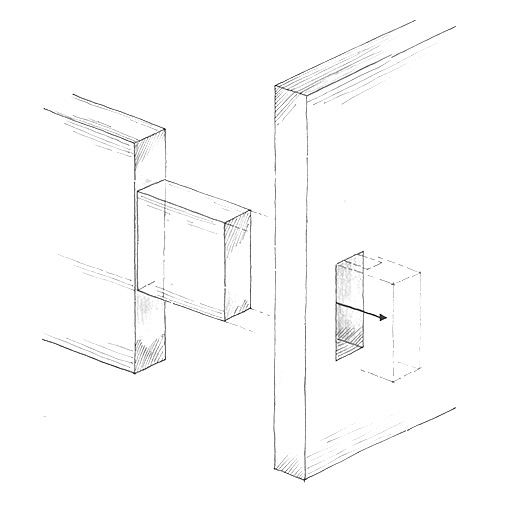
Mortise chisels are usually available in widths from 6 mm to 25 mm. The width corresponds to the standard tenon dimensions. However, the widths vary slightly depending on the country of manufacture. With a mortise and tenon joint, the wood is usually cut into thirds. The two mortise and tenon joints are therefore just as wide as the tenon itself. If imperial material is used for the squared timber to which the tenon is attached (England and USA), this results in certain tenon widths that do not necessarily correspond to the metric system. The same applies to Japanese Mortise chisels, which are also used for other joining techniques. The common widths here are 12, 15, 18 and 24 mm. Special chisels (Hiro Nomi) have a width of 30 mm, and even 50 mm chisels are available.
As a general rule, if the Mortise chisels are slightly narrower than the tenon, the width is perfect.
Which Steel is suitable for Mortise chisels?
The steel used for heavy Mortise chisels is the same as that used for chisels. Many manufacturers such as Kirschen, MHG, Pfeil or Stubai refrain from naming the exact type of steel used. Usually, the term "special tool steel" is used for simplicity. For chisels, for example, 90MnCrV8 Steel, hardened to 62 HRC, is suitable. If chisels are drop-forged, 115CrV3 Steel is often used. The Hardness of most Mortise chisels is between 59 and 62 HRC. If the hardness is below this, the heavily stressed cutting edge of the tools will quickly fold over. In order to cushion the impact on the cutting edge, some Manufacturers, including Henry Taylor, install a leather disc between the shoulder on the iron and the contact point on the handle. Manufacturers in the lower price segment, however, who do not finish the shoulder and therefore do not create a clean contact surface, often only use the leather disc to even out the forged surface.
The wedge angle and dimensions on the Mortise chisels
The wedge angle or Angle of the cutting edge is usually 30° for chisels. As chisels are always driven with a hammer, the cutting edges with a 30° bevel angle achieve a better service life and are also more stable when levering. A 25° bevel angle is also possible for soft and medium-hard wood. The Veritas Mortise chisels are characterised by a round-ground bevelled rear edge. This enables a pivot point when levering. Only the front area of the bevel is finely ground or honed on these chisels.
Special handle shape?
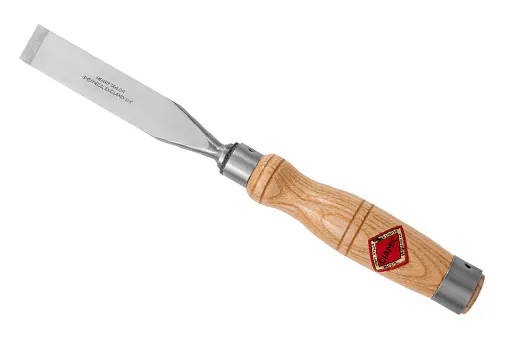
Japanese Mortise chisels
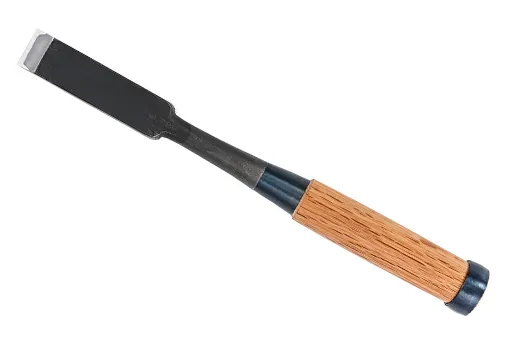
Mukomachi Nomi are the actual Mortise chisels. The width of this design does not taper. The back of the blade and the side edges are sometimes slightly concave. This "relief-ground" shape prevents the chisel from tilting in Japanese irons.
Which wooden joints in furniture construction require Mortise chisels?
Mortise chisels are used for joints in stud construction, e.g. for mortise and tenon joints. Such joints can be found, for example, on chairs, tables or cabinets using the stud construction technique. The purpose of this joint is to connect the foot posts and the bars. Mortise chisels are also used for finger tenons, e.g. when building shelves. In both cases, the excess material of the mortise is first drilled out and then reworked with the Mortise chisels.
Tip for mortising without pre-drilling
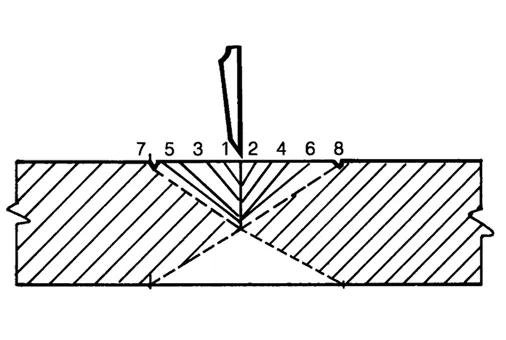
When mortising a through mortise, work in a V-shape from the inside to the outside up to half the workpiece thickness and then from the opposite side. The cutting edge bevel is directed outwards.
