Basic knowledge of timber joints
What are the most important wood joints, what are they used for and how can they be differentiated? We usually use one or more wood joints in our projects and tutorials. As skilled craftsmen, we often assume that the terms we use are clear and that everyone knows why this or that wood joint is made and what purpose it serves. However, when preparing this topic, we realised that timber joints are a rather complex subject, which is why we have broken down the topic of timber joints and organised it into a comprehensible system. Firstly, we look at what timber joints are used for and the criteria by which they can be categorised. Later, we will take a closer look at the most important traditional timber joints.
What are timber joints used for?
Fixing. Wooden joints are intended to connect several parts or workpieces and fix them in the desired position. This applies at least to fixed joints. There are also movable and detachable joints, but these will not be discussed here.
Force transmission. Wood joints transfer and distribute the forces that occur (compressive, tensile and shear forces, etc.) to all parts in such a way that the workpiece or joint can withstand the loads. The principle is: The load-bearing capacity of a timber joint must always be greater than its stress.
Increasing the gluing surface. Glue plays a key role in force transmission. It ensures the transfer of force from one workpiece to the other, even in the case of butt-jointed wooden surfaces. To optimise this property, many wood joints are designed to increase the gluing surface. We have covered this topic in detailin our adhesives guide.
Wood joints according to the orientation of the workpieces
Wood joints can be very simply categorised into three groups based on the orientation of the workpieces in relation to each other.
Width joints. These are also known as parallel joints, as the workpieces being joined are orientated parallel to each other. These joints are usually used to create a larger surface from several narrow workpieces. We do this, for example, whenever a larger board surface is glued together from several solid wood strips in order to minimise the warping of the wood.
Longitudinal joints. These usually involve assembling a longer workpiece from two or more short strips or beams. Compared to the other types of joints, longitudinal joints are rarely needed in joinery. Europe is a densely wooded region and wood is usually available in sufficient lengths. This is different on the Japanese islands, for example, where wood was a scarce raw material and every short piece of wood was utilised where possible. A large number of longitudinal timber joints have therefore developed in Japan.
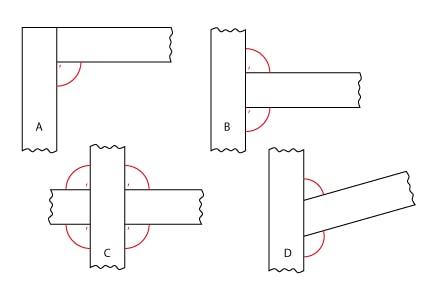
Corner joints are probably the most commonly used type of joint. Whenever two workpieces are joined together at an angle, we speak of "corner joints". These can be further subdivided according to the construction of the piece of furniture, which we will look at in more detail below.
Corner joints are generally only used to describe joints where two parts meet at right angles at one end to form a single internal angle. However, the following sub-categories can also be derived from corner joints:
T-joints (B). In these, one workpiece does not meet the other at its end, but in its surface or along its length, creating two internal angles.
Cross joints (C). In this case, the two workpieces overlap and cross each other, creating four internal angles.
Angled and looped joints (D). In the case of angled joints, the parts do not meet at right angles in one axis, i.e. not at a 90° angle, and in the case of stiffened joints, several axes are shifted at the same time.
Corner joints can be subdivided into further categories.
Classification of corner joints according to construction method
Furniture constructions can be categorised according to their construction method. In general, they are divided into three types of construction: frame construction, board or panel construction and stud construction. A piece of furniture can also combine several construction methods. For example, the body of a wardrobe can be made using the stud construction method and its doors using the frame construction method. Each construction method requires its own timber joints, with frame construction using so-called frame corner joints, including the sub-categories T and cross joints. Examples of these are mortise and tenon and cross overlap. Surface corner joints are mainly used for board and panel construction. Compared to the frame construction method, the workpieces have a greater depth. Examples of flat corner joints are dovetails and tines and ridge joints. Typical of the stud construction method is furniture in which four corner posts support the entire piece of furniture as the basic building block. So-called cleated corner joints are used to connect the corner posts to form a carcass. These are usually a combination of frame corner joints and also hybrid forms between frame corner joints and flat corner joints. A typical example is the mortised tenon in a chair construction. The specific designation of a timber joint therefore always includes a definition of the construction method. For example, a mortised tenon can be a frame corner or, in stud construction, connect the frame to the stud.
What are the most important traditional timber joints?
Timber joints are a broad field. It would go beyond the scope of this article to even begin to introduce all timber joints. Traditional wood joints are the joints that are commonly used in Europe and we would like to look at the most important ones, i.e. the joints that every carpenter learns about during their training. In order to organise the variety of wood joints in a sequence, we have oriented ourselves to their complexity. This has resulted in our "Evolution of wood joints", which shows the development of wood joints from simple butt joints to complex funnel joints.
Butt joints are only held by glue or other fasteners (dowels, external springs, etc.). Butt joints are unfavourable as corner joints, as end timber often meets longitudinal timber and therefore no durable joint is created when gluing. However, as a parallel joint, longitudinal wood glued to longitudinal wood, they are quite durable. Glued wooden panels are a common example of butt joints.
Mitre joints offer a slightly better construction. Here, end grain meets end grain or longitudinal grain lies against longitudinal grain, resulting in a continuous grain pattern that offers better force distribution and a slightly larger gluing surface. However, the joint is only held by glue or other fasteners. Mitre joints are visually appealing, which is why many more complex joints are "mitred".
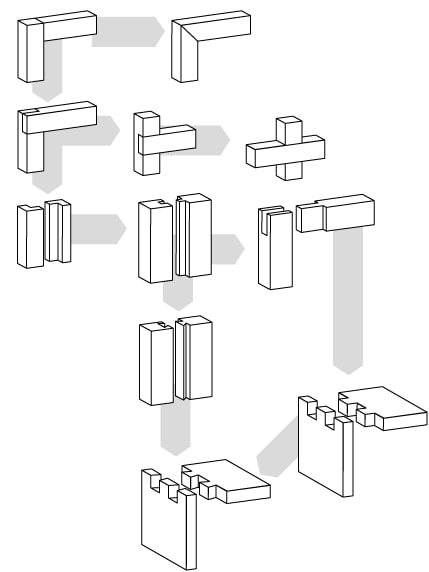
Overlapping (single, crosswise). They significantly increase the glued surface and longitudinal timber is joined to longitudinal timber. However, single overlaps are not self-locking, i.e. overlaps can be separated in all axes. Cross rebates already offer more stability, as they can only be easily separated in one axis. A typical application example for overpanelling is muntin bars on wooden windows.
Fold. Basically a small overlap, usually found on long edges. Rebates allow the wood to shrink and swell without creating a continuous gap. Examples of simple rebated joints can be found in floorboards and wall panels.
Tongue and groove. With two opposing rebates, a tongue is created in the centre. The groove forms the counterpart to this. Like rebates, tongue and groove are often used as a loose connection to allow the wood to work. In contrast to the simple rebate, the tongue and groove can only be moved in two axes. Examples are machine- or hand-made corner joints as frame or surface corner joints.
Slot and tenon (single, mitred, double, etc.). Basically, a mortise and tenon joint is an extended tongue with a correspondingly large groove. A simple corner with mortise and tenon can be released in two axes. In contrast, a mortised tenon, as a corner or T-joint, can only be separated in one direction. Compared to a simple overlap, a mortise-and-tenon joint doubles the gluing area. In order to further increase the gluing area, the tenon is not made thicker (1/3 pitch) for thicker material thicknesses, but the width is further divided (1/5 or 1/7 pitch) and double or triple tenons are produced. This increases the gluing surface enormously and the forces are better distributed over the workpieces.
Ridge joints (continuous, concealed...) can also be regarded as a further development of tongue and groove. The joint becomes pull-out resistant due to the wedge shape in an additional axis. Correctly manufactured (slightly wedge-shaped), the ridge joint forms a positive and non-positive connection that does not need to be glued. Ridge joints are usually produced as a T-joint, rarely as a corner joint. It is often found on table tops and old doors as a so-called ridge moulding (longitudinal wooden moulding inserted into the transverse wooden surface), where it prevents warping of the wide wooden surfaces.
Fingerjoints (finger joints, dovetail joints, funnel joints, etc.) are very varied wood joints. Their simplest form is the so-called finger joints, which basically consist of many small slots and tenons and thus offer a very large gluing surface. Often used and very popular as a decorative wood joint are dovetail joints. Just like ridge joints, dovetail tines are also pull-out resistant due to their wedge shape in an additional axis. There are many different variants such as semi-covered tines, mitred tine joints, funnel tines and interesting special shapes such as Japanese devil tines. In our video, we present a few of these tine shapes in more detail.
Dowels and external springs. Wooden fasteners were used early on to additionally secure simple wooden joints. Wooden nails and dowels have been known since ancient times. There is also a long tradition of inserting thin wooden plates for joining, known as external springs or loose tenons. Modern variants are grooved dowels and pressed flat dowels (so-called lamellos and dominoes). If you want to try out more complex or unusual wood joints, take a look at our online course on Japanese wood joints.