Tips for good lighting in the workshop

If you want to work accurately, you need to be able to recognise what you are doing. In the commercial sector, the "Technical Rules for Workplace Lighting and Visual Communication (ASR A3.4)" specify exactly which lighting conditions should prevail for different activities at the respective workplace. These include, above all, the brightness and colour rendering of the lighting equipment. In the hobby sector, there are no standards that must be complied with for lighting. But here too, good lighting helps you to recognise details better so that you can mark out, chisel, plane or saw with precision. We give you tips for the right lighting in your workshop.
How bright should it be in a workshop?
As already mentioned, the ASR specify exactly how the light should be at the workplace. In woodworking, for example, they recommend an illuminance of at least 200 lx (lux) at the saw frame, 300 lx for work at the workbench and at least 500 lx when working on machines. For surface treatment (sanding, varnishing) and veneer work, at least 750 lx is recommended.
Applied to the hobby sector, this simply means that the finer and more precise the work, the brighter the workshop should be. A room with daylight and additional electric lighting is therefore ideal. If your hobby workshop is in the basement or garage, you should ensure sufficient lighting conditions with ceiling lights and additional workplace lighting.
Another aspect is the age of the (hobby) craftsman. Eyesight deteriorates with age. Older people need more light than younger people, especially to recognise details. This is not only the case when reading, but is also noticeable when working. So don't be surprised if you realise at some point that you now need glasses or simply more light for some tasks that you used to be able to do well without aids.
Avoid disturbing shadows
Sufficient brightness also means that no unfavourable shadows are cast where work is carried out. Even the best task light is of little use if it stands or hangs in an unfavourable position and you are constantly casting shadows when working. So make sure you position the light sources correctly. LED technology means that light sources are now available in many different forms. In addition to the classic light bulb shape, spotlights and fluorescent tubes, the technology also enables panel lights, so-called LED panels, which provide more even illumination. LED panels with a low overall height can also be installed in rooms with low ceilings (basements or garages).
The arrangement of the light source determines the shadow cast.

Tip: For ceiling lighting with fluorescent tubes or so-called LED tubes, shadows can be minimised by arranging them crosswise or in a zigzag pattern (as shown in our video ).
Which is better, warm or cold light in the workshop?
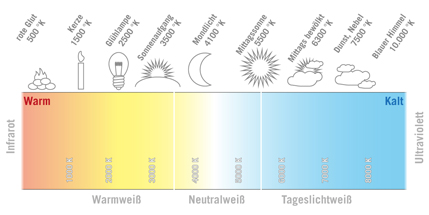
When it comes to the colour of light, a distinction is made between cold and warm light. This categorisation is initially confusing because it has nothing directly to do with the actual temperature or the weather. The light temperature is the colour that is selected on a spectrum from infrared to yellow and white to ultraviolet. It is measured in Kelvin, the base unit for temperature in the international SI system. Candlelight and classic light bulbs, for example, have a temperature of approx. 1500 to 3000 K and emit warm light. Normal household fluorescent tubes emit a rather cold light of approx. 4000 K. So-called "standard light" is between 5000 and 6500 Kelvin and therefore corresponds to the light conditions on a bright sunny day. With many LED lights, different colour temperatures can be selected between cold and warm.
In the range from 3500 to 5500 Kelvin, this is referred to as neutral white or daylight white.
Pinpoint light for very precise work
When precision is required, a lot of light is needed. Very bright light can be dazzling and can be tiring, as well as consuming more energy. Accordingly, targeted lighting of the areas that are used for precise work makes sense. Here are two examples from the workshop:
1. saw sharpening. When resharpening hand saws, the file must be placed at the correct angle between the saw teeth and moved back and forth. If it is also a moulding or fine saw, the distances between the small saw teeth are in the millimetre range. An illuminated magnifier (e.g. LED precision optics) is very helpful for such fine work. The optics magnify the details so that you can accurately judge the shape of the tooth tips, for example. The ring-shaped LED light ensures bright and shadow-free illumination of the working area. An illuminated magnifier is also very useful for inlays, restoration work and many precision mechanical tasks.
2. turning thin-walled objects. To be able to judge the wall thickness of lampshades, bowls and vessels with very thin walls during the turning process, many turners use a so-called gooseneck lamp (e.g. magnetic base lamp "gooseneck"). The movable gooseneck allows you to align the light source so that the light shines through the walls. The brighter an area appears, the thinner the wall thickness (if you can see through it, there is a hole in the workpiece). In contrast to halogen lamps, LED lights have the advantage that they produce hardly any heat. Fresh, wet wood remains moist for longer and does not warp due to the lamp. With the magnetic base, you can also easily attach the gooseneck light to other machines with a cast iron table or a sheet steel housing (e.g. fine-cutting band saw, router table, pillar drill, etc.).
Bringing light into the dark
There are always situations in which there is very little light available for working, for example when connecting fittings in kitchen or bathroom furniture, during maintenance work on stationary machines or when inspecting cavities. The SPERAS V3 mini torch with a double light source is an easy way to bring light into the dark. With 900 lumens, its output is perfectly adequate for many indoor and outdoor tasks. The light intensity of this compact torch can be adjusted in four stages. With a magnet on the back, the SPERAS V3 can be attached to machine housings or the bonnet, for example. Additional features: UV light enables banknotes to be checked, the fluorescent housing makes it easier to find the torch in the dark and various flashing lights ensure safety and attention.
Brightness vs. light output
The brightness at the workplace is specified in lux (lx). The surface brightness on the work surface is measured. For many lights, especially torches, the light output is given in lumens (lm). This value says nothing about the brightness at the workplace, but only indicates how much light the light source emits (radiates). The amount of light that hits an object decreases with distance. The further away a light source is from the workplace, the lower the brightness at the workplace. The optics of the lamp also play an important role. If the amount of light is distributed over a large area at a wide angle, this is helpful when assessing surfaces, for example, but reduces the brightness at greater distances.
If you want to be mobile while working and also want to keep your hands free, a headlamp is a practical lighting solution. The SPERAS B47L-1 headlamp offers several special features in this regard. The battery pack and LED spotlight of the B47L-1 are mounted on the side, which means less weight on the forehead and prevents glare on the face. In addition, an LED strip is incorporated into the silicone band at the front, which generously illuminates the surroundings. The light intensity of the LED spotlight and strip can be varied in two stages. There is a switchable hand sensor on the battery block that allows you to switch the headlamp on and off without having to touch the lamp - very practical if your hands are dirty or you are wearing thick gloves!
Inspecting the inner workings of machines or instruments is a particular challenge when it comes to light. When illuminated with normal (torch) lamps, upstream components often cast disturbing shadows, narrow areas remain in the dark and small parts go undetected. With inspection lights, such as the Bend-A-Light, you can bring the light source directly into the smallest cavity. At the end of its flexible neck is an LED bulb just 0.5 cm in size, so you can illuminate even hard-to-reach areas. Instrument makers use these inspection lights, for example, to make it easier to detect and assess cracks in the soundboard.
With all these practical lamps and lights, please don't forget the most important source of light and treat yourself to some sunlight from time to time after the work is done!