Which glue for what? Wood glues for special tasks
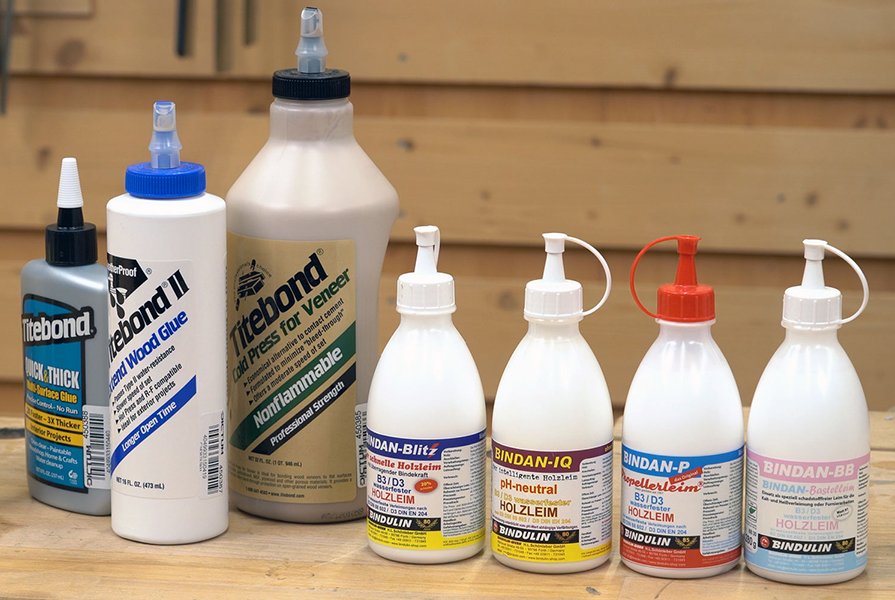
- Which glue offers the strongest hold?
- Which glues are suitable for application on large surfaces?
- Is there an invisible wood glue?
- How can glue stains or discolouration caused by glue be avoided?
- Which wood glue is suitable for toys or chopping boards? Which glue is non-toxic?
- Which white glue does not drip?
In the DICTUM course workshop, we usually use Titebond Original and Titebond 2 Premium as our standard glues for furniture construction projects. However, sometimes a special wood glue is required because the task places special demands on the adhesive. In this blog post, we present a selection of wood glues that have customised "formulations" for special tasks. Experts use the term "formulation" to refer to the composition and resulting properties of adhesives.
First of all: there is a suitable adhesive for every task. It is impossible to present them all in one article. We will therefore only look at wood glues, i.e. polyvinyl-based adhesives, also known as white glues.
Which glue offers the strongest hold?
In timber construction, windows and doors, the glue has to withstand significantly higher loads than in furniture construction. The stresses are also greater during assembly work and in interior fittings, for example the glue joints of wooden floors and parquet are exposed to constantly changing loads. The wood glue must not only be waterproof, but also have a high level of strength. The breaking strength is therefore usually specified for wood glues.
Of the glues offered by DICTUM, Bindan-Blitz wood and assembly glue has the highest breaking strength of 1400 kg/cm² (according to EN 204/205). This glue builds up strength particularly quickly (pressing time only 16 to 24 minutes) and is therefore an ideal adhesive for assembly work and for laying prefinished parquet and laminate.
For more complex components, more time is required to coat all surfaces with glue and to position the parts correctly. Bindan-P "Propeller Glue" also has a breaking strength of 1400 kg/cm², but at 5 to 10 minutes it has a slightly longer "open time" than Bindan-Blitz. It also needs this "open time" to flash off, as the parts should only be joined towards the end (keyword "open waiting time").
Which glues are suitable for application on large surfaces?
The "open time" is also an important factor when gluing large surfaces. The larger the surface, the more difficult it is to coat it completely with glue within the "open time". This is often the case, for example, when veneering door leaves and table tops and when gluing mouldings.
Titebond II Glue Extend with an "open time" of 15 minutes is very suitable for large-area glue application. It is also suitable for hot gluing, for example in a professional veneer press. It can also be processed in summer at 30 °C without any concerns (most glues have a processing temperature between 10 and 20 °C).
Time is an important factor when applying glue to large areas.
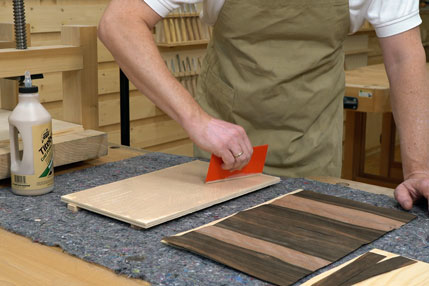
Veneering also has the additional problem of "glue bleed-through". This is particularly noticeable with open-pored woods and makes surface treatment, such as staining and varnishing, more difficult. Titebond veneer glue also has an extended "open time" and is also adjusted to reduce glue penetration.
Is there an invisible wood glue?
As I said, we mostly use Titebond glues, which are also known as "yellow glue" because they form a yellowish glue line. There are certainly situations in which this colour can be distracting, for example with very dark or very light woods or when the glue joint should be as inconspicuous as possible, such as with invisible wooden hinges.
As its name suggests, Titebond Transparent Gl ue forms a transparent glue joint and is otherwise a versatile glue with a short pressing time (20 minutes) for universal use in the household and in furniture construction. Titebond II Dark Glue has similar properties to the normal Titebond II Premium, but is coloured and forms a brown glue joint, making it particularly suitable for dark woods such as teak or iroko.
How can glue stains or discolouration caused by glue be avoided?
A slightly different problem arises with light-coloured, tannin-rich woods such as maple, chestnut and larch. Normal white glue has an acidic pH value and can therefore cause unsightly stains and discolouration in combination with tannic acids and other wood ingredients.
Bindan-IQ wood glue is pH-neutral and therefore prevents discolouration in these woods. However, it is not suitable for oak containing iron, which is particularly prone to discolouration.
Tip: When gluing wood containing tannin, such as oak and ash, always use a glue brush without a metal ferrule, e.g. natural bristle glue brush.
Which wood glue is suitable for toys or chopping boards? Which glue is non-toxic?
Basically, almost all white glues, i.e. PVAc glues, are also suitable for children's toys once they have hardened. However, we are often asked about glues for chopping boards. Bindan-BB wood glue is a polyvinyl dispersion and, according to the manufacturer, is absolutely free of harmful substances and suitable for sensitive areas such as bedrooms, children's rooms, nurseries, etc. You can also use it for handicrafts. You can also use it for handicraft work with children without hesitation.
Which white glue does not drip?
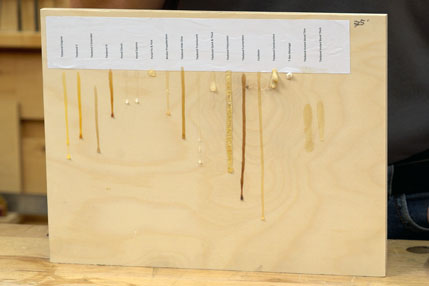
Especially during finishing work, when only the last cover mouldings or profiles need to be glued on, thin glue can be very annoying. Dripping glue easily stains the finished surface or drips onto your face. Titebond moulding/modelling glue is a thick glue, it does not drip and is therefore ideal for vertical glue joints and overhead applications such as cornice fixings, window reveals and ceiling mouldings. It also offers good initial adhesion while still allowing the parts to be aligned and positioned correctly.
The viscosity of glues and adhesives varies greatly.