


Turning tool sets


Turning tool sets
EXPERT KNOWLEDGE TURNING TOOL SETS
Why buy a Turning tool sets?

Many people find it difficult to choose suitable tools, especially when starting out as a woodturning hobby. In addition, investing in a solid woodturning lathe often limits the budget for the necessary woodturning knives. A multi-piece set of woodturning tools not only includes a good set of standard woodturning tools, but also usually offers you a reasonable price advantage.
Which turning tools belong in the basic equipment?
A basic distinction is made between two types of woodturning - long wood turning and cross wood turning. Both types sometimes require different turning tools.
Long wood turning
Here, the wood fibres run parallel to the spindle's axis of rotation. As the workpieces are usually clamped between the Spur drivers and the centre point, this is also referred to as "turning between the points". Chair legs, stair posts, tool handles, vases and mugs, for example, are produced in this way. The following chisels are used for long wood turning:
- Roughing-out gouges are usually needed to turn angular workpieces round or to remove a lot of material. With a little experience, a roughing-out gouges is also suitable for moulding slightly curved outer contours and leaves a smooth surface.
- Spindle gouges are a universal tool for creating profiles, recesses, V-grooves and curves. It can also be used to achieve a high surface quality.
- The Skew chisel is also known as a turning knife. A Flat chisel is suitable for finishing work on straight, curved, hollow and slightly profiled surfaces. An oval chisel is also ideal for cutting narrow profiles and notches.
- A parting tool is used to separate finished workpieces from the remaining material (parting off). The application of grooves and rebates or the turning of dimensionally accurate tenons (e.g. for clamping in a Four-jaw chucks) are also essential tasks for the so-called parting tool.
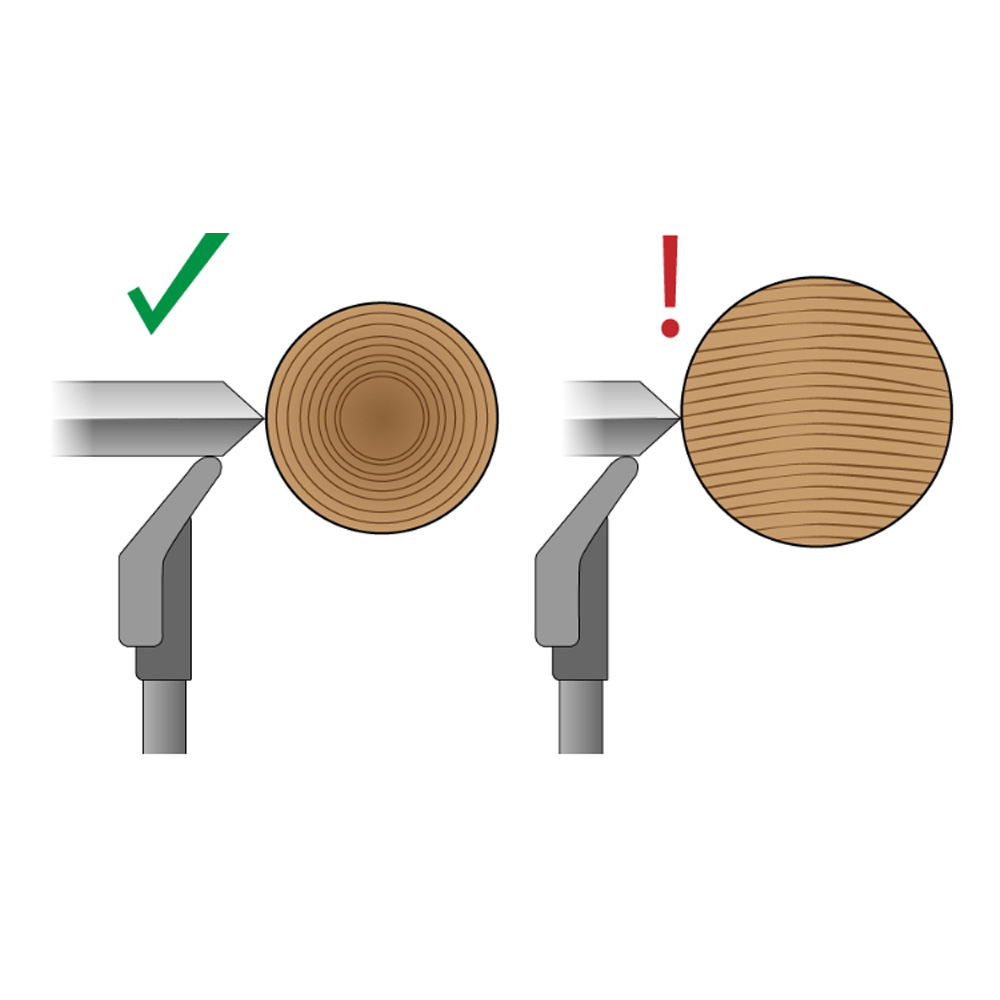
The grain direction does not change when turning longitudinal wood (left), but does change twice per revolution when turning transverse wood
The following chisels are more suitable for advanced long wood techniques and can be used to supplement basic equipment:
- A detail gouge - in contrast to the longwood Spindle gouges - has a less deeply milled/forged flute and therefore more material under the cutting edge. The additional material means that it can be provided with a second bevel without risk and therefore also allows access into very narrow recesses.
- Boring tools usually have an offset shape and are therefore suitable for hollowing out hollow objects with narrow openings, e.g. vases and urns.
- Hook tools are a versatile tool for hollowing out bodies. Thanks to their complex cutting geometry, they are suitable for both rough material removal and finishing work in the end grain area.
- Ring tools are used for working end grain on cups or vases. When used correctly, they produce very fine surfaces.
Cross grain turning
The wood fibres run at right angles to the spindle's axis of rotation. The fibres must therefore be cut crosswise twice per revolution. Tools for cross-cut woodturning are therefore somewhat more solid in comparison to long woodturning tools in order to better withstand the load generated during cutting. Shawls, tins and plates are produced, for example. The following turning tools in particular are used for cross-cut wood turning:
- The Spindle gouges or Bowl gouges are similarly versatile in their use as the long wood moulding gouges. This tool can be used to machine the outer and inner sides of shawls and hollow bodies.
- Blade scrapers are preferably used for reworking the inside of shells. However, this is not its only use, as profile edges can also be turned with a blade scraper.
Both turning knives, Bowl gouges and Blade scrapers, are part of the basic equipment and are included in many Turning tool sets.
What should you look out for in a Turning tool sets?
Beware of complete sets where a lathe including a Turning tool sets is offered at a conspicuously low price. Especially if the lathe is of acceptable quality and features (which is usually not the case with such offers), savings are usually made on the accessories. The short blades are usually made of a cheap steel, at best a simple HSS, the irons are not particularly hardened and the short handles are also made of light wood. To ensure that you can enjoy woodturning and achieve the results you are aiming for, pay attention to the quality of the chisels, which you can recognise by the following criteria:
- Steel: Quality manufacturers use high-quality HS steels (M2 HSS, M42 HSS) for their woodturning chisels. Got to tools are hardened in complex processes after production. For example, the blade is cooled to minus 185 °C using low-temperature techniques such as cryogenic hardness. This results in a very fine metal structure with an outstanding service life and excellent sharpening properties. PRO-PM steel, as used by Crown, is a sintered steel, i.e. a steel mixture that cannot be produced using normal alloying techniques.
- Thickness: In order to be able to withstand the sometimes extreme stresses of woodturning over the long term, turning tools in particular, such as Roughing-out gouges, moulding gouges or Hollowing tools, must be manufactured to be very solid and stable. Their blades are therefore often up to 5 or 6 mm thick and the tang with which they are anchored in the handle is not or only slightly tapered.
- Handle: You should also pay attention to the material of the handle. High-quality, dense woods dampen vibrations and thus ensure less vibration and a better surface quality.
- Profile shape of a tube: There are certain profiles that have been established over decades and are used by renowned manufacturers. These include the superflute with a parabolic shape. If a Spindle gouges only has a V-notch, this will make both sharpening and Use more difficult.
- Workmanship: Another quality feature is the ferrule that surrounds the handle at the transition to the blade. Is it a simple sleeve made of thin sheet metal or a solid metal ring? Do the blades already have a usable bevel or do you have to grind them into shape first?
- Compilation: Take a close look at the turning tool sets. Can you actually use all the tools it contains or would a different combination, perhaps a smaller turning tool sets, better meet your requirements? Woodturning tools in a set that you don't use are not only useless, they also take up space for useful tools. A 5-piece or 8-piece set of standard tools is ideal to start with.
