


Wooden planes


Wooden planes
EXPERT KNOWLEDGE WOODEN PLANES
A Wooden planes is an indispensable, traditional tool in the woodworking shop that has been used for centuries by craftsmen, especially carpenters and joiners.
How the Wooden planes work
A Wooden planes consists of a planer body (either made of wood or metal), a blade (also called a knife), which is attached to a fixed position in the planer body, and a chip breaker (sometimes also called a flap). Its main task is to smooth wooden surfaces, remove Material precisely and bring workpieces to the desired thickness and flatness.
The blade is positioned at a certain Angle to the wood surface, this is referred to as the cutting angle. Typical angles are 45° to 50°.
Types of western wood planes
There are many different types of wood planes, varying in size, shape and function. Choosing the right planes depends on the task you want to complete.

Scrub planes
A Scrub planes (also known as a roughing plane) is designed to remove large quantities of wood quickly. It has a strongly curved blade that removes large chips and roughly processes the wood. This plane is often used in the first step before finer planes are used.

Finishing plane
The finishing plane has a cutting angle of 45°. It is used for reworking after the Scrub planes to smooth Flat surfaces. A roughing bench with a significantly longer sole can also be used for this purpose.

Plough plane
The plaster plane is used to smooth the wood surface after rough processing. It has a cutting angle of 50° and therefore has a slightly scraping effect, which prevents tears in heavy grains. The fine adjustment of the blade allows extremely thin shavings to be removed.

Rabbet planes
The Rabbet planes are narrow planes that are used to plane rebates and grooves in wood. It is ideal for creating clean edges on window and door frames or decorative mouldings.

Special planes
There are numerous special planes that have been developed for very specific uses. These include, for example, the Scraper planes, which are intended for fine surface finishing, or the Dovetail planes, which are used for the Production of
Low Plane slicer
The Low Plane Planes enables a quick change of hand position and shift in pressure thanks to its low design without interfering handles. Its low weight makes it easy to guide and reposition on the material, allowing it to be pushed or pulled depending on the situation.
Using a Wooden planes: techniques and tips
Working with a Wooden planes requires skill, precision and experience. However, with the right technique, you can achieve impressive results.
Preparing the workpiece
Before you start the planes, you should carefully inspect the wood and make sure that there are no knots or cracks that could affect the planing result. If this is the case, these areas should be processed with particular care (low chip removal and, if possible, an adapted cutting angle). The workpiece should also be firmly clamped to prevent it from slipping during planing.
Planing along the grain
Planing along the grain is one of the most important rules when planing. If you work across the grain, you risk damaging the wood and creating unsightly tears. Planing with the grain ensures smooth, clean surfaces.
Even pressure
It is important to guide the planes with even pressure over the workpiece. Too much pressure at the beginning or end of a planing stroke can lead to unevenness.
Iron setting
The correct setting of the planing iron is crucial for precise and clean work results. A correctly adjusted iron ensures that the wood is removed evenly without damaging the surface. If the chip removal is too large, the wood may tear. Size also increases the force required and the planes becomes difficult to control.
To find the right setting, adjust the plane in small steps. Start with a small infeed and slowly feel your way forwards by pushing the iron forward slightly. Make sure that the plane iron protrudes evenly from the plane sole on the left and right at the corners.
It is also important to sharpen the plane iron regularly. A dull iron can fray the wood or cause unclean cuts. With a sharp and well-adjusted iron, you can achieve smooth, precise surfaces.
Care and maintenance of the Wooden planes
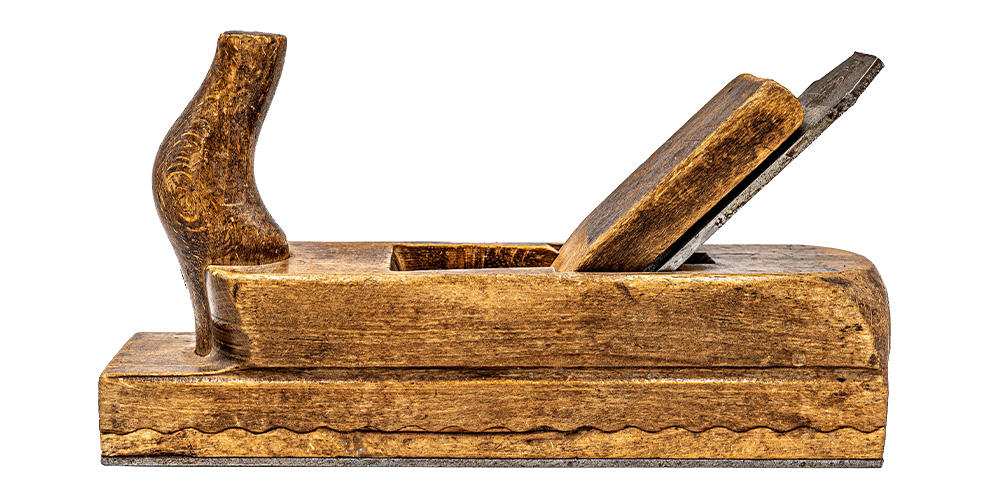
A well-maintained Wooden planes can remain in use for decades. The maintenance of a planes is mainly focussed on the plane iron, as this does most of the work.
Sharpening the plane iron
Sharpening a plane iron is crucial for precise results. Start by honing the edge flat on a Grinding stones to smooth the back / mirror side. Then sharpen the bevel at the ideal Angle. Use a sharpening guide to keep the Angle constant and ensure even sharpening. Work with fine to very fine grit until an even burr is created on the cutting edge. The burr should then be carefully removed by honing the back again on the finest stone.
Cleaning the planer body
Wood shavings and dust can easily accumulate in the planer body and impair its function. Clean the Planes regularly with a brush and a dry cloth. If the planer body is not varnished, you can occasionally rub it with linseed oil to keep the wood supple.
Checking and dressing the soleplate

Checking and dressing the soleplate is important for precise planes. Check the soleplate for unevenness by holding it against the edge of a straight edge. If it is uneven, dress the soleplate with fine Abrasive paper sandpaper on a flat sanding plate. Work evenly until the entire sole is flat. A smooth, even sole ensures clean levelling results and prevents the planes from "jumping" during use or causing uneven material removal.
A bevelling or edge planer is an ingenious tool for any edge processing in woodworking by hand. Whether for furniture, skirting boards or ornaments - this tool enables fast and precise chamfering.
Wooden planes vs. electric planers power planers
Electric planers power planers are often used in modern woodworking, as they allow Material to be removed faster and with less physical effort. Nevertheless, there are numerous situations in which the classic hand plane is preferable.
Precision
A hand plane enables greater precision, as the user can control exactly how much material is removed. A hand plane is ideal for fine work, especially when finishing surfaces.
Surface quality
While electric planers power planers can process larger surfaces faster, they often leave tiny grooves on the wood surface. A hand plane, on the other hand, can produce a flawless, smooth surface that hardly requires any finishing.
Creative freedom
With a hand plane, you have more creative freedom, especially with irregular shapes. You can make fine adjustments that would be difficult to achieve with a machine.
Ergonomics and tradition
For many wood craftsmen, the manual Planes is a tool that symbolises tradition and craftsmanship. Working with your hands creates a deeper connection to the material and allows you to better understand and utilise the texture and natural properties of the wood.
Wooden planes in modern wood processing
Even though modern workshops are often dominated by machines and power tools, the Wooden planes remain an indispensable tool for precise work. Many craftsmen appreciate the versatility and control that a hand plane offers.
Fine machining
The Wooden planes are particularly valuable when it comes to finishing furniture. It can level out tiny irregularities and create a smooth surface that is perfectly prepared for surface finishing such as staining or oiling.
Restoration of antiques
Wooden planes play a central role in the restoration of antique furniture or wooden objects. It is used to carefully remove damaged or weathered layers without damaging the underlying material too much.
Asian Wooden planes
Special versions of the Wooden planes are the Japanese Kanna and the traditional Chinese planes, which differ from Western planes in terms of construction and handling.

Japanese finishing plane
With the Japanese Planes (Kanna), the Planes are pulled instead of pushed, which requires a different posture and control. The kanna consists of a wooden body with a slightly wedge-shaped blade set at a low angle. Japanese plane blades are extremely sharp and often consist of a combination of hardness and softness, which gives them a long service life and high precision. The kanna is particularly valued for the very fine finish of wooden surfaces.

Chinese finishing plane
The Chinese planes, on the other hand, combine elements of the Western and Japanese planes. Here, too, it is often pulled, although there are models that are pushed. The body of the plane is usually made of wood and the blade is fixed, similar to the Japanese model.
A unique feature of some Chinese planes is the ability to adjust the depth of the blade using a simple wooden wedge, which allows for flexible and quick adjustment.

Both planes, the Kanna and the traditional Chinese planes, represent centuries of craftsmanship and are characterised by high precision and efficiency in woodworking. However, their unique handling requires practice to achieve optimum results.
Despite technological developments in woodworking, the Wooden planes have not lost their importance. It is a precise, versatile and traditional tool that is appreciated by both professional carpenters and hobby craftsmen.
Whether you want to remove large quantities of wood, smooth a surface or work on fine details - the Wooden planes offers the right solution for every task.
