
Japanese knives in Western design (chef's knives)


Japanese knives in Western design (chef's knives)
EXPERT KNOWLEDGE JAPANESE KNIVES IN WESTERN DESIGN (CHEF'S KNIVES)
Warum ein Kochmesser von DICTUM?
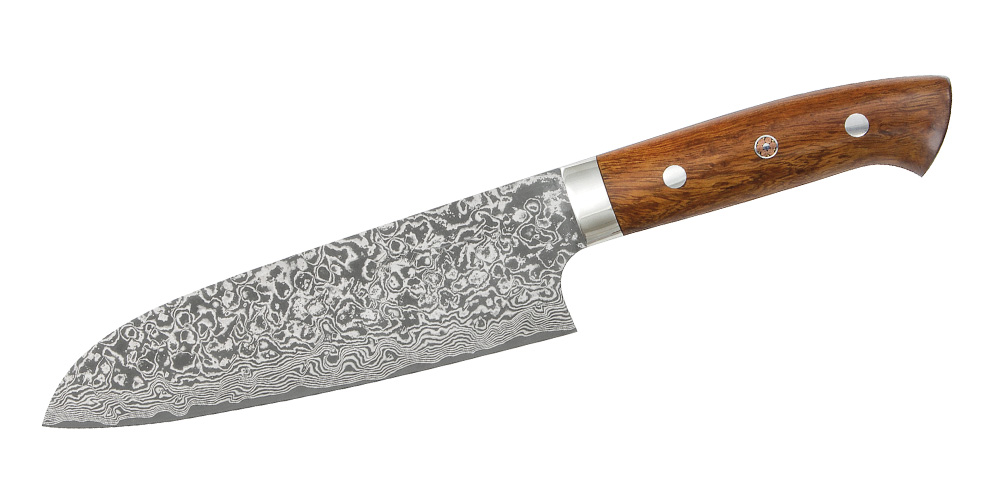
A high-quality chef's knife, often referred to colloquially as a chef's knife, should be part of every kitchen's basic equipment. It is not only ideal for cutting meat, fish and vegetables, but also for weighing and chopping herbs and other ingredients.
Our comprehensive service offers you expert advice - from the selection to the care of your tools.
In addition to sharpness, the durability of a knife plays a key role. High-quality DICTUM chef's knives made from first-class steel or fine blade structure stay sharp for much longer, ensuring precise cuts. Blunt knives, on the other hand, destroy the structure of the food and impair the flavour. A smooth cut ensures a better consistency and more intense flavour.
Invest in a high-quality chef's knife and experience the difference:
Superior cutting performance, exceptional longevity and a significantly improved cooking experience await you. As soon as you hold a high-quality chef's knife in your hand, you will immediately feel the difference. Excellent workmanship, precise sharpening and exceptional sharpness characterise a first-class knife.
Which chef's knife is right for you? Of course, this depends on various factors that reflect your individual needs and preferences. Ultimately, the best chef's knife is the one that suits your cooking style and needs. It's worth trying out different knives to find the perfect model for you.
Was spricht für ein handgeschmiedetes Kochmesser?
Workmanship of risk
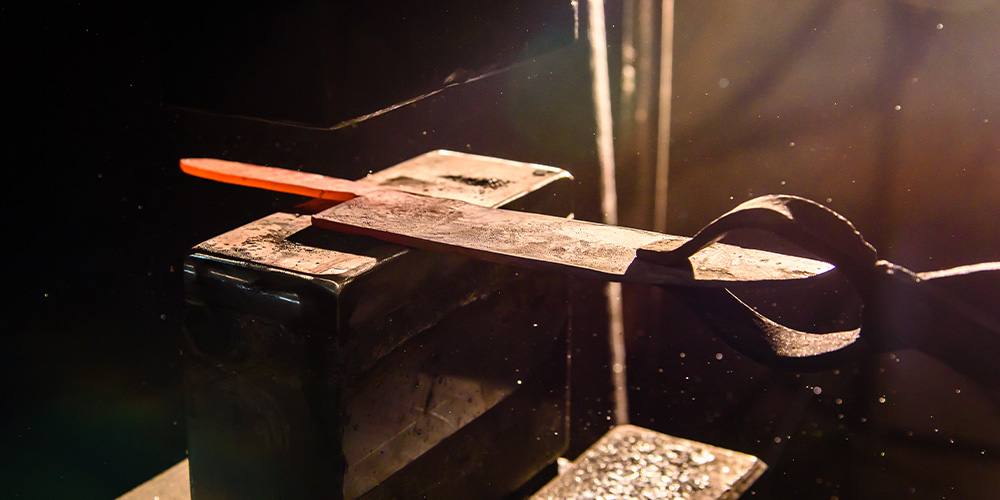
David Pye, a well-known industrial designer, author of several specialist books and skilled craftsman, has coined the phrase "workmanship of risk".
This term means that any moment during a manufacturing process involving manual labour can lead to an end product becoming unusable due to an oversight, carelessness or lack of knowledge. Interestingly, for thousands of years, objects made by hand have been honoured, valued and admired by us in museums. Only since the advent of mass production have there been manufacturing methods in which the craftsman controls a machine, but does not directly decide whether the product is ENJOY or scrap through his actions in the manufacturing process. At best, this results in high-quality products. However, these are not unique and are usually not appreciated by Use.
At best, a Santoku chef's knife will last a lifetime after purchase. Every hand-forged chef's knife is madewiththe risk that some work step will destroy it. Nevertheless, we hold it in our hands. You will look at, hold and appreciate a hand-forged Japanese knife differently than a knife with a high proportion of machine production. It has a soul and a different value. So you have to ask yourself whether a hand-forged chef's knife is not the better choice in terms of sustainability, which results from handling and appreciating the knife.
The last few metres
Fabrication is always cost-driven and only a certain level of quality is aimed for. For example, the fact that the wood handle has a grain that runs against the longitudinal axis of the knife and thus destroys the appearance is not taken into account. The same applies to the final grind, the blade thickness and the choice of steel. Steels that may have the best properties for Sharpness & Edge Life but are not suitable for industrial production are not used.
If you want something special and you want a product where someone (the craftsman) has thought about things that you understandably cannot know yourself before the purchasing process, then you can only choose a hand-forged knife.
From a single source
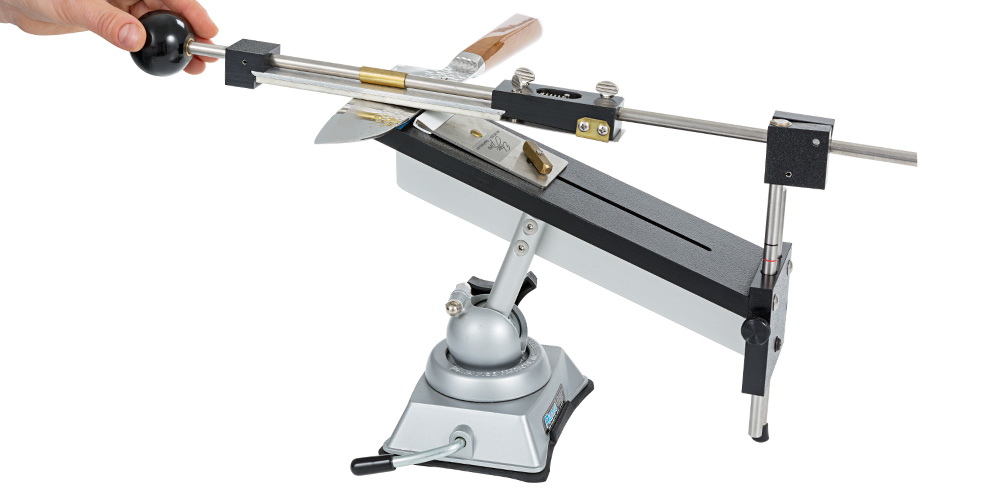
Many knife enthusiasts are familiar with this scenario: you buy a knife from a reputable brand and when you sharpen it for the first time with a knife sharpening system, you realise that the edge is not sharp, even though it has been sharpened on both sides at the same Angle specified by the sharpening system and a coordinated sequence of stones has been used.
The reason for the lack of sharpness may have many causes, but it is usually a lack of understanding of the original manufacturing technology. The user wants to have a sharp knife and does not want to have to deal with the manufacturing technology.
Many industrial manufacturers, regardless of price level, have uneven bevel angles on their knives. It is often a gamble to get a chef's knife with a centred edge and the same bevel angles. The reason for this lies in the industrial sharpening process. The machines used for sharpening are very precise. However, due to the grinding pressure or because the blanks are warped during Hardness, the blades can bend during processing or be sharpened more strongly on one side. The machines are not just used for one type of knife, but for countless blade shapes. Of course, they are adjusted accordingly, but any adjustment within this narrow tolerance range inevitably leads to problems. What's more, the hardening shop and grinding shop are two departments, so at best the machine operator knows his own machine, but knows nothing about possible hardening errors.
A blacksmith is also familiar with these problems. After all, he does the hardness hardening himself and grinds both sides by hand. However, he knows the complete product and the production steps and can counteract this problem with his experience. Not every hand-forged knife is necessarily better than an industrially produced knife, but the following statement is true:
The more complex the production steps for a product, and a damask knife has many production steps, the safer the production from a single source.
Wie steht es um die Qualität industriell gefertigter Kochmesser?
Products from Asian countries (except Japan) such as China, Vietnam, Taiwan... are usually labelled as cheaply produced and poorly finished. This may be true for the majority of Asian Manufacturers. However, just as the slogan "Made in Germany" no longer always guarantees quality, there are Asian manufacturers and factories that produce chef's knives to a high standard. Steel has long since become a global issue, so every Manufacturer worldwide can source high-quality knife steel from Japan, e.g. VG-10 or so-called super steels from the USA such as CPM Cru-Wear. Today, many Manufacturers such as Hitachi (Japan) or Damasteel (Sweden) also pre-produce hot-dip welded Damascus steels in sheet or flat steel form at a high quality level as semi-finished products.
If a manufactory or manufacturer is able to deliver consistent quality from these raw materials using suitable and controlled hardening processes and CNC-controlled grinding processes, this results in products with a good price-performance ratio. The country of production is not the decisive factor here, but rather the selection of a good Manufacturer who may even produce according to our specifications. It is therefore important to separate the wheat from the chaff and to constantly check the Manufacturers who produce good goods with regard to the actual Steel supplied, Hardness, possible defects during grinding such as grinding burn, centred cutting edges.... We check the quality before dispatch.
We have the means and expertise to check knife deliveries on site at our company premises using spectral analyses for steel determination / non-destructive hardness testing on the cutting edge, grinding burn etching or microscope images of the cutting edge. In addition, we have been working with accredited testing laboratories for many years in order to verify results and carry out extensive metallurgical tests. This allows us to offer products from Asian manufacturers without any reservations regarding processing and quality.
Fazit
At DICTUM you will find handmade chef's knives as well as industrially produced chef's knives, both from Japan and other Asian countries. We make sure that our Quality levels, which we have been pursuing for decades, are maintained.
Ergonomie und Handling: worauf es bei Kochmessern ankommt
In Germany, a higher weight is often associated with higher value when it comes to chef's knives. A heavy knife often feels bulky and stable, which can give a good feeling. However, real professional knives are deliberately designed to be light to avoid hand fatigue during Lengthy use. Weight and quality are not directly linked. A good chef's knife should be neither too light nor too heavy, so that its own weight makes work easier without straining the hand. A good balance between blade and handle weight is crucial for comfortable cutting. In Japan, for example, knives are developed with thin blades and light handles to minimise weight. Ergonomic handles and a sharp, durable blade are the basis for comfortable handling in the long term.
Die richtige Aufbewahrung hochwertiger Kochmesser
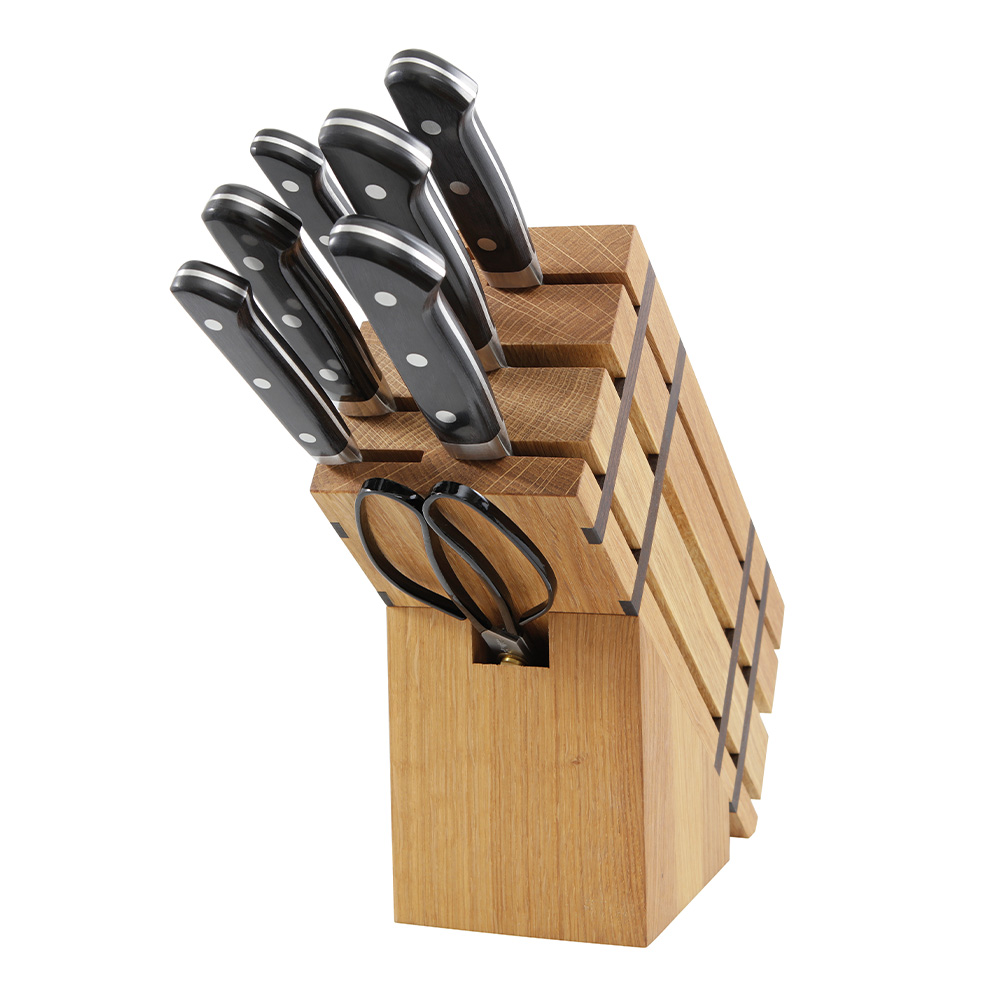
- Knife drawer with knife inserts: Use special inserts for drawers designed for knives. These inserts prevent the blades from bumping into each other or wearing out. The wood, cork or plastic insert holds your chef's knives securely in place and protects the blade.
- Knife bag or roll: A knife bag or roll is ideal for chefs who need to transport their knives. These bags protect the blades from damage and prevent contact between the cutting edges.
- Knife block: A knife block is a traditional and safe way to store knives. Choose a block with special pockets for different blade shapes such as Santoku, Usuba and Gyuto to ensure optimal storage and easy accessibility.
- Knife sheaths: Protective sheaths made of wood, plastic or leather can also be used for single knives. These protect the blade from external influences and prevent it from becoming blunt.
The right storage not only protects your investment in high-quality chef's knives, but also ensures safe and efficient work in the kitchen.
What blade hardness does a good chef's knife need?
Blade hardness is an important aspect when buying a good chef's knife, but it is not the only one.
Hardness is crucial for sharpness, as harder material allows for finer shaping of the blade. Many Japanese chef's knives have a blade hardness of over 60 HRC. However, a high degree of hardness makes the blade brittle and therefore more susceptible to nicks and chipping.
Softer, tougher blade steel, on the other hand, offers greater resistance and is less susceptible to damage, but at the same time it is also less easy to cut. Ultimately, the choice of blade hardness depends on the individual cutting requirements and the desired maintenance effort.
Which chef's knives do professionals recommend?
For professional use, a Kitchen knives with a Blade length of approx. 20 cm is usually recommended. This size offers a good balance between control and versatility. However, many manufacturers also offer smaller chef's knives that are similar to paring knives with a Blade length of 15 cm, which are also excellent for everyday use in the kitchen. For a professional chef's knife, a good balance is crucial for how the kitchen knives fits in the hand and can be guided. The weight distribution between the handle and blade should be balanced to ensure fatigue-free handling. A well-balanced blade facilitates precise work and reduces the risk of injury or strain.
Tip: Many of our chef's knives are available both individually and in carefully compiled knife sets. Buying a set usually offers you a price advantage and a perfectly coordinated set for the ultimate performance in your kitchen.
