Sharpening scraper blades

A scraper is a very simple tool, as it basically consists of a single piece of steel or sheet steel. Nevertheless, it is versatile and a practical helper in problematic cases. We would like to introduce you to this often underestimated tool and explain how to sharpen a scraper and use it correctly.
How do you work with a scraper?
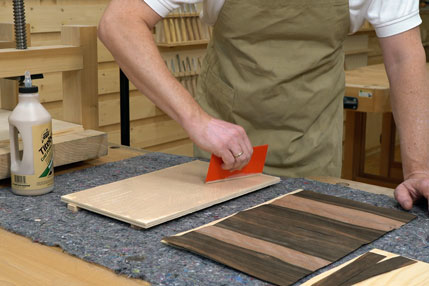
The scraper is usually held with both hands. Contrary to what the name suggests, it can be used for more than just pulling. It is usually pressed or pushed. Using thumb or finger pressure, it is bent slightly so that it does not remove chips across the entire width, but only partially. The blade is tilted slightly in the cutting direction. How much it is tilted depends on the tightened burr. More on this later.
Fig.: Well-sharpened scraper blades do not produce dust, but fine wood shavings

How does a scraper work?
Scraper blades are made from relatively hard steels, such as those used for saw blades. They are available in different thicknesses and shapes. The scraper is a cutting tool. It must be properly sharpened and have a sharp burr that is capable of removing very fine wood chips. The chip removal can be very finely dosed and adapted to the respective situation by its inclination and the pressure exerted.
Fig.: The fine burr works in principle like a very small plane iron

What are scraper blades used for?
They are suitable for the following tasks:
- fine material removal, also in places
- Smoothing alternating woods
- shaping
- Removing old layers of varnish and paint
- Reworking rounded and curved surfaces
Due to the very fine material removal, the scraper has a number of advantages, especially in difficult situations. It can be used with, against and across the wood fibre. You can use it to smooth out alternating grain woods that are difficult to work with planes (see "Scraper plane" below). If tears occur during planing or if there are small knots and knots in the wood, you can use it to target the problem areas. This involves gradually removing material in a larger area around the spot, from the outside inwards, until the surface of the problem area is smooth and free of tears. The result is a gentle indentation that is usually barely visible.
Strong scraper blades are a simple and inexpensive tool for removing layers of paint and colour without chemicals. They don't even need to be specially sharpened. All you need to do is roughly sharpen the burr from time to time (more on this later).
What do you do with a gooseneck scraper?
They are available in different shapes for reworking recesses (e.g. seat recesses, inlays, carving work) and curves (e.g. curved doors, mouldings, knife handles). Scraper blades whose long edges are straight and whose short sides are convex and concave are very versatile. The so-called swan neck is intended for more strongly moulded surfaces. It offers a variety of inner and outer radii of different sizes.
Which is better, thin or thick scraper blades?
Scraper blades are available from 0.25 to 1 mm thick. Thin ones are easier to bend than thick ones. This is particularly advantageous when working on details and small surfaces, but has the disadvantage that the scraper blade yields to the resistance of the wood and usually becomes blunt more quickly. The larger the surface to be worked on and the more material removal is required, the stronger the steel can be. However, bending a 1 mm thick blade can be quite strenuous in the long run. As they are inexpensive tools, even the purchase of a set with different thicknesses is an affordable investment for most woodworkers.
How do I sharpen a scraper for woodworking?
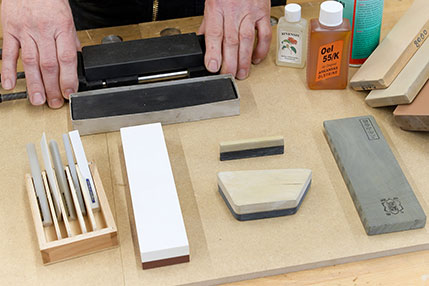
The basic equipment for sharpening scraper blades includes a file (without handle), bench stones from coarse to fine or a combination stone (1000/6000), dressing tool for bench stones and a honing steel. Scraper blade sharpening is carried out in three to four steps:
- File/dress the edge
- Grinding the edge and sides
- Compacting
- Tighten burr
Fig.: The burr is tightened with the honing steel

1. dressing
Tools required:
- Flat file (single cut)
- Clamping option
- Optional tools: File holder/breaking gauge.
As new scraper blades are usually punched and are therefore rounded on one side and frayed on the other, the edges must be smoothed with a file (without a handle). Clamp the scraper in a vice with wood supports or the front clamp of a planing bench. Allow it to protrude a few millimetres. Run the file lengthways over the edge of the scraper and remove as much material as necessary until all punch marks have been removed. Make sure that the file is exactly at right angles to the blade or parallel to the surface of the workbench; a levelling gauge can help with this. The aim is to achieve a right-angled edge.

2. sand the edge and sides
Tools required:
- Sharpening stone set or combination stone
- water
- Optional tools: Wooden block
Once all the punch marks have been removed, the edge is now sharpened at a right angle. Align the whetstone before sharpening. Start sharpening with a coarse grit (800 to 1000). A diamond dressing plate is ideal. Then switch to a finer grit (1000 to 2000) and finally to a whetstone (6000 to 8000). The side surfaces of the scraper are also polished on the whetstone. For occasional use, a combination stone with grit 1000/6000 is also sufficient. Make sure that the scraper is guided exactly perpendicular to the sharpening stone. A wooden block can be used as a guide. Always move the blade at a slight angle/diagonal across the stone so that it does not grind into the stone and leave deep grooves in it. The aim is to achieve a smooth edge with correct 90 degree angles.

3. compacting
Tools required:
- Honing steel / scraper steel
- Oil
The sharp scraper edge is already suitable for scraping and scratching, but will quickly become blunt again. In this step, the steel is compacted at the edge and pressed outwards in preparation for tightening the burr. To do this, place the blade on the work surface near the edge of the table and apply one or two drops of oil to the scraper. Now apply a little pressure to the scraper and stroke over the side surfaces. Turn the scraper over and repeat the process. The aim is to compact the steel and drive some material outwards.

4. tighten the burr
Tools required:
- Honing steel / scraper steel
- Clamping option
How do I strip a scraper correctly?
In the final step, the material that has been driven outwards is folded over so that a cutting burr forms on the edge. To do this, clamp the scraper in the vice/front pliers. First place the scraper horizontally and stroke it over the edge a few times. Then tilt the scraper stand slightly to tighten the burr a little more. The angle varies between 5° and 15°, the greater the inclination, the more aggressive the burr. Please note that the carbide inserts on the Carbur 2 sharpener are orientated at a slight angle to the handle, which makes it easier to tighten the burr, but must be taken into account at the start of the process. The Carbur 2 has two differently shaped carbide inserts made from wear-resistant carbides. The round insert is used for smoothing with normal pressure, while the pointed insert applies high deformation pressure and thus ensures stronger burr formation. Three common angles (5°, 10° and 15°) are already specified for the Accu-Burr honing steel. The aim is to create a burr that is suitable for the intended work.

Tip 1: To begin with, experiment with different angles, slightly or strongly tightened burrs and blade inclination angles. A properly sharpened scraper cuts thin wood shavings, a blunt one only produces dust.
Tip 2: A rectangular scraper has four edges. If you also sharpen the short sides and apply a burr to all of them, you can use a total of 8 sides or burrs for working. However, take care when working so that you do not cut yourself on the burrs.
How do I sharpen a gooseneck scraper?
You can sharpen a gooseneck blade in the same way as a normal scraper. However, as this is much more complex with the curved shape and usually only a small section or a specific curve is used, a gooseneck is only partially sharpened. This also reduces the risk of injury. You can sharpen all convex edges on normal sharpening stones, for concave inner curves you need moulding stones.
Fig.: Moulding stones are used to sharpen a swan-neck drawing blade

Can I resharpen a blunt scraper?
The burr wears out with use, at some point it is no longer sharp and no longer cuts. As long as there are no nicks or chips in the cutting edges, you can dispense with dressing (step 1). It is often even sufficient to flatten the burr again (step 3) and sharpen it again (step 4).
How do I store sharp scraper blades correctly?
Store the blades safely and gently in a leather case. The burrs are optimally protected and the scraper blades remain sharp for a long time. You can also keep sharpened scraper blades of different thicknesses and shapes in the case.
Special shapes
The profile moulding plane uses blades that are shaped according to the profile. The shape of the profile shaving plane is reminiscent of a tail plane. It also has a side stop and is guided over the workpiece with both hands, just like a moulding plane. You can use a moulding plane to decorate mouldings, round and profile edges and also structure surfaces.

So-called "scratch stocks" are a very simple form of profile scraper. They basically consist of a simple block of wood into which a specially shaped piece of scraper plate is clamped. The shape of the profile is simply filed into it using small spanner files. It is placed against the edge of the workpiece, tilted slightly and then pulled or pushed with little pressure.

The moulding plane is basically a large, very strong scraper blade that is guided in a planer box. It is suitable for surface treatment of hard, alternating woods and can also be guided against the wood fibre. The plane is ground in a similar way to a normal plane (45° bevel angle). A burr can also be tightened. The angle of the plane iron can be varied from 75 to 90° on most models.
The scraper is a tool for rough work. It contains two plates bent at the front which, with their sharp edges, provide excellent service when removing glue and paint residues, stripping boat paints and scraping off fruit tree bark.
Conclusion
With a little practice and a few tools, you can sharpen any scraper. Properly sharpened, it removes thin chips, leaves a smooth surface and is also suitable for difficult tasks where a normal planer fails. In our online shop you will find high-quality scraper blades in various thicknesses and shapes as well as everything you need for sharpening and honing.
Our top selection for you


Folgende Beiträge könnten Sie interessieren