
Vacuuming, but the right way! How to find the right extraction unit for different machines
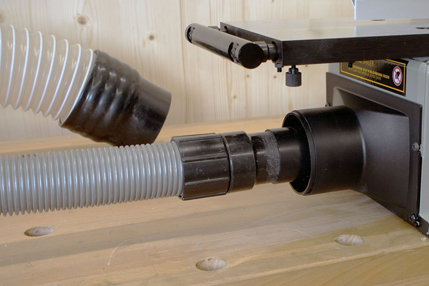
There are many different devices that can be used to extract dust and chips. These range from simple household hoovers to permanently installed extraction systems with chip bunkers. In this article, we take a look at which extraction devices are suitable for which tasks and which machines they are best suited to.
What kind of dirt is produced in the wood workshop?
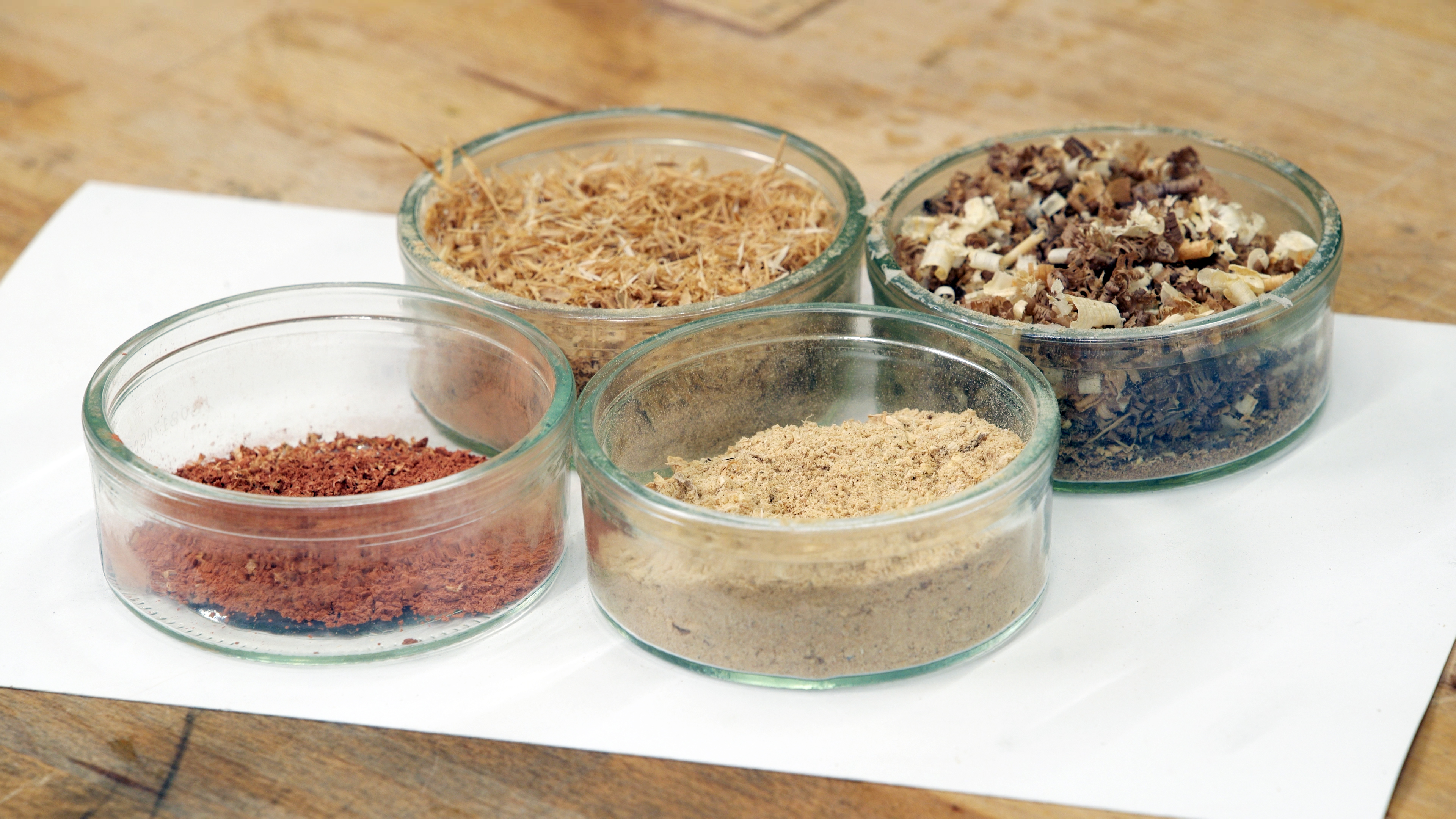
Assembly work with a hand drill produces mainly fine drilling dust, while work with a jigsaw and circular saw produces coarser wood dust. Drilling dust from stone and concrete, for example when drilling holes for dowels, is fine and heavy. Drilling and sawing chipboard, on the other hand, produces coarse wood dust, as the board material itself already consists of wood shavings that are crushed into dust during cutting.
A mixture is usually produced in the bench room : dust from cleaning the floor and from sanding machines, and chips from working with hand and power tools. This is mainly wood dust, which is considered hazardous to health.
Some power tools, such as the router and the electric hand planer, produce a large amount of wood fibres and chips in a short time, which have a significantly larger volume than wood dust.
In the machine room , the stationary circular table saw or sliding table saw and the band saw mainly produce wood dust, while planing machines (jointers and thicknessers) produce a large quantity of large-volume wood chips in a very short time.
Four different types of dirt are produced in the woodworking shop
Is a household hoover sufficient as an extraction system?
A normal hoover is not a suitable solution for the wood workshop. For one thing, the volume of the collection container is very small at approx. 3 to 6 litres. Secondly, the suction hose usually has a small diameter (approx. 26 mm) and only enables a comparatively low suction power. A normal household hoover is only suitable for occasional work, e.g. drilling holes in a wall or cleaning after installation. The advantage of the hoover: it is usually quite quiet.
What is a workshop vacuum cleaner (wet/dry vacuum cleaner) suitable for?
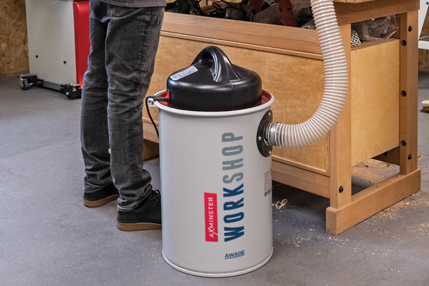
The difference to a domestic hoover is that the collection container in most workshop vacuum cleaners is located under the suction unit, so that the dirt sucked in falls directly into the container and is not sucked into a bag or container located in front of the motor housing. This means that liquids can also be sucked up without posing a risk to the electric motor. As a rule, workshop vacuum cleaners have a simple air filter without an additional dust bag. The collection container has a significantly larger volume than a domestic hoover. Workshop vacuum cleaners are primarily used in the non-professional sector or for cleaning tasks, e.g. on construction sites or during assembly.
Simple chip vacuum cleaner with 50 litre container volume
What are the advantages of mobile extractors?
So-called mobile extractors are assigned to dust protection classes (L, M and K), which are prescribed by the employers' liability insurance associations in the commercial sector. In the private sector, however, the dust protection classes play a subordinate role. Important differentiation criteria are primarily the volume of the collection container and the diameter of the suction hose. In addition to flexible suction hoses with a diameter of 27 to 35 mm, most mobile vacuum cleaners also offer the option of connecting larger hoses with a diameter of 58 to 66 mm. 27 to 35 mm corresponds to the diameter that can also be found on household hoovers and workshop vacuum cleaners. Such hoses fit most electric tools such as hand-held circular saws and routers. Hoses with 58 to 66 mm are more than twice as large and therefore offer more space for coarse particles and larger chips. Most semi-stationary machines such as mobile circular table saws, milling tables and small planing machines have corresponding suction connections.
With the S 200 volume extractor, the container of the MAFELL S 35 M can be extended from 35 to 200 litres
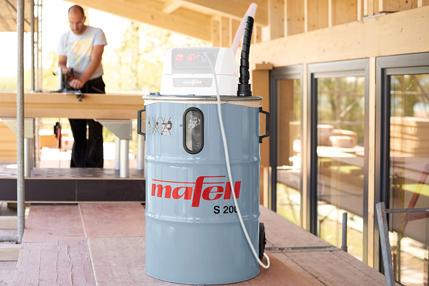
The container volume of the mobile dust extractor is also important for sufficient extraction. An extraction unit with a container volume of only 4.5 litres can be used to extract one cut with a hand-held circular saw. However, when routing a rebate with a router, such a small dust bag is full after five minutes at the latest, the suction hose is clogged and the blockage has to be laboriously removed - and that can cost a lot of time! For all work that quickly produces a large amount of voluminous chips, for example when routing with a router and planing with an electric or assembly planer, the container volume of the mobile dust extractor should therefore be at least 25 to 35 litres!
In addition, the air flow from a mobile extraction unit is filtered at least twice by a dust collection bag and one or more air filters and is therefore cleaner than with a simple workshop vacuum cleaner. A mobile extraction unit is always a sensible investment in your health.
When is a chip extraction system useful?
While we have previously talked about mobile extraction units, chip extraction systems are more or less stationary devices. Although they usually have castors and can be moved around the workshop, they are not so easy to transport (e.g. to the construction site). However, their size makes it possible to install correspondingly powerful fans and air filters and to use large dust containers and bags. The connections are also correspondingly larger (Ø 63 to 100 mm).
The air filter of this chip extractor is cleaned by turning the lever
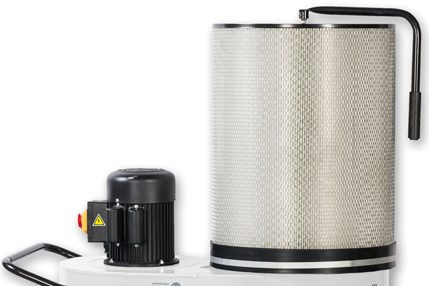
Extraction systems are used in the workshop or machine room. They are already recommended when working on semi-stationary machines (circular table saws, router table) (e.g. DICTUM SA 1140 extraction unit (No. 725033). For small planing machines (surface planer, thickness planer), a chip extraction unit is clearly more suitable than a mobile extraction unit, as it can cope better with the large quantity of chips (e.g. DICTUM SA 2200 extraction unit (No. 725034)). For stationary machines that are correspondingly powerful and produce a lot of chips very quickly, chip extraction is essential in the long term. Many professional extraction systems offer two or more connections so that several machines can be extracted at the same time (e.g. DICTUM extraction system SSA 3500 (no. 725035) and SSA 5200 Twin (no. 725036) with three or four 100 mm extraction nozzles). With a suitably dimensioned extraction system, you can also plane, saw or mill for an hour at a time without having to change the chip bag in between.


