Basic tool equipment for the woodworking shop
Anyone who discovers woodworking for themselves will at some point ask themselves the question: "What tools do I need?". A simple answer to this is difficult. It all depends on you and your individual plans. You should rather ask yourself the question: "What do I want to do?".
If you initially want to implement simple ideas, a relatively small selection of tools will suffice. Divide your project into three sections to concretise the tool list.
Marking out
For marking out, you need at least one accurate metre rule, a precise square and a sharp pencil. That's basically all you need to get started. If you intend to make classic wooden joints such as dovetail tines yourself, you need to be able to transfer different angles precisely. The best way to do this is with an angle bevel. When marking parallel lines and transferring depth measurements, a moulding gauge is very helpful. These are exactly the marking tools that a professional has in his toolbox.
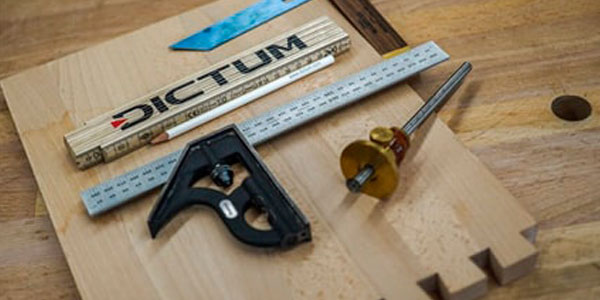
| Minimum equipment for scribing | For marking out timber joints |
| metre rule | additionally |
| Square | moulding rule |
| Pencil | Square mould |
Formatting
When carpenters talk about "formatting", they do not mean deleting data from the hard drive, but rather cutting boards and panels to a specified size. Beginners will certainly start by working with pre-cut wooden boards and planed mouldings. A good hand saw is usually sufficient to cut these to the desired final dimensions.
For example, you can use a Ryoba to cut mouldings and boards by hand. The Ryoba is a Japanese saw whose saw blade is serrated on both sides - one side is ideal for longitudinal cuts, the opposite side for cuts across the wood fibre. If you want to cut panel material to size yourself, you can also use a hand-held circular saw or plunge-cut saw with a guide rail to precisely format larger furniture parts.
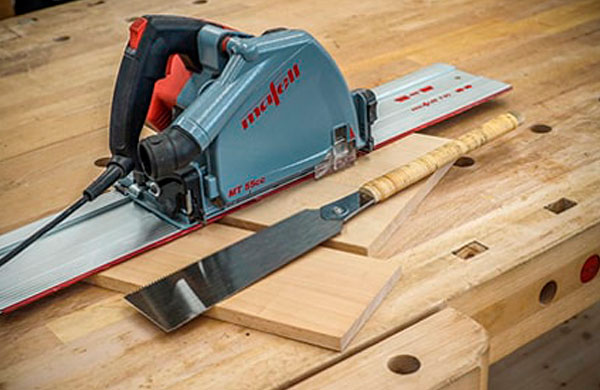
Japanese saw and plunge-cut circular saw for formatting
Equipment for sizing:
✔ Hand saw, e.g. Ryoba, for mouldings, boards and beams
Circular handsaw with guide rail for panel material
Joining
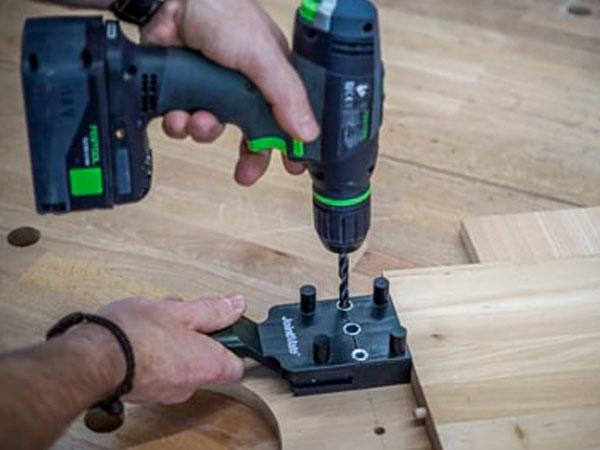
There are many options for joining wood-based materials. Many beginners start with simple joints using wooden dowels. All you need is a drill or cordless screwdriver and a suitable wood drill bit. A dowel gauge makes it much easier to position the holes precisely.
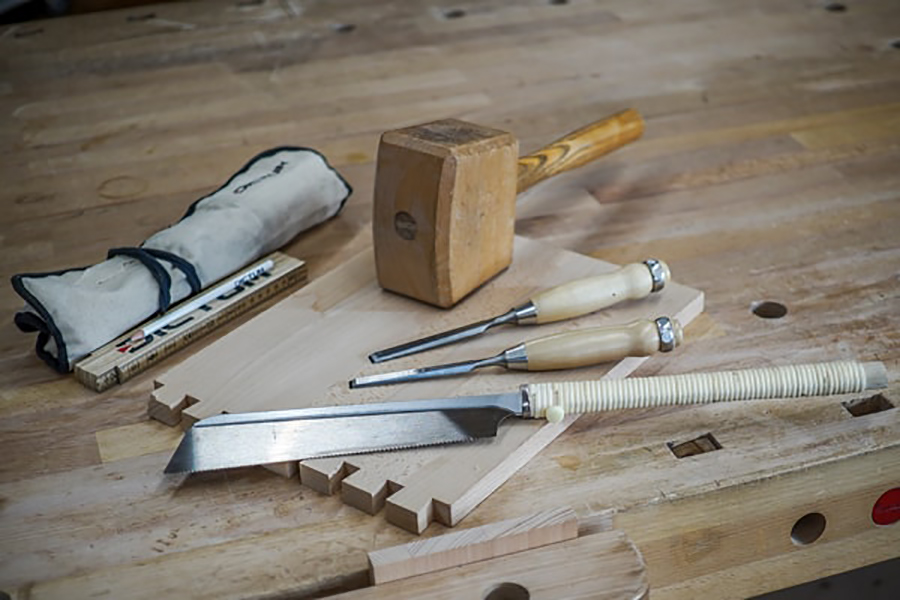
If you are creative and have more confidence, you can try your hand at classic wooden joints. To make joints such as mortise and tenon or tenons, you will need a saw for fine cuts, two or three sharp chisels and a hammer or mallet. A Dozuki Universal, for example, is very suitable as a versatile saw for wood joints. The saw blade of the Dozuki is reinforced by a spine and is therefore thinner and finer than a Ryoba. When selecting the chisels, the question "What do I want to do?" comes into play again. To chisel slots, you need a relatively narrow chisel with a width of 6 to 10 mm. For finger joints and dovetail joints, a chisel between 12 and 20 mm. And a wider chisel between 22 and 30 mm is a sensible purchase for working on larger surfaces, such as when mortising overlapping panels or reworking tenons.
Last but not least, a versatile planer should not be missing from your tool set. Although there is no universal plane, a good one-handed plane is sufficient for cleaning wood joints, planing bevels and smoothing edges to start with. As you gain experience, you will certainly venture into more complex projects and expand your tool and machine equipment accordingly. Whatever you want to build, at DICTUM you will find high-quality tools that you will enjoy using for a long time. Our practice-orientated craft courses make it easier for you to get started in creative woodworking.