
Guitar machine heads / tuners


Guitar machine heads / tuners
EXPERT KNOWLEDGE GUITAR MACHINE HEADS TUNERS

There are different types of guitar machine heads, which differ in terms of construction and function:
- Open tuners: With these, the gears are visible, which allows for easy maintenance. They are often used on classical guitars.
- Closed machine heads: Here, the gears are housed in a casing that protects them from dust and dirt. This design is typical for acoustic guitars and electric guitars.
- Locking tuners: These have a clamping device that fixes the string in place and thus increases tuning stability. They are particularly popular with guitarists who favour intensive bending or the use of tremolo systems.
Material
The quality of the materials used influences the longevity and function of the mechanisms. Frequently used materials are:
- Metals: Steel, brass or bronze are used for the gears and housings. A surface finish such as chrome or nickel protects against corrosion and increases the hardness of the surface.
- Plastics: High-quality plastics are used for the swivels or knobs. They offer a pleasant feel and reduce the weight.
- Wood: Particularly for classical guitars, pegs are also made from hardwoods such as ebony or rosewood, which are not only functional but also aesthetically pleasing.
Manufacturer
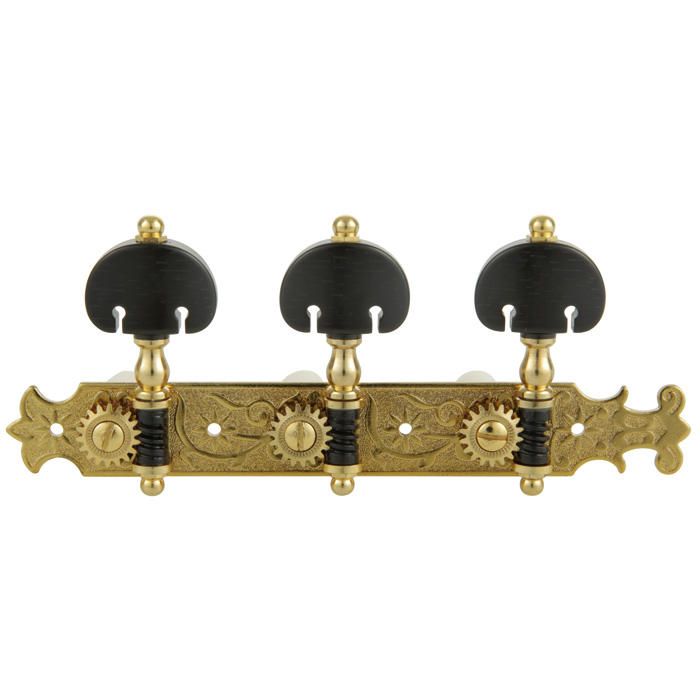
Jung tuning machines offer exceptional performance at an unbeatable price. They close the gap between inexpensive standard tuners and expensive, handmade models for concert guitars.

Gotoh tuners from Japan are renowned among guitar makers for their precise workmanship and outstanding quality. With decades of experience in production, Gotoh offers tuners that are characterised by exceptional durability and precise tuning stability. Gotoh offers a wide range of machine heads in different price ranges.

Rubner Mechanik is a renowned Manufacturer of guitar machine heads that impresses with its special design, precise workmanship and good tuning stability.
Differences in quality
The quality of guitar machine heads is reflected in several aspects:
- Precision: High-quality machine heads enable fine and accurate tuning without backlash.
- Tuning stability: Good machine heads keep the tuning constant even with intensive use.
- Durability: Robust materials and careful workmanship ensure a long service life.
Selecting the right mechanics
When choosing the right machine heads, guitarists should consider the following points:
- Compatibility : The machine heads must match the headstock and the guitar's bore.
- Gear ratio: A higher gear ratio enables finer tuning.
- Budget: High-quality machine heads are often more expensive, but offer better performance and durability.
Dimensions and distances
The dimensions of the tuners vary depending on the type of guitar and manufacturer. Standard tuners for electric guitars and acoustic guitars have a shaft diameter of around 10 mm, while classical guitars often have smaller diameters. The distance between the tuners, also known as the hole spacing, should also be taken into account to ensure correct fitting.
Installation and fastening
The installation of guitar machine heads requires precision. The machine heads are inserted into the headstock of the guitar and fixed in place with screws. It is important that the centre bores in the headstock correspond exactly to the diameters of the machine heads to prevent slippage or damage. When building a new guitar, the installation of the machine heads is a crucial step that requires precise work and careful planning to ensure optimum functionality and a perfect appearance. Here is a detailed description of the process:
Tools and materials for installation
- Drill with drill bits of different sizes (usually 8-10 mm, depending on the mechanics)
- Drill stand or drilling jig (for exact drilling angles)
- Calipers or templates for positioning the holes
- Pencil or marking tool
- Abrasive paper sandpaper (fine Grit, e.g. 240-400)
- Centre punch for precise positioning of drill holes
- Hammer and protective pad for sleeve assembly
- Ruler or steel ruler for precise measurements
Step-by-step instructions for installing the machine heads
1. planning and preparation of the headstock
1. design of the headstock:The headstock is designed according to the type of guitar (e.g. 3+3 tuners for acoustic guitars or 6-in-line tuners for electric guitars). The thickness of the headstock is set at around 12-15 mm so that the guitar tuners can be mounted securely.
2. marking the positions:Draw the positions of the machine heads on the headstock using the manufacturer's instructions or a template. The usual hole spacing for 6-in-line machine heads is around 35 mm. Make sure that the guitar machine heads are evenly aligned to ensure a symmetrical appearance.
2 Drilling the machine head holes
1. centring:Mark the centres of the drill holes with a centring centre punch to prevent the drill bit from slipping.
2. drilling the holes:Drill the holes with a pillar drill or drill jig to ensure an exact 90 degree Angle to the headstock, starting with a small drill bit (e.g. 2 mm) and gradually enlarging the holes to the final diameter (e.g. 10 mm for acoustic guitars or 8 mm for classical guitars).
3. smoothing the drill holes:remove splinters and sharp edges with fine Abrasive paper sandpaper.
3. preparation of the sleeves
1. fitting the sleeves:Test whether the sleeves supplied with the machine heads fit into the drill holes. If necessary, the holes can be widened slightly.
2. inserting the sleeves: Carefully press the sleeves into the holes. If they do not fit easily, use a small hammer with a protective pad to avoid damaging the wood.
4. mounting the mechanisms
1. positioning the machine heads:Insert the guitar machine heads into the sleeves and align them. For 3+3 machine heads, the knobs should run evenly along the headstock; for 6-in-line machine heads, all axes must be in a straight line.
2. fixing with screws:Mark the positions of the screw holes with a pencil and pre-drill them with a small drill (e.g. 2 mm) to avoid cracks in the wood. Tighten the screws carefully without damaging the wood or the mechanisms.
5 Adjustment and fine tuning
1. function test:Turn the knobs to ensure that the guitar machine heads run smoothly and have no stiffness or play.
2. tuning stability:Tension the strings provisionally to check the tuning stability and function of the guitar machine heads.
Tips for an optimal version
- Use templates: A template ensures even placement of the guitar machine heads and makes work much easier.
- Observe the Manufacturer's Dimensions: Guitar machine heads from different brands differ in Diameter and hole spacing. Use the data sheets or measurements provided.
- Take care when drilling: A clean drilling process is crucial, as unclean holes can lead to wobbly guitar machine heads later on.
- Consider aesthetics: The alignment of the guitar machine heads affects the appearance of the guitar. Take your time to ensure symmetry.
Overall, the choice of guitar machine heads has an influence on the playability and sound of an instrument that should not be underestimated. Careful selection, neat installation and regular maintenance of the guitar machine heads ensure that the guitar is and remains easy to tune.
