

Woodturning tools & lathes


Woodturning tools & lathes
EXPERT KNOWLEDGE WOODTURNING TOOLS & LATHES
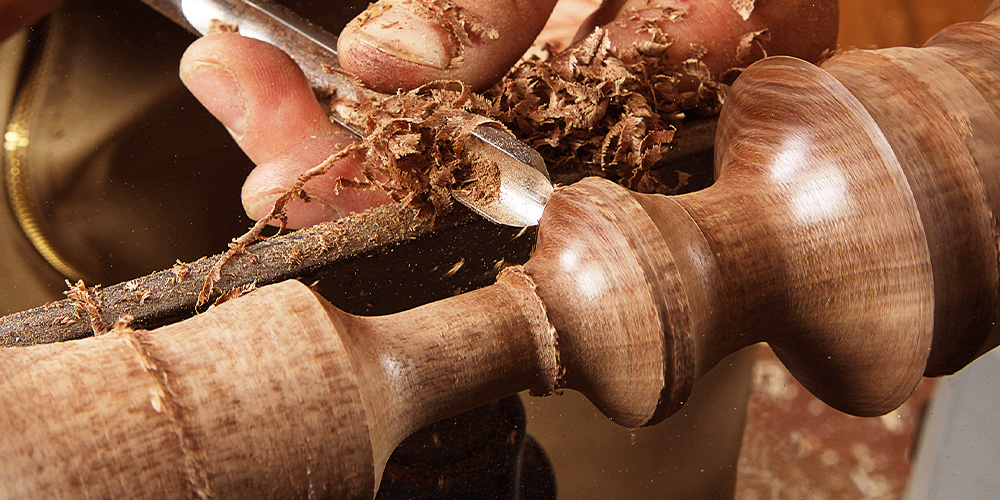
Finding the right tool is no easy task. Lathes are available in different sizes and versions, and the selection of suitable turning irons and turning tubes is many times larger. In our woodturning courses, beginners learn the basic techniques and suitable woodturning tools. Our instructors also teach experienced woodturners new, creative techniques in challenging workshops. Here is an initial overview of the tools you need for woodturning.
Which lathes to buy?
To get started, many people choose a compact bench lathe that can be easily integrated into any workshop. These models are placed on a workbench and can be stowed away quite easily when needed. With a suitable bed extension, you can extend the distance between centres (e.g. from 400 mm to 1000 mm on the DICTUM S175), and with a suitable base frame, the bench lathe becomes "independent". However, the centre height cannot usually be changed at a later date. Entry-level models offer good value for money. If you want to use your lathe more intensively and are interested in larger turning objects, you will want to opt for a powerful model with a greater Centre height and width, greater Engine power and corresponding Weight. More on this topic in our "Lathes " category.
Which woodturning tools to buy?
In the production of turned parts, a basic distinction is made between two working methods, for each of which different tools are used:
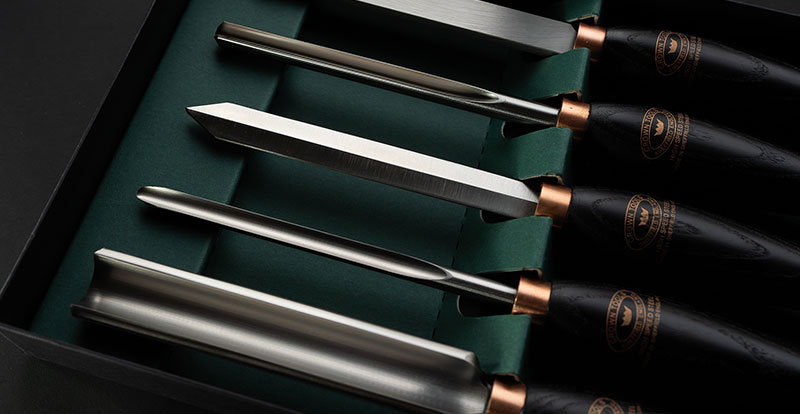
Long wood turning: Here, the wood fibres run parallel to the spindle's axis of rotation. Clamping is done either with the help of a Four-tooth spur driver and the travelling centre or with a chuck, whereby the travelling centre can also be used as a support for Length workpieces. Examples of workpieces produced include chair legs, stair posts, tool handles, vases, mugs ... Tools used: Roughing-out gouges, Spindle gouges, Skew chisels, boring tools, Hook tools and Ring tools.
Cross turning: The fibres of the wood run at right angles to the spindle's axis of rotation. This means that cross-grain wood must be machined twice per revolution. Workpieces that are machined crosswise can be clamped in chucks, on faceplates or with screw-in chucks. They are rarely supported by the Tailstock, as it would be a hindrance during machining and the usually short parts do not require any support. For heavy parts, however, support from the tailstock is recommended at the start of the turning process. This is how bowls, cans, plates, etc. are produced. Tools used: Bowl gouges (with fingernail grind) and scrapers.
What tools does a beginner need?
As an inexperienced woodturner, it is easy to buy the wrong tools. Many people are not yet sure whether they will pursue woodturning as a hobby in the long term and buy a cheap set of woodturning knives. These usually have short handles made of cheap wood and are unfortunately mainly made of cheap steel, which does not have a long enough service life. You will not enjoy using such blades in the long term, as you will not be able to achieve satisfactory results with them. Pay attention to quality right from the start and buy a few selected, high-quality tools.
The most important turning tools in the basic equipment are
- Roughing-out gouges: used exclusively for long wood turning! It is used for rough round turning directly after clamping the blanks and must be stable in order to withstand the blows that occur.
- Spindlegouges: As the name suggests, they are used for shaping, i.e. for turning profiles. Longwood moulding-out gouges are also suitable for roughing-out if a roughing-out gouge is too unwieldy (e.g. for pen turning).
- Skewchisels: for long wood turning. The simplest and oldest shape of woodturning tools. Two different shapes are commonly used for turning chisels: the simple flat chisel and the oval chisel. The correct handling of skew chisels requires some practice and experience. With a little know-how, they enable complex shaping and produce mirror-smooth surfaces.
- Parting tools: also known as turning knives or parting tools. For long timber, rarely also used in cross pieces. Suitable for cutting workpieces between centres and for cutting dimensionally accurate notches and tenons. Different shapes are available, such as knife shape, trapezoidal shape or diamond shape with one or two bevels.
- Bowl gouges: mainly for crosscut timber. Similar to the Spindle gouges, but the flute is often short, the blade has a solid Shaft and the Angle of the bevel is steeper in order to be able to reliably hollow out deeper Shawls.
- Spindle gouges / detail gouges: also similar tospindle gouges, but usually smaller in cross-section and with a less deeply moulded flute.
When using woodturning tools, pay particular attention to the steel used and the quality of the handles. The steels must be heat-resistant to prevent the cutting edge from annealing. HSS or high-speed steels, from which most of our blades are made, are resistant up to 570 °C and extremely wear-resistant. PM steel, which is produced using powder metallurgy, is even harder and more abrasion-resistant. The vibration behaviour of the handles is also crucial: strong handles made of dense wood dampen vibrations and thus improve the result. The length of the handle must also match the application. While a Roughing-out gouges can be guided well with a comparatively short handle, a Bowl gouges needs a long handle in order to be guided safely.
What other tools are needed in addition to a lathe and a turning iron?
- Clamping devices: Lathes are usually supplied with a driving centre and rotating centre punch. These are the standard clamping options for longitudinal wood turning. Matériau du manche, such as a Faceplates, a Chucks with different clamping jaws or a so-called Mandrels for pin turning, are required for cross-grain processing and special projects.
- Measuring tools: In order to turn objects to an exact dimension (e.g. a tenon for clamping in the chuck) or to check the wall thickness of Shawls and tins, measuring and testing tools such as an Inside callipers and Outside callipers are required. Calipers make it easier to check depths and lengths.
- Hollowing tools: With tools such as the Martel and Wiedemann hollowing hook or the Crown Revolution tool, you can undercut internal moulds to produce bulbous shawls and vases with a consistent wall thickness.
- Special tools and texture tools: There are numerous specially developed turning tools for special tasks and projects, e.g. thread chisels for wood threads, ring tools to cut so-called "trapped rings" or can scrapers to turn the bottom of a wooden can or urn flat. You can decorate and loosen up the surface of turned objects with spiral & texturing tools.
- Saws: Most woodturners use a powerful Bandsaws to cut the blanks to size. In some cases, it is safer to cut through a clamped workpiece with a handsaw/Japanese saw than with a parting tools.
- Drill and cordless screwdriver: For pre-drilling holes for screw chucks and for screwing onto faceplates.
- Personal protective equipment (PPE) and extraction system: Think about your health too! Working on a lathes is associated with certain dangers. Always protect your eyes with safety goggles or a visor. A woodturning jacket fits snugly, especially the cuffs, so that they do not catch easily on the machine. It also protects your normal clothing from splashes and dust. When you sand your workpieces on the lathes, large quantities of wood dust are quickly produced. Most wood dusts are hazardous to health, some are even carcinogenic. For this reason, use a funnel to extract sanding dust directly from the lathes.
How are turning tools sharpened?
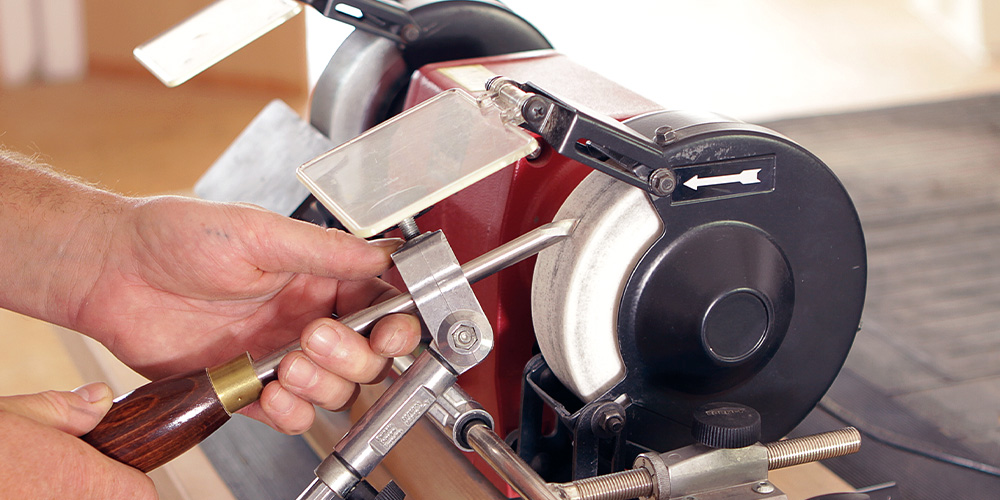
Due to the hardness of the steels used for the tools (HSS, Cryogenic and PM steel), we recommend grinding on a normal bench grinder (double grinder) with the aid of a sharpening jigs, e.g. Tormek BGM 100 or Wolverine sharpening system, for coarse material removal (e.g. when resharpening a tube). For the actual sharpening of the turning tools, many woodturners prefer a wet grinding system with harder grinding wheels (e.g. Tormek Blackstone Silicon) or low-wear CBN grinding wheels.
