
Throwing axes


Throwing axes
EXPERT KNOWLEDGE THROWING AXES
Which throwing axe to buy?

Throwing axes are subjected to heavy loads when thrown. The blade must not deform on impact with the target and must not break out even if the throw misses. Our throwing axes are forged by hand from high-quality steel, usually carbon steel. This gives them a compacted structure and an attractive forged look. The axe handles must not come loose and must be made of robust wood. To prevent the axe handle from breaking on the first throw, the wood fibres should ideally run parallel along the entire length.
Historical role models
There are basically three origins: medieval battle axes, traditional tomahawks of indigenous peoples in North America and double-edged felling axes.
Battle axes. In the Middle Ages, axes and hatchets were weapons of equal value to swords and spears. They were used by knights both in battle and in tournaments. The Vikings were skilful craftsmen and skilled axe fighters. They used both long-handled Viking axes and short axes such as the so-called "Franziska". This axe is also suitable as a throwing axe. The typical shape of the Viking axe is the historical bearded axe.
Tomahawks. It is not easy to define the exact origin of this axe. The tomahawk was a versatile tool used by numerous peoples in North America. The name "tomahawk" itself comes from an Algonquin language spoken by tribes such as the Delaware, Abenaki and Passamaquoddy. This shape can be found on some of our outdoor axes. Typical for these axes is the narrow and light axe head compared to other axes, as well as the Length Straight handle, which is inserted into the eye from above. The handle wedges itself due to its conical shape.
Double-edged felling axes. Before chainsaws and harvesters were used for timber harvesting, felling was hard work. Originally, the two cutting edges of double-headed felling axes had different wedge angles for hardness and softwood. In addition, if one of the cutting edges was no longer sharp, the second edge could be used. Some lumberjacks later used the double-headed axes as a pastime for throwing axes. When used as a throwing axe, they have a slightly shorter axe handle.
Are there rules for axe throwing?
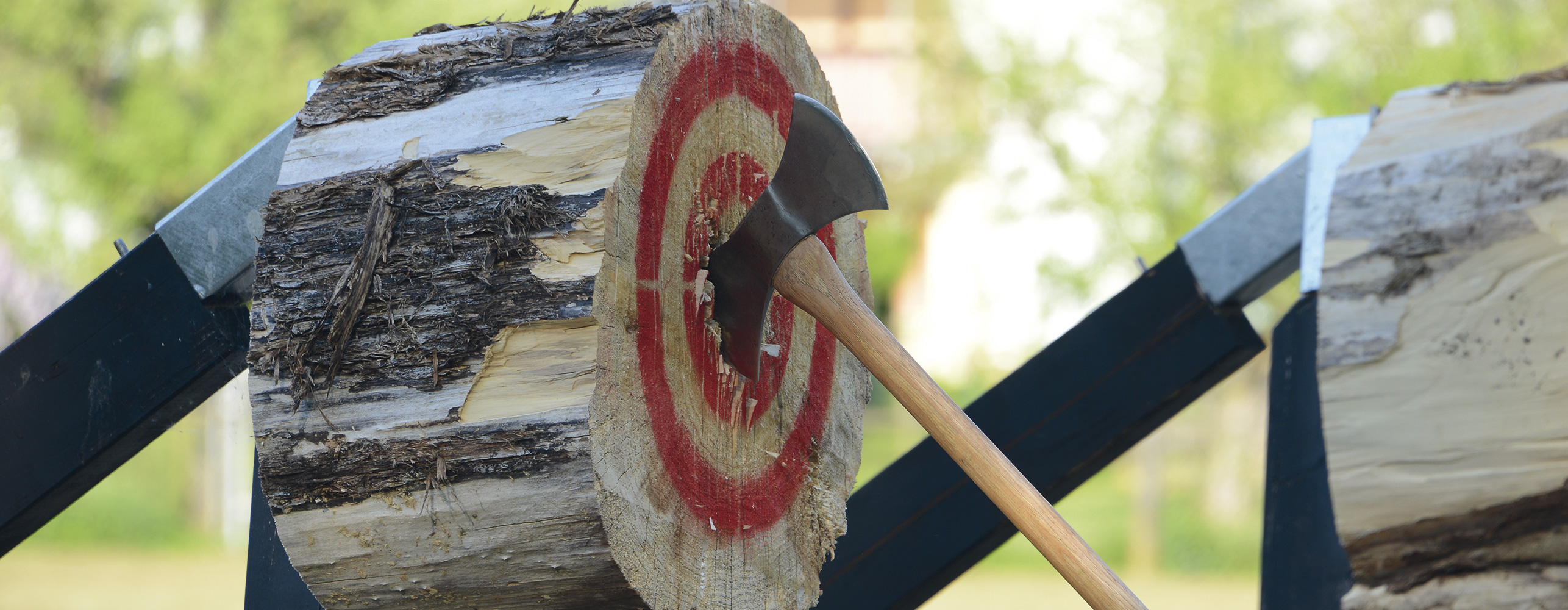
Axe throwing is very popular in Nordic countries (e.g. Scandinavia and Canada) and is also becoming increasingly popular here. Internationally, there are different disciplines and rules. Without claiming to be exhaustive, here are a few key points based on the rules of the "Swedish Axe Throwing Society":
- Double axes (double-edged felling axe) are used, with a handle length of at least 61 cm and a weight of at least 1.134 kg.
- The axe is thrown at a wooden disc with a diameter of at least 45 cm, which is divided into five rings of 5 cm each.
- The distance between the throwing line and the target is 6.1 m (20 feet), the centre of the target hangs at 1.5 m.
- Points are awarded for the ring in which the front edge of the throwing axe sticks (centre 5, outer ring 1 point).
- If the axe is also stuck in the disc with the rear edge, the point is invalid (0 points).
- The winner is the player who scores the highest number of points after three or more throws (usually 6 in tournaments).
Internationally, the Global Axe Throwing Commission (GAC) acts as an umbrella organisation. In English, for example, the Association of German Double Axe Throwers (VDDAW) regularly organises axe throwing competitions.
