The right clamp for every purpose
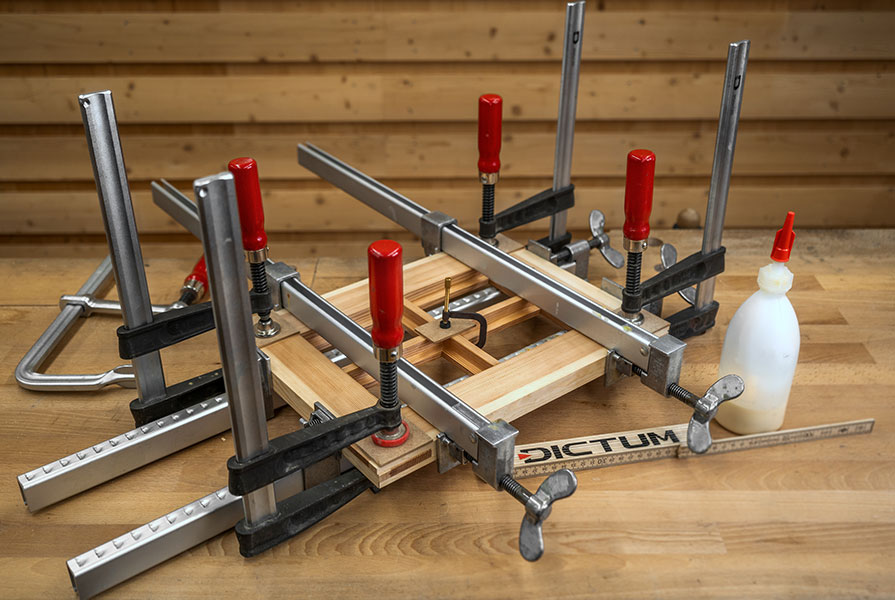
Clamping tools are just as much a part of the tool kit as saws, planes or chisels. However, they are often neglected. Yet they are the ones that make work much easier on complex projects. With the right clamp, you can complete any clamping task reliably and precisely.
Standard clamps for every workshop
Malleable cast iron screw clamps (e.g. no. 720413) are the standard in the woodworking shop. Their simple design makes them suitable for most clamping work. They are used to fasten workpieces to the workbench, hold individual parts in place during assembly and ensure sufficient contact pressure when gluing.
As a rule, malleable cast iron screw clamps consist of a fixed clamping bracket and a movable clamping bracket with a spindle. The latter can be moved along the rail to adjust the clamping width.
A speciality are screw clamps with two or more movable clamping brackets (e.g. no. 721011). They are also suitable for spreading (pressing apart) and, if several clamping brackets are pushed on, for gluing and assembling complex workpieces.
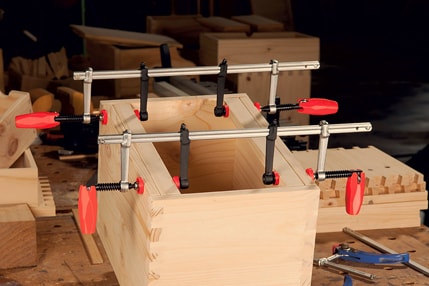
When working with wood and wood-based materials, malleable cast iron screw clamps usually provide sufficient grip. However, if hard and smooth materials are to be clamped, for example wood with metal or stone, standard screw clamps may slip. All-steel clamps (e.g. no. 705632) are better suited for flexible, elastic clamping. Thanks to their elastic fixed and sliding clamps, vibrations have a significantly lower influence on the clamping force, which increases clamping safety.
All-steel clamps with a ratchet system (e.g. no. 720460) are very helpful when clamping in confined spaces, for example in a furniture body. Even if there is little space available, sufficient clamping pressure can be built up using the ratchet lever.
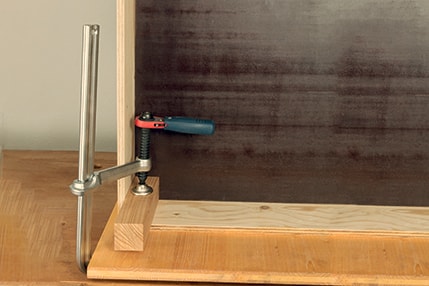
Clamps for vibration-proof clamping
Lever clamps (e.g. no. 705630) are a further development of the all-steel clamps. The rail and fixed clamping bracket are also forged from a single piece and the movable bracket is elastic to withstand vibrations. They are clamped using a ratchet lever instead of a spindle, which cannot open in the event of vibrations. Lever clamps are therefore ideal for clamping fixtures and stops on machine tables. Lever clamps for guide rails (e.g. no. 705643) can be inserted into T-slots using an adapted fixed clamping bracket. This ensures that the guide rail is held securely when cutting with the hand-held circular saw. Lever clamps for guide rails also fit into the T-slots of the DICTUM® multifunction table Pro and in numerous machine tables (e.g. on the PantoRouter and on band saws).
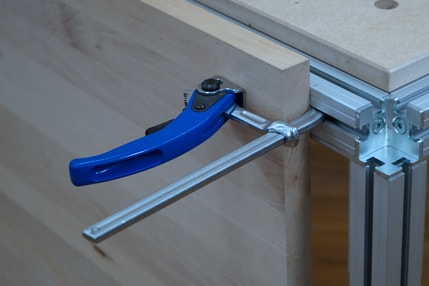
Clamps for assembly and soloists
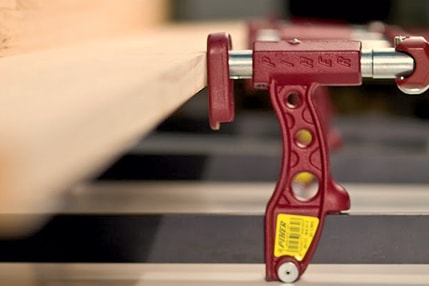
Every "solo craftsman" knows situations in which he might need one or even two helping hands when applying clamps. Even when assembling larger parts, it is sometimes impossible to operate the clamp with both hands. One-handed clamps (e.g. no. 721001), which can be closed and opened with one hand using a kind of pistol grip, can help here. Most one-handed clamps can be repositioned so that they are also suitable for spreading, for example when gently dismantling furniture.
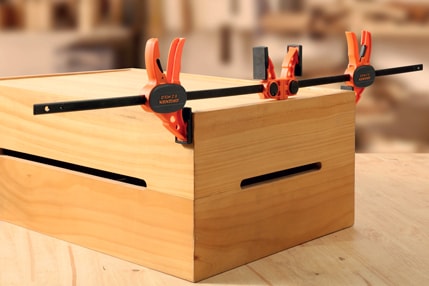
One-hand clamps (e.g. no. 729514) can also be applied and closed with one hand. The clamping width and clamping pressure are set in advance using a knurled screw. Additional protective caps (e.g. no. 729516) are used to protect against pressure marks on softwood.
Gluing clamps
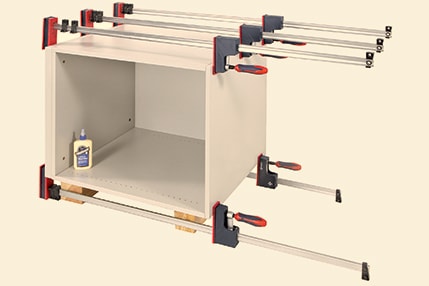
Carcase clamps (e.g. no. 720420) are clamps with precisely parallel guides. Their clamping brackets are covered with plastic protective caps and offer large clamping surfaces for gluing furniture carcasses and frames. The large contact surfaces of the plastic protective caps prevent pressure points as far as possible.
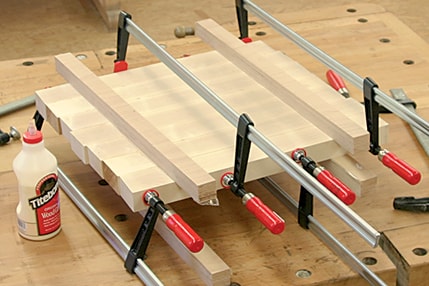
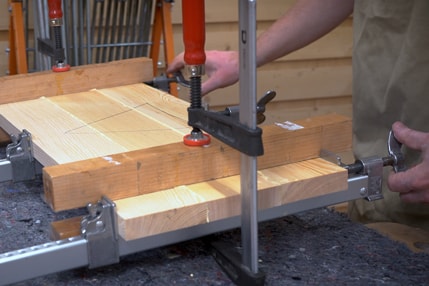
So-called joint clamps (e.g. no. 707690) are used for gluing board surfaces. The clamping width is first roughly determined using the movable clamping head. It usually snaps into a notched rail or is fixed in holes in the rail. During gluing, the clamping pressure is then built up via the spindle at the end of the rail.
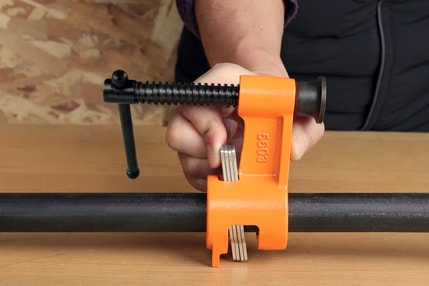
Clamping elements (e.g. no. 708932), which are mounted on normal water pipes, offer a cost-effective and flexible alternative to joint clamps. The span of the clamp is only limited by the length of the pipe. Particularly heavy-duty versions of joint clamps are the so-called door clamps (e.g. no. 705827). Their rails are very solid and torsion-resistant for gluing large and thick solid wood surfaces. Powerful trapezoidal threads and robust hand cranks generate the necessary pressure to be able to glue even larger door frames.
For powerful clamping
C-clamps (e.g. no. 705640) are used when particularly high clamping force is required, for example when bending wood or gluing mouldings. They are compact and simple in design, consisting of just a bracket and a spindle. This simple design allows high clamping forces of up to approx. 15,000 N.
Pump clamps (e.g. no. 720400) are also known for their high contact pressure of up to 9000 N. In the woodworking trade, they are therefore often used by carpenters when clamping beams. Another advantage of pump clamps is the protected spindle. A so-called pump (hence the name) encloses the trapezoidal thread and protects it from dirt or damage, for example during welding work.
For precise and gentle clamping
Repair clamps (e.g. no. 735719) are C-clamps in a small format. As the name suggests, their small and lightweight design makes them ideal for repair work and modelling. These small clamping tools are particularly appreciated by musical instrument makers. Wooden clamps with eccentric clamping levers became known under the brand name Klemmsia Zwinge (e.g. no. 705810). Due to their low weight and the soft cork pads on the pressure surfaces, they are suitable for very fine clamping tasks such as gluing profiled mouldings.
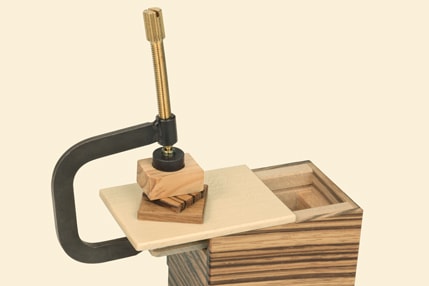
Tip: With an additional extra clamping arm (e.g. no. 708129), which is not pushed onto the rail and instead rotated by 90°, Klemmsia clamps can also be used as edge clamps.
Specialists
Edge clamps (e.g. no. 705758) are intended for gluing edge bands on narrow workpiece edges. They are placed over the edge and first clamped to the surface. The desired pressure is then applied to the edge using the side spindle.
The jaws of parallel clamps (e.g. no. 708928) can be set both parallel and at an angle. This means that they can also be used to optimally clamp non-parallel surfaces. The wooden jaws ensure even pressure distribution without twisting the workpieces (torsional forces).
The Japanese "Hatagane" clamp(no. 713201) is a very slim brass clamp with parallel jaws. It is useful for gluing light parts, as a "third hand" when scribing and when working on narrow workpieces.