
Delta sander, belt sander, random orbital sander and co. - which one for what?
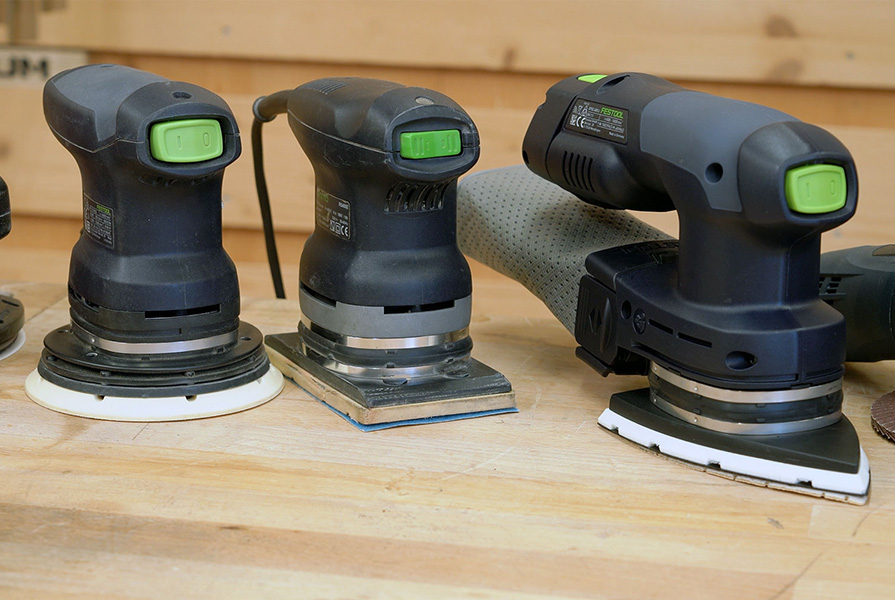
Hand sanders are available in many different designs and sizes. The design of almost all of them is the same, only the hand belt sander differs. In this blog, we take a look at the different hand sanders and show which machines are best suited for which sanding tasks. We will only be looking at sanders for wood and wooden surfaces or power tools that are used in the wood workshop. There are other sanding machines for stone and metalworking, but these play a minor role in the wood workshop.
General structure
The hand belt sander is the exception among hand sanders, as can be seen from the abrasive used. While all other sanders work with a flat abrasive (sanding discs, sanding pads), the hand belt sander uses a sanding belt that runs over two rollers and the pressure plate. It is moved by the drive roller, which is connected to the motor via a belt drive. The guide roller can be used to correct the position of the belt so that it runs as centrally as possible on the rollers and the pressure plate.
The hand belt sander differs significantly from other sanders.
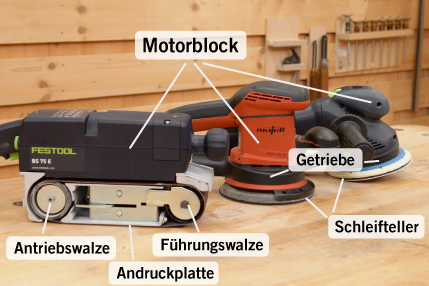
In most other hand sanders, a sanding disc or sanding pad is located under the motor block and is coupled to it directly or via a gearbox. Depending on how this sanding disc or pad is moved, this results in a different sanding movement and therefore a different sanding pattern and different material removal.
Hand belt sanders
Hand belt sanders (e.g. Festool belt sander BS 75 E-Plus) work with sanding belts that are moved in one direction (linear) by the drive drum. The sanding belt rests on the surface to be sanded in the area of the pressure plate. Compared to other hand-held sanders, the abrasive is moved quickly over a large distance.
This drive concept has several advantages: As the sanding belt has no end, you could say that the sanding movement is "infinite". In addition, the sanding movement is linear, in a single direction (not circular or oscillating). This is particularly practical when sanding solid wood, as wooden surfaces should always be sanded in the direction of the grain to avoid scratches. In addition, the sanding dust is picked up directly by the abrasive and transported away almost completely.
As a result, hand belt sanders work very effectively and remove a large amount of material. They are therefore ideal for working on large surfaces and removing a lot of material, e.g. old paint. Many hand belt sanders are supplied with a holder so that they can also be used as a compact stationary sander for smaller workpieces. However, the material removal is usually too coarse or too fast for finer sanding tasks, e.g. the final sanding of a furniture surface, which means that surfaces quickly become wavy and edges are sanded round.
Slide and orbital sanders
Orbital sanders with a rectangular sanding pad are generally referred to as chute sanders, whereby the eponymous "chute" comes from Festool (e.g. Festool RTS 400 REQ-Plus).
In orbital sanders (e.g. MAFELL UVA 115 E), the motor block is located above the sanding pad. This is set into circular oscillation by an eccentric gear. Compared to the belt sander, the sanding movement is quite short, which is why it is also referred to as a sanding stroke or oscillating circuit. Depending on the machine and design, standard orbital sanders have a sanding stroke of 2 to 5 mm.
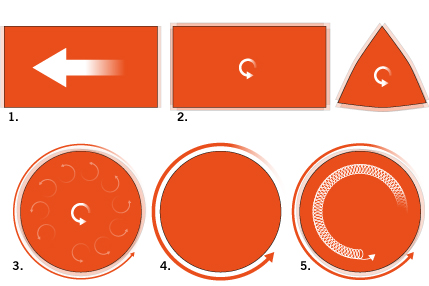
Overview of sanding movements:
1. belt sander, 2. orbital sander/delta sander, 3. random orbital sander, 4. angle grinder and 5. Rotex
Advantages of this drive concept: Material removal is significantly lower and more controllable than with belt sanders. Due to the rectangular sanding pad, orbital sanders are also suitable for sanding close to the edges of rebates and in corners. Depending on the size of the oscillating circuit, these sanders are recommended for different sanding tasks. Orbital sanders with a large stroke of 5 mm are ideal for efficiently sanding larger solid wood and veneered surfaces (furniture carcasses, doors, etc.), for example, or for sanding off layers of lacquer in a controlled manner. Orbital sanders with a 2 mm orbit, on the other hand, are suitable for fine sanding before surface treatment or intermediate sanding between two coats of paint. When renovating or sanding built-in parts such as door and window frames, small, lightweight machines are particularly practical, as they can be used vertically or overhead for long periods without difficulty.
Delta sander
Most delta sanders (e.g. Festool DTS 400 REQ-Plus) are designed like orbital sanders and perform the same sanding motion. The only difference is the shape of the sanding pad. The triangular shape makes it easier to reach inside corners, e.g. on frames or in drawers. There are only a few delta sanders where the sanding pad swings sideways (oscillates); these are rarely found in woodworking.
Random orbital sanders
Most random orbital sanders (e.g. MAFELL EVA 150 E / 3) also have a similar design to orbital sanders, but their round sanding disc is mounted on a rotating bearing. The circular oscillation of the drive also causes the sanding disc to rotate around its own axis.
The advantages of this drive concept: The additional rotational movement ensures more even material removal and a finer sanding result. The sanding movement is also greater overall, which ensures better removal of the sanding dust and less heat generation. Random orbital sanders also have oscillating circuits of different sizes, so that there are also machines for coarser and finer sanding work. Here too, small, lightweight devices (e.g. Festool ETS 125 REQ-Plus) are ideal for renovation work.
Disadvantages: The round sanding disc is unsuitable for sanding in corners. The rotation of the sanding disc is uncontrolled or is not controlled by a drive and can be inhibited by excessive pressure or resinous surfaces.
Tip: Never sand with pressure! The abrasive and the sanding machine do the work. Pressure only makes it more difficult and generates more heat, which is counterproductive, especially when sanding lacquers.
Angle grinder
The angle grinder should not go unmentioned. This machine is suitable for cutting materials as well as for sanding and polishing. With the right sanding attachment (sanding disc or flap disc), it can also be used to work on wood. The sanding movement of the angle grinder is circular.
Advantages of this drive concept: The rotary movement enables fast material removal. With suitable sanding attachments and abrasives, the angle grinder is suitable for a wide range of sanding tasks from very coarse (rasping) to very fine (polishing).
Disadvantages: The abrasive moves faster at the edge of the sanding disc or sanding plate than in its centre. Clearly visible sanding marks quickly appear when sanding wood. This can also lead to clumping/clogging in the centre of the sanding disc. Uniform, controllable material removal is therefore only possible if the speed of the angle grinder can be regulated.
However, the angle grinder is very versatile. It can be used for cutting, carving, sanding and polishing wood, stone and metal in equal measure, which is why no workshop should be without one.
Geared orbital sander
With the other hand sanders, we have learnt that an oscillating sanding motion produces a fine, even sanding pattern and that a rotary motion ensures rapid material removal. With a geared random orbital sander (e.g. Festool RO 125 FEQ-Plus ROTEX), these two movements are combined. In contrast to a normal random orbital sander, however, the rotation of the sanding disc is not random, but is controlled by a gearbox and can be switched on and off.
The advantages of this drive concept: The combination of eccentric and rotary movement results in up to three times greater removal than with conventional random orbital sanders. As the rotation (Festool refers to it as a cam track) can be switched on and off, geared random orbital sanders are very versatile and are equally suitable for coarse sanding (with rotation), fine sanding (without rotation) and polishing painted surfaces (with rotation).
The disadvantage of the round sanding disc (not suitable for internal corners) is compensated for on the Festool RO 90 DX FEQ-Plus ROTEX by the FastFix interface, with the option of replacing the sanding disc with a triangular disc. The ROTEX RO 90 can be converted to a delta sander in no time at all.


