Please heat a cold workshop!
In a cold workshop, not only does motivation suffer, but so does the material.
While professionals heat their workshop with a wood or pellet stove in the colder months, many hobby craftsmen do not heat their garage or cellar. This can have fatal consequences!
Tempering workpieces
Wood reacts relatively strongly to fluctuations in humidity and temperature by changing its dimensions. It expands in damp, cold rooms and contracts in warm, dry rooms. The workshop should therefore have conditions as similar as possible to the rooms in which the furniture will later be used. This is even more important for built-in parts than for free-standing pieces of furniture. If you store your wood in a different room, you should bring it into your workshop at least one day before processing so that it can acclimatise. If you join timbers with different temperatures and moisture content, the parts may dry to different degrees afterwards, resulting in cracks and warping.
Glue suffers
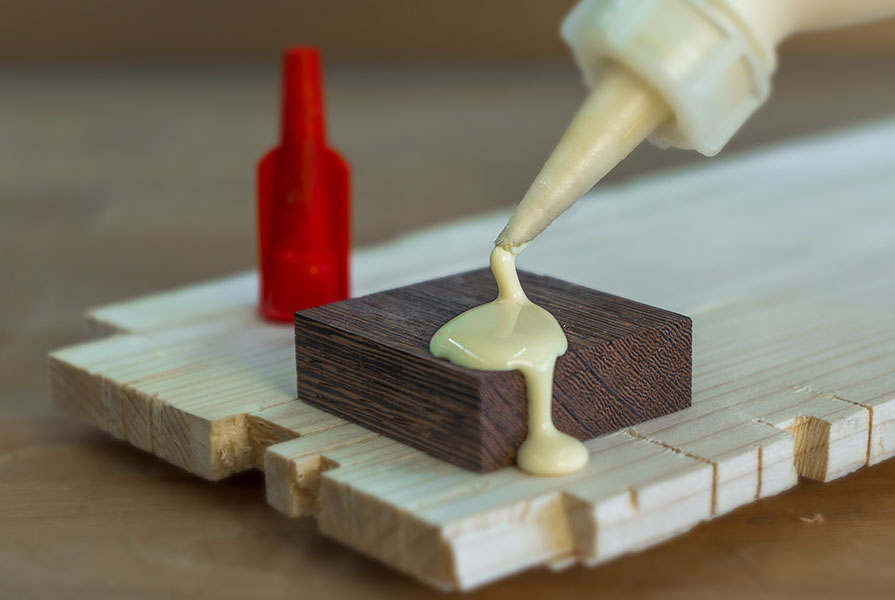
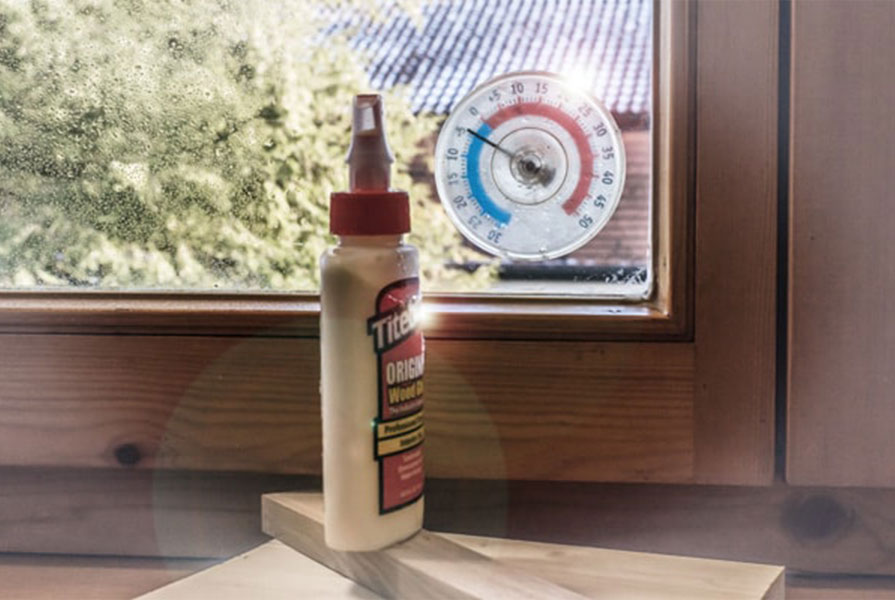
The most commonly used glues are PVAc dispersion glues. In a dispersion, substances are not dissolved in a liquid but are very finely dispersed. In most white glues, the PVAc synthetic resin is dispersed in water. Water and synthetic resin react differently to low temperatures. While the water contracts and freezes, the even distribution of the PVAc particles is lost and the PVAc forms larger polymer lumps. The process is not reversible, i.e. the lumps do not dissolve again when temperatures rise. Consequence: The glue loses its adhesive strength. Glues that have been stored below 5 °C are generally unusable. Always observe the processing temperature information on the glue containers.
Glue loses its adhesive strength.
Power loss with rechargeable batteries
Older machine batteries in particular suffer from low temperatures. In modern lithium-ion batteries, the ions move back and forth in an electrolyte liquid between the cathode and anode. When temperatures drop, this electrolyte fluid becomes increasingly viscous. The ions can only move slowly in it. The result is a drop in the battery's voltage and even a sudden deep discharge - the battery can be permanently damaged.

Cold temperatures lead to a loss of battery performance.