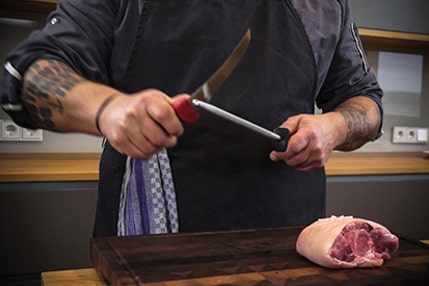
Sharpening - the basics
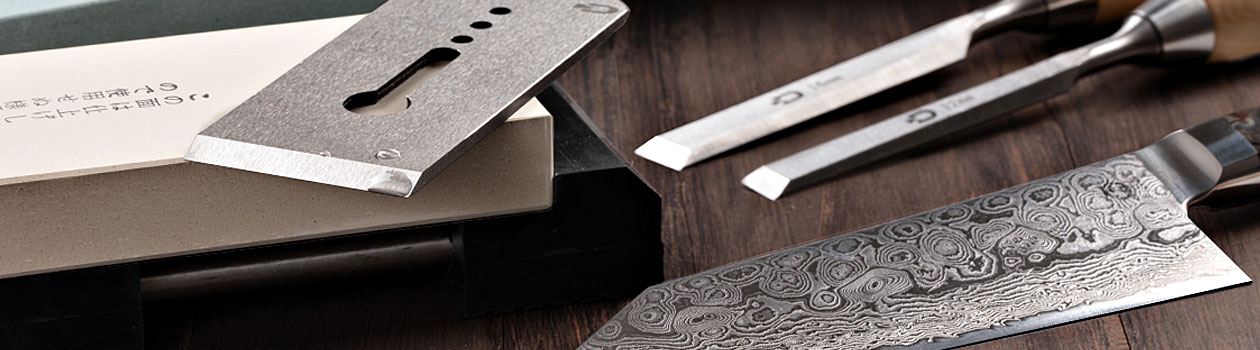
How to turn a blunt edge into a sharp one is a question on which opinions often differ widely, even among experts. We prefer the technique that has proven itself over centuries for the sharpest of all blades, the samurai sword:
Sharpening with water stones
This method, equally suitable for knives and tools, is presented here together with many tips and tricks from our sharpening experts.
- What is sharpness?
- Angle table
- Sharpening stones
-
Why do some stones from different manufacturers, sharpening stone series and even within individual sharpening stone series feel as if they have better sharpening performance than others?
- Which criteria should I use when choosing the right sharpening stone?
What is sharpness?
Technically speaking, we understand sharpness as the intersection of two surfaces: the bevel face, or bevel, and the back face of a blade. Together, they define the edge angle. Their line of intersection forms the cutting edge, also known simply as the edge. Sharpening is therefore about removing material precisely from the bevel face, or faces, in order to restore a perfect intersection
- the fineness of the sharpening stone grit (the finer the grit, the sharper the edge)
- the fineness and hardness of the blade steel (the finer and harder the structure, the sharper the edge)
- the geometry of the edge (the smaller the edge angle, the lower the cutting resistance)
- the skill of the person sharpening
Angle table
The angles listed in the following table can be used as guide values. In special cases, the edge angles may differ from the values given.
| O | Scrapers / cabinet scrapers | up to 75° |
|
O | Scissors | 55°–60° |
|
O | Chisels / plane blades | 23°–35° |
|
O | Splitting / felling axes | 25°–30° |
|
O | Forestry axes | 20°–25° |
|
O | Knives / carving tools | 15°–25° |


Sharpening stones
Sharpening by hand on bench stones has the advantage that:
- the hardness of the steel is not affected, as no heat is generated and the temper is not drawn
- an exact edge geometry can be produced, with no rounding as can occur on felt or rubber wheels
- sharpening itself is safe, with no flying sparks
- extremely fine grits are available
- the basic equipment required does not involve a high financial outlay
Water stones
Here, water acts as the rinsing medium. It prevents the pores of the stone from becoming clogged by abrasion residue, which would reduce its sharpening action. If the stone is rinsed with water less frequently, the abrasion residue forms a pasty slurry that reduces the cutting action. Experienced sharpeners use this deliberately to obtain a finer sharpening effect and to compensate for larger grit jumps between sharpening stones.
The stones must be soaked in water for 10–15 minutes before use. Ceramic stones, for example from Shapton, absorb very little water. A short soak of around one minute is sufficient here
Synthetic abrasives
1) Silicon carbide is characterised by particularly sharp-edged crystals, but is also very brittle. It is mainly used for coarse grits and, due to its shape, offers very good material removal.
Green silicon carbide is the toughest and purest form of silicon carbide.
2) Aluminium oxide is the second-hardest mineral after diamond and, thanks to its blocky grain shape, is exceptionally well suited as an abrasive. Its sharpening behaviour is significantly finer than that of silicon carbide.
White aluminium oxide is one of the purest abrasives.


Diamond-coated sharpening blocks
As an alternative to Japanese water stones, diamond-coated sharpening media can also be used. The diamond particles are applied to extremely flat, warp-free and unbreakable backing plates. This has the advantage that diamond stones are highly wear-resistant and remain permanently flat. No more hollowing, no more flattening.
The high-quality monocrystalline diamond particles ensure rapid material removal even on the hardest tool steels, such as HSS, carbide and PM steels. We recommend moistening the diamond stones with water and sharpening with light pressure.
Oil stones
Some stones form a smooth lubricating film in combination with oil, allowing the stone to cut properly. Porous stones are usually pre-soaked with oil and only require a few drops of honing oil on the stone surface for sharpening. Stones with closed pores absorb very little oil; here too, a few drops of honing oil on the surface are sufficient. Since oil does not rinse the stone in the same way as water, the stone clogs more quickly. It can be cleaned with
paraffin oil.
Why do some stones from different manufacturers, sharpening stone series and even within individual sharpening stone series feel as if they have better sharpening performance than others?
Shapton explains this complex interaction of five components in the diagram shown alongside.
The two diagrams show the difference between a 4000-grit stone with a harder bond and a 4000-grit stone with a softer bond. For reference, we have also included the diagram of a 220-grit stone with a hard bond. All components influence one another.

- Sharpening feel
- Bond hardness
- Sensitivity
- Hardness of the abrasive material
- Grit purity
Which criteria should I use when choosing the right sharpening stone?
Sharpening stones are always designed for specific types of steel and often also for specific applications, such as straight razors. This does not mean that a sharpening stone developed for low-alloy steels, for example, cannot be used for HSS. However, anyone looking for optimum performance should follow these recommendations.
Especially when steel types differ greatly, even a beginner will immediately notice the difference in sharpening feel — the blade seems to stick to the stone, the stone loads almost instantly, and so on.
Simply bring your tool to one of our shops or workshops and test our different stone series before buying.
To ensure that the manufacturer’s specifications are not merely marketing claims, but genuinely affect both sharpening feel and sharpening results, we check them by means of microscope images before adding a new sharpening stone series to our range.
Please contact us if you have any questions. We will be happy to advise you.