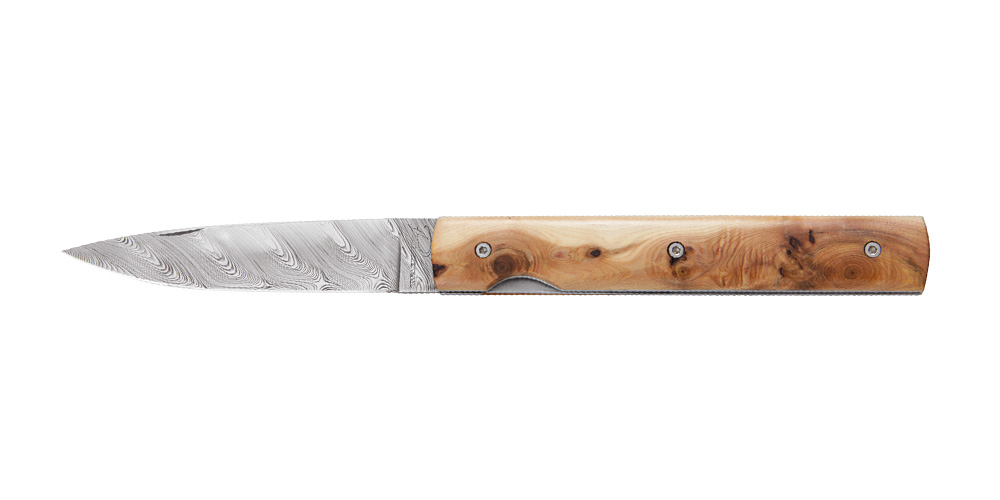
Damascus knives


Damascus knives
EXPERT KNOWLEDGE - DAMASK KNIVES
Laterally bevelled iron with a constant narrow edge towards the handle, reduces friction when chiselling and enables precise re-piercing of wooden joints such as tines without damaging edges.
Japanese blacksmithing and Blade structure
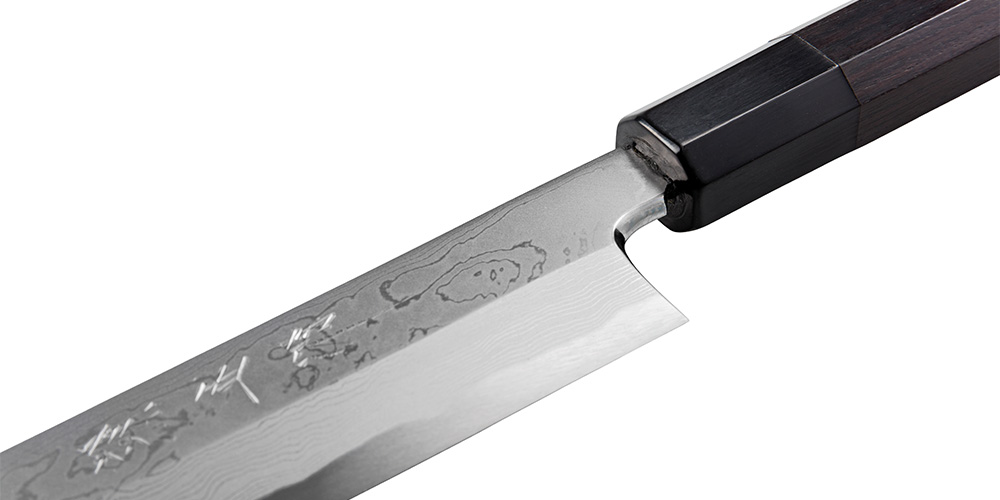
The Japanese art of blacksmithing is known and appreciated worldwide, especially for the production of samurai swords (katana) and high-quality Kitchen knives.
The blades of Japanese knives (Hocho) are traditionally forged in several layers, whereby hard carbon steel is fire-welded with tough iron. Only this elaborate process guarantees an optimum synthesis of Bond strength and maximum sharpness.
Japanese blacksmiths have taken the production of Damascus steel to a new level by combining traditional techniques with modern expertise. Japanese knives are a testament to the exceptional craftsmanship and precision that goes into every knife.
What is Damascus steel?
Damascus steel is produced by repeatedly folding and welding different types of steel. Traditionally, Hardness, high-carbon steels are combined with softer, low-carbon steels. The result is a material that combines the positive properties of both steels: the Hardness and sharpness of one and the toughness of the other.
Damascus steel is a manufacturing technique in which two or more types of steel are forged together. This technique results in the typical wavy or water-like patterns on the surface of the Steel. Originally, this method was used to produce a material that was particularly sharp and break-resistant.
Blade structure can be produced in various ways, for example by
- Pattern welding: This involves forging different layers of steel together and then creating the patterns by folding and twisting.
- Wootz-Damascus (historical method): A special raw steel with a high carbon content is crystallised by slow cooling and forms the typical patterns.
The advantages of Japanese kitchen knives made from damask
A Japanese chef's knives offers numerous advantages that make it an indispensable tool for any chef who values quality and craftsmanship.
- Superior sharpness and precision
Japanese Damascus knives are known for their exceptional sharpness. This sharpness makes it possible to perform even the finest cuts with great precision, which is particularly beneficial when preparing sushi, sashimi or other delicate dishes. - Unique aesthetics
The pattern on the blade of a Japanese Damascus knife is not only a sign of quality craftsmanship, but also an aesthetic feature. Each knife has a unique pattern that is created by the forging process and gives the knife a special look. This aesthetic quality makes Damascus knives not only a functional tool, but also a collector's item and a highlight in any kitchen. - Durability and resilience
Thanks to the high-quality materials and precise production, Japanese damask knives are extremely durable. With the right care, such a knife can retain its sharpness and functionality for generations.
For Japanese kitchen knives made from damask
The production of Japanese Damascus knives is a complex and time-consuming process that requires great craftsmanship. Japanese blacksmiths pay particular attention to the choice of materials and the precision of the forging process to create knives that are both functional and aesthetic.
- Forging and folding
As with other Damascus kitchen knives, Japanese Damascus knives are forged by welding and folding several layers of different steels together to create the so-called Damascus steel. This process is often repeated up to 16 times to create the desired number of layers and the characteristic pattern. Each folding process requires great skill to achieve the right balance between Hardness and flexibility. - Hardness and grinding
After forging, the blade is Hardness. In the Japanese tradition, the blade is often quenched in water or oil to increase Hardness. The blade is then sharpened in several steps to produce an extremely sharp edge. - Handle assembly and finishing
The handle of a Japanese knives is also a work of art in itself. Traditionally, handles are made from materials such as magnolia wood or walnut and are often reinforced with a ring of buffalo horn or plastic. The handle is designed to fit comfortably in the hand and provide optimum balance to the blade. Fitting the handle is a crucial step to ensure that the knife not only looks good, but also works well.
Why invest in a Japanese kitchen knives made from damascus?
A Japanese damask knife is more than just a tool - it is an expression of art, culture and craftsmanship. Investing in such a knife is worthwhile for both professional chefs and amateur cooks who value the highest quality.
- The perfect tool for precise work
The sharpness and precision of a Japanese damask knife make it the ideal tool for preparing dishes that require the utmost accuracy. Whether for the fine work on sushi or the precise filleting of fish - a Japanese damask knife is unbeatable in the kitchen. - An aesthetic highlight and a piece of Japanese tradition
In addition to its functionality, a Japanese damask knife is also a visual highlight in any kitchen. The traditional patterns and meticulous workmanship make it a collector's item that epitomises the centuries-old Japanese art of forging. - Sustainability and durability
Thanks to the use of high-quality materials and precise craftsmanship, Japanese damask knives are extremely durable. They are an investment that will pay off for years to come, as they can last a lifetime with the right care.
For Japanese kitchen knives Damascus: A masterpiece of the art of cutting with Japanese tradition
Quality in the kitchen starts with cutting! Kitchen knives are an indispensable tool in every kitchen, and for many amateur and professional chefs alike, a high-quality kitchen knife is one of the most important utensils. Among the various types of chef's knives available on the market, the Damascus knife stands out in particular. It not only combines functionality and sharpness, but is also an aesthetic work of art.
Especially in Japan, the art of forging Damascus kitchen knives has developed into a true art form.
European knives made from damascus
Apart from Santoku and the like, Damascus knives are not unknown in Europe either. In recent times, Rustproof Blade structure knives in particular have become increasingly important. While knives in the kitchen are easy to care for and protect against corrosion, this is not always the case outdoors. This is why many manufacturers of outdoor knives rely on Rustproof Damascus from Damasteel. The powder metallurgically produced Steel has excellent properties. It is made from two different hardenable steels (RWL34 and PMC27).
The steel has a long service life thanks to additional alloy components (carbide formations), is highly pure and therefore has a uniform microstructure and good sharpenability. It also has a high degree of toughness, which makes it resistant to breaking, bending and impact stress. This results in knives made from Blade structure with exceptional properties.