
Rip solid wood lengthwise by hand
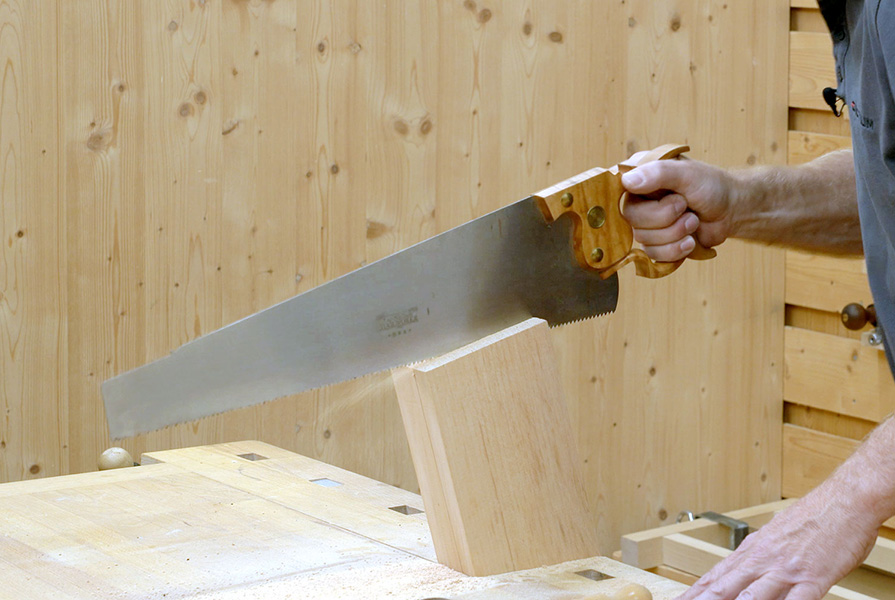
If you want to produce complete projects using only hand tools, one of the first steps is ripping lengthwise. This includes trimming cuts as well as flat ripping to saw thin boards from thick boards or even ripping a log into small boards.
No matter what type of ripping cuts you want to make, you will always need a saw with longitudinal serration. For some applications, such as trimming, you may be able to use a saw with universal teeth. However, the toothing should always be quite coarse and the saw blade as long as possible. Here's a tip to start with: Always utilise the entire length of the saw! This way, more material is cut through in one stroke, which contributes to significantly faster work progress.
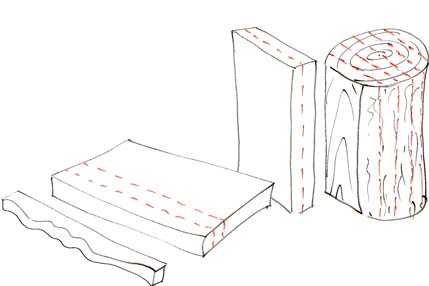
Two types of ripping cuts: Trimming cuts and flat ripping cuts
Saw guidance through cuts
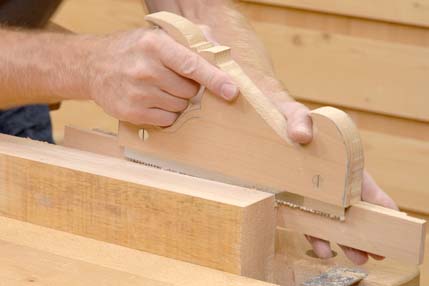
An important technique is to create a guide for the saw by making incisions. A so-called "kerfing plane" can be used so that the actual cut runs less. If a circular saw is available, the cuts can also be made with it.
The "Kerfing Plane" is used to score the wood all round.
The right sawing technique for rip cuts
Regardless of whether you want to use Japanese or Western saws, the sawing techniques required are very similar. Always saw downwards only on the side where you can see the crack clearly. The result will be much better if you always saw the workpiece diagonally and turn it over frequently. This improves the guidance and the saw runs less.
Trimming cuts
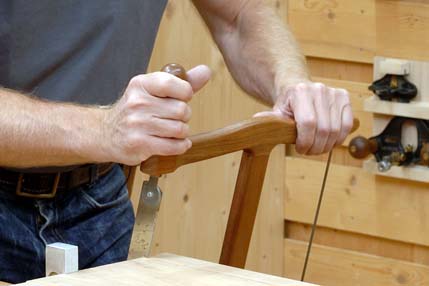
The following method is suitable for cutting off the tree edge and if you want to cut several narrow pieces lengthwise, e.g. for chair or table legs. Traditionally, a frame saw is used for edging cuts. In contrast to normal saw cuts (cross-cuts, short format cuts, curved cuts), the saw blade is turned at right angles to the frame when trimming and the saw is guided up and down in front of the body. This type of sawing is also known as "fusing". The saw is not gripped with one hand on the arm, but with both hands on the handle, which is used to turn the saw blade, and with the other hand on the spreader or on the other end of the arm and the clamping device.
It is important that you clamp the workpiece firmly in the workbench. To prevent it from tipping over, the bench hooks are pushed over the workpiece with their thickening so that they hold the workpiece down without tilting. The movement is not just up and down, but slightly oscillating, so that the saw blade moves in a similar way to jigsaws with the pendulum action switched on - slightly tilted forwards during the downward movement (working stroke) and almost vertically during the upward movement (relief stroke).
Classic sawing position when fausting
If a foxtail is used for trimming, place the material on a saw bench or sawhorse. These are significantly lower than a planing bench so that you can work with full physical strength. Right-handers fix the workpiece with their body weight using their right knee. Sawing is carried out in a pendulum motion as described above. A flat sawing position first creates a guide, then the saw is set at a steeper angle and sawn through. These two types of sawing are alternated again and again.
Trimming with the fox tail on a saw bench
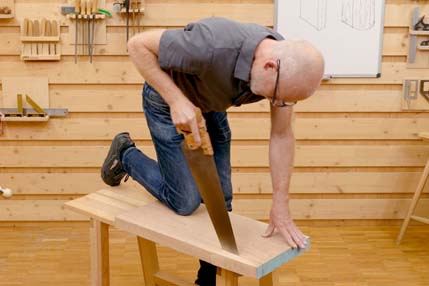
Japanese saws are used to make edging cuts while standing. The workpiece rests on one or more low work trestles and is pressed down with one foot. As when sawing with a fox tail, the angle of the saw is constantly changed.
Flat rip cuts
This technique is used to obtain two or more thin boards from one thick board, to produce sawn veneer or to cut a small tree trunk into boards.
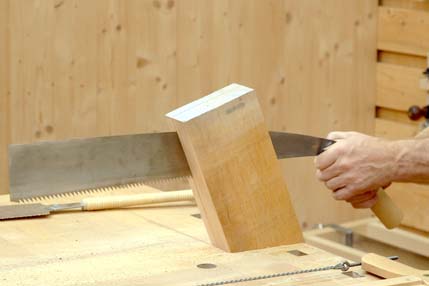
As the cross-section to be sawn is significantly larger, it is advisable to saw at least the long sides with a "Kerfing Plane" or on the circular saw so that the handsaw has better guidance (this is not possible when ripping a small log as there are no trimmed edges). Even if you have made cuts for guidance in advance, always saw diagonally deeper on the side facing you. Turn the workpiece over and continue sawing deeper on the side that is clearly visible. This gives you better control over the cut and allows you to recognise and correct small errors immediately.
Regardless of which saw you use, clamp the workpiece on edge if possible so that gravity pushes the saw down under its own weight. Most frame saws have the disadvantage that a lateral tilting moment occurs if the frame has to be opened wide in order to have sufficient space between the saw blade and the spreader. In addition, the frame or saw blade often has to be moved from one side to the other if the thicker part does not fit through the opening between the spreader and saw blade when ripping a log. A frame saw with an extended handle provides a remedy against tilting to the side, creating a grip for both hands to the left and right of the saw blade. Alternatively, you can use a frame saw of the "Roubo" type if its clearance next to the saw blade is large enough. You do not have the problem of clearance and tilting torque with a fox tail or Japansaw. You can use them to cut through workpieces of any width. These saws are also available in the appropriate size and with suitable longitudinal cutting teeth.
Even with deep rip cuts, the saw cuts diagonally first
You have now learnt about some of the options for ripping lengthways. No matter which method you choose, it will definitely take a lot of muscle power and sweat, but nothing fills you with more pride than holding a completely handmade workpiece in your hand.


