Which plane for what?
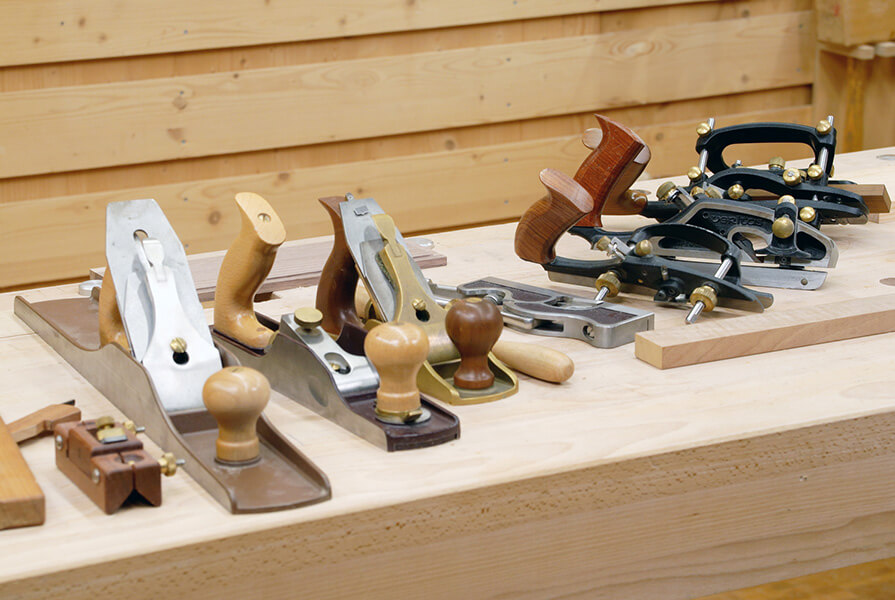
There are countless types of hand planes: finishing and plastering planes, rough bench and roughing planes, moulding planes, rabbeting planes and many more. There are also different designs with a planer box made of wood or metal, bevelled top or bottom. There is no clear answer to the difficult question of which planes belong in the basic equipment. You should first answer the question of what work you want to do with the planes. We will help you with this by first clarifying which planer is used for what. To do this, we categorise the tools into three application groups:
- Finishing surfaces
- Dimensioning wood
- Making wood joints
Which planer is suitable for surface finishing?
Planes for surface finishing are used for fine tasks, e.g. to remove the plane marks from wood that has been planed on the machine or to clean the joints on an almost finished workpiece.
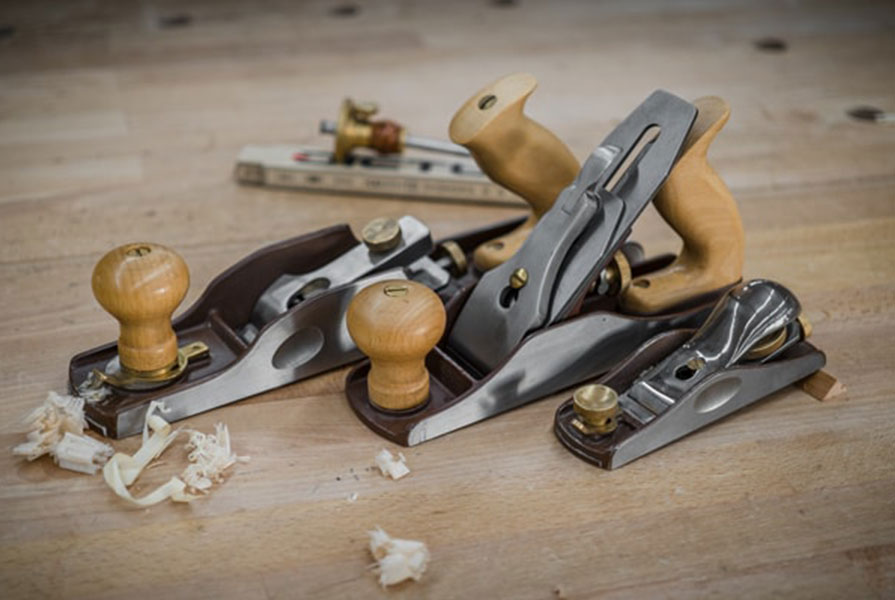
To smooth or plaster wooden surfaces, you need a plane with a comparatively short sole so that it can follow slight unevenness in the surface. A classic is the Stanley No. 4 planer (e.g. DICTUM No. 4). With a very narrowly adjusted planer mouth and well-sharpened plane iron, you can plane machine-planed surfaces to a mirror-smooth finish. If edges are to be broken and joints such as mortises or mortises and tenons are to be plastered, a small block plane is ideal. For planes with a metal body, this would be plane no. 60 ½ (e.g. DICTUM one-hand plane, flat angle 12°). The bed angle of this plane is 12°. Its planer mouth can be easily adjusted and adapted to the situation. It is therefore ideal for removing thin chips and smoothing end grain.
Fig.: If you mainly work with machines, you can usually manage well with just two planes

To summarise: Short planes such as plane no. 4 and block planes are used for finishing and cleaning wooden surfaces. With a well-sharpened plane iron and a narrowly adjusted plane mouth, they remove the finest shavings.
Which planer do I need for sizing wood?
Dimensioning" refers to the cutting and planing of workpieces to the desired dimensions, i.e. length, width and thickness. If you want to prepare and dimension rough sawn timber by hand, the workpiece must first be levelled. A planer that can remove a lot of material in one go is used for this. Traditionally, a roughing plane is used for this (e.g. Ulmia roughing plane). It is used to plane across or at an angle to the grain. Instead, a No. 62 plane or a long No. 5 finishing plane is often recommended as a metal plane. For both planes, an additional plane iron is ground to a strongly rounded shape. Some manufacturers also offer special chisels for the No. 62 for this purpose. Large quantities of wood can be quickly removed across the grain with a very wide planer mouth setting and a thicker chip removal. Adjusting the planer mouth is much quicker and easier with the No. 62 than with the No. 5, but the iron must be rounded more with the No. 62 due to the flat bedding angle. (You can see how rounding the plane iron works in our video "Rounding the plane iron" (external link))
After roughing, the surface is smoothed and an edge is joined by inserting another straight iron into the plane (no. 62 or no. 5) and planing along the grain. In the case of the wood planes, the so-called roughing bench would be suitable for this, a heavy wood plane with a long sole. If a lot of material has to be planed off to achieve the desired thickness, it is first roughed out again with a hand plane. To plane to the final size, switch to a finishing plane, as it leaves a finer surface.
Fig.: If you love manual labour, you will need several planes for sizing wood

Last but not least, all parts must also be cut to length when dimensioning. To do this, they are roughly sawn off and cut to the exact length in a planer. The planer is guided with the planer body lying on its side. The No. 62 also performs well here. There is therefore an additional handle for the 62, the so-called hotdog, which can be placed on the box of the plane. As end grain is almost always planed, we recommend using an additional plane iron ground to 25°. The 62 has a bedding angle of 12°, resulting in a cutting angle of 37°. The roughing bench can also be used lying on its side in a planer box.
To summarise: different hand planes are required to plane wood to thickness, width and length. A No. 62 with differently ground irons can be used in a variety of ways. Classically, a lot of material is first roughly planed off with the roughing bench and then the surfaces are smoothed with the finishing plane. A planing plane is also used for trimming.
Can I make wood joints with a planer?
Hand planes are also used to make wooden joints. These are usually specialised planes and only made for a specific purpose. They are not part of the basic equipment and are usually only purchased when a specific application arises. The simplest joints you can make with a planer are rebates and grooves. You will therefore need a planer for this relatively soon if you want to get to grips with the subject of wood joints. A rabbet plane (e.g. Veritas rabbet plane) can be set to the desired rabbet size using stops. The position of the groove and its depth can also be adjusted with stops on the rabbet plane (e.g. Veritas rabbet plane). Several irons of different widths are used to change the width of the groove. A moulding plane is often used to finish rebates and similar shapes, for example to finish the tenon and the tenon shoulder. These are available in different widths and sizes. Our recommendation: choose the larger model, as you can also process narrow rebates with a wide moulding plane; the reverse is not possible.
Fig.: There are a variety of special planes for wood joints

If you want to produce burr joints, you will need a burr plane and a base plane (e.g. Veritas large base plane). While you can only plane ridges with a ridge plane, a base plane is also suitable for producing other wood joints, such as overlapping, and for reworking mortise-and-tenon joints.
To summarise: a rabbet plane or a moulding plane is often used for simple wood joints. A basic plane can also be used for wood joints or for reworking. Specialised planes such as a ridge plane or a tongue and groove plane for bungs are not part of the basic equipment. Many other planes are less common, as they have very limited areas of application. There are countless moulding planes for making certain profiles, scraper planes for plastering inlays and marquetry and many other special planes for individual trades, such as for cabinetmakers or coopers. In most cases, however, they are out of place in basic planing equipment.
Summary
If you mainly work with machines and power tools, but occasionally want to plane joints and offsets flush and possibly plaster the surfaces, you can get by with a No. 4 planer and a block plane. If you want to size wood by hand, you will also need a roughing plane (no. 62 with a round-ground replacement iron), a finishing plane (also no. 62, but with a straight plane iron) or a roughing bench. For all other "special tasks", special planes are used, which are usually only purchased when the need arises.
Our recommendation for beginners: Anyone who initially only wants a single planer should consider a block plane with a 12° bed angle (e.g. DICTUM one-hand plane, flat angle 12°). This small, compact planer with an adjustable planer mouth is suitable for a wide variety of tasks such as plastering timber joints, chamfering edges and making adjustments during assembly. It is also included in all three application groups and should therefore definitely be part of the basic planer equipment.
Frequently asked questions about "Which plane for what?"
What is the difference between a finishing plane and a plastering plane?
Both planes are similar in design and usually have a chip breaker. However, at 50° to 60°, a smoothing plane has a steeper cutting angle than a finishing plane at 40° to 45° and is therefore better suited to cleaning difficult woods with varying grain patterns. Find out more about "Cutting and bevelling angles for planes" in our video.
What is a double plane?
A double plane is a classic wood plane and is very similar in size and design to the finishing plane. It has a cutting angle of 45° and has a so-called "double plane iron", i.e. an iron with a flap or chip breaker. As most finishing and plastering planes are now also equipped with chip breakers, it is becoming increasingly rare.