
Tools for pruning trees
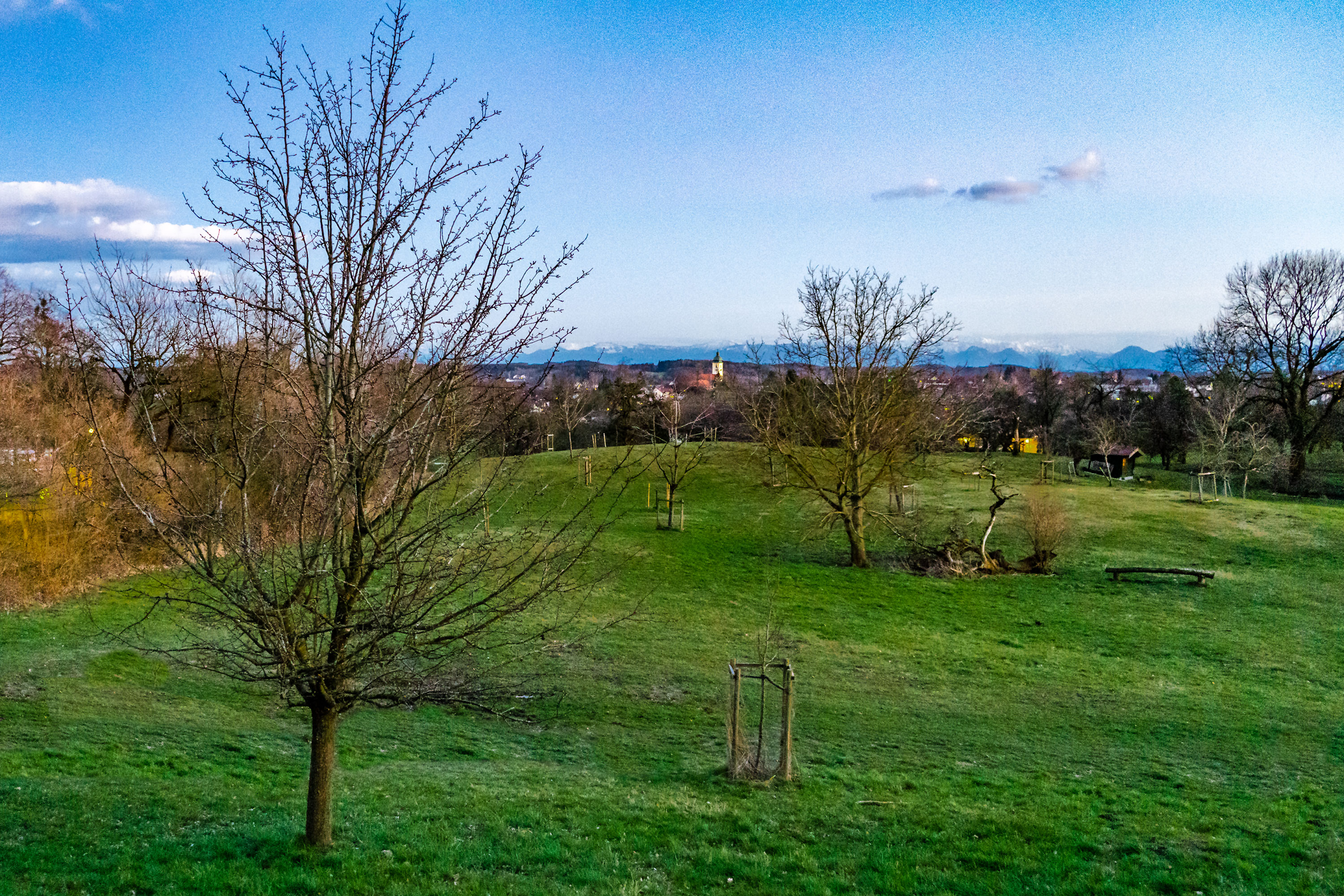
Pruning fruit trees is necessary to maintain their vitality. Optimal pruning is only possible with very sharp tools!
Fruit trees are cultivated plants. Pruning is necessary to maintain their vitality in the long term. Pruning can be carried out all year round. As the leaves are missing during winter pruning, the structure of the tree is easier to recognise. In order to optimise the yield of stone fruit, some experts recommend pruning when the fruit is fully ripe or at harvest.
Tips for pruning fruit trees
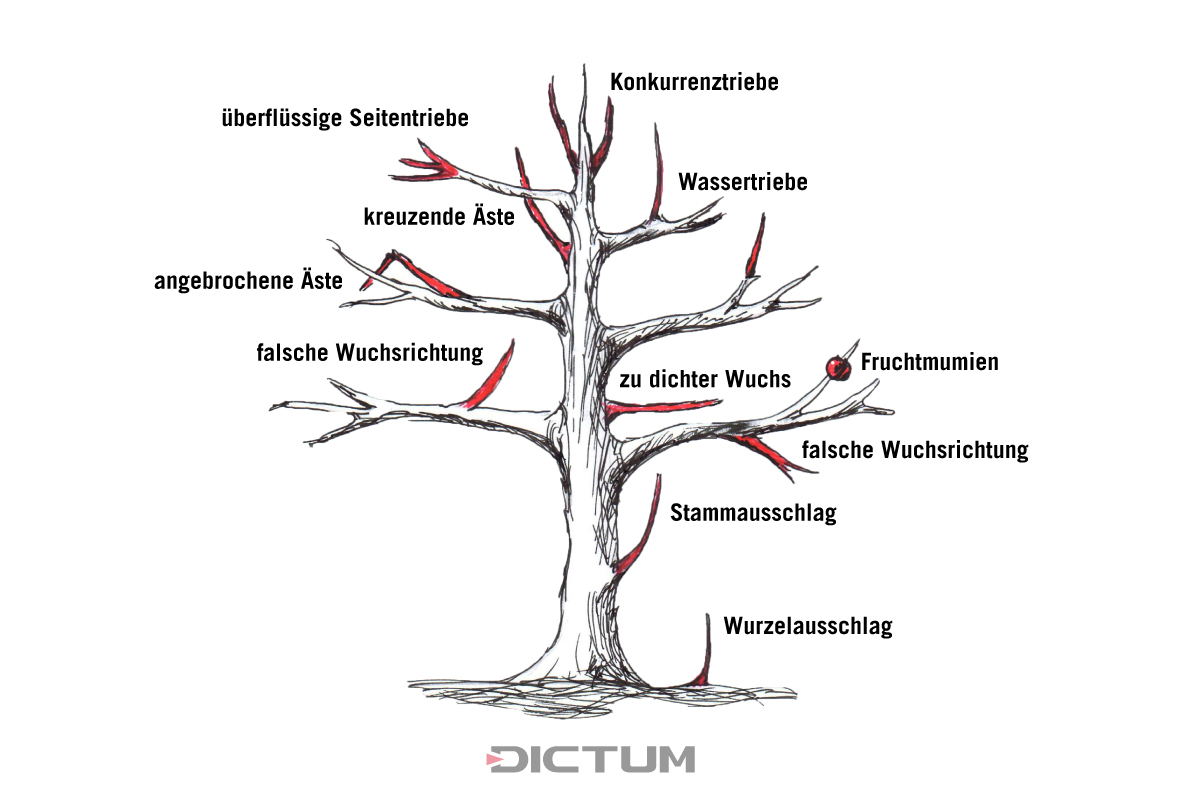
When pruning fruit trees, the aim is to bring sufficient light and air into the crown. All branches that do not fit into the growth pattern are removed, including fruiting shoots that grow from the outside inwards. The tree needs a balanced ratio of fruiting shoots (with flowers) and leaf shoots (without flowers). So-called water shoots develop at the highest points of the branches. Of these, only a few future shoots remain, which will later help shape the tree crown. Fruit shoots that grow horizontally upwards and show good growth should be encouraged. All other water shoots are cut off as close to the branch as possible with pruning shears. Shoots that grow upwards at an angle of more than 45° generally do not bear fruit.
These branches and shoots must be removed
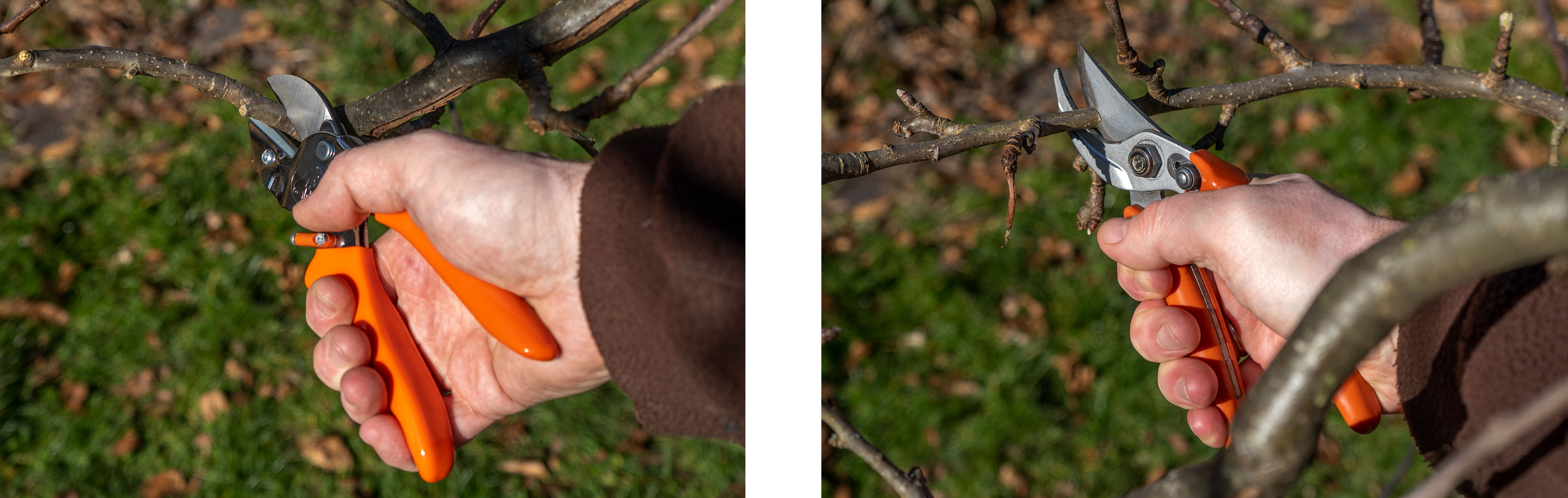
Shears and saws have proven equally effective for pruning. The important thing with both is that they leave a clean, smooth cut surface that the tree can quickly close and overgrow. Optimal pruning is only possible with very sharp tools!
Shear types
With pruning shears, you have the choice between bypass and anvil shears. Bypass shears are shears in which two cutting blades slide past each other. With anvil pruning shears, the cutting blade meets a rigid counterpart, the so-called anvil. Both variants can have a curved or straight blade shape. The advantage of a curved blade is that the slightly pulling cut requires less cutting force.
| Bypass shears | Anvil shears | |
| Advantages: | Precise, smooth cut | Good power transmission |
| Suitable for: | Trimming green wood | Pruning dead wood |
| Disadvantages: | Greater effort required Limited cutting thickness | Cuttings are crushed Bark injuries possible |
Thinning shears with a straight, slim blade shape are a special type of bypass shears. As these only allow small cutting diameters, they are not suitable for pruning. Small anvil pruning shears usually have straight blades, as the anvil can be made more solid in this design. Larger two-hand pruning shears, on the other hand, often have a curved blade shape with a matching moulded anvil.
| One-hand pruning shears | Two-hand pruning shears | |
| Advantages: | Lightweight Can be used in tight spaces | Good power transmission Extended working radius |
| Suitable for: | Shoots up to max. 15-20 mm Ø | Branches up to max. 45-50 mm Ø |
| Disadvantages | Low power transmission | Relatively bulky |
Power amplifier
Some loppers have a so-called ratchet system. The ratchet mechanism in the articulated head allows the shears to be opened during cutting without the blades opening. This enables pumping movements that transfer more force to the blades.
Reach
The longer handles give two-hand pruning shears an extended working radius. Models with telescopic handles also allow you to optimise the handle length and therefore the reach. For young fruit trees, this is often sufficient to reach the entire treetop. If you do not want to use a ladder for taller trees and prefer to keep both feet firmly on the ground, you can still reach shoots and branches up to 4 metres high with a telescopic pruner. Some telescopic pruners, such as the Barnel Ultra Reach, have a clippings gripper that prevents the cut branches from falling.
The tracked shears from Silky and Barnel are true reach monsters. With these attachments for telescopic branch saws (more on this below), you can even cut branches up to 50 mm thick at a height of up to 6 metres cleanly. A cable pull system with pulleys provides the necessary power transmission.
Old espalier tree is cut with caterpillar shears

Branch saws
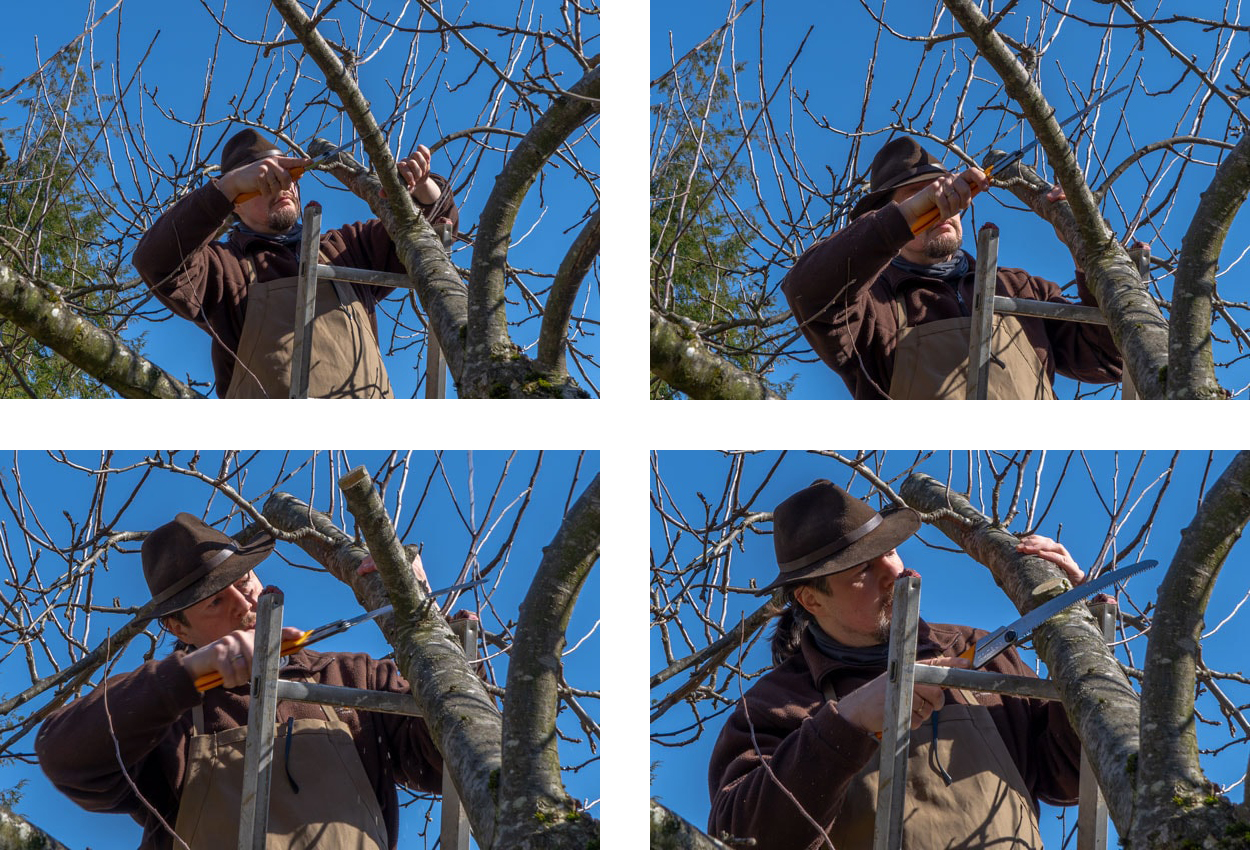
It is advisable to use a pruning saw from a branch thickness of 30-35 mm. With a sharp saw, you can also remove smaller shoots quickly and cleanly. There is basically no upper thickness limit. To cut effectively, the saw blade should be at least twice the length of the branch thickness. Thicker branches are shortened in stages to reduce the weight on the branch base. To avoid uncontrolled tearing of the bark, the cut is first made from below and only then from above. Finally, the branch is cut "on branch ring", i.e. the branch is not cut off flush with the trunk (this would result in a very large cut surface), but only after the base. The tissue is particularly active here. However, no branch stumps should be left on the trunk, as these make it more difficult for the wound to heal and cause an increase in water shoots later on.
Straight or curved
Garden saws are available with straight or curved saw blades. Saws with straight saw blades offer good guidance, especially for horizontal cuts up to shoulder height, for example when pruning hedges. Curved saw blades are particularly good for overhead vertical cuts.
| Straight saw blades | Curved saw blades | |
| Advantages: | Long stroke | Good guidance in the kerf |
| Ideal for: | Horizontal cuts close to the body | Vertical cuts above shoulder height |
Fixed or folding
The quality of the saw blades, and therefore the quality of the cut, is the same for saws with fixed saw blades or folding saws. The trapezoidal toothing with alternate bevel cuts the wood fibres razor-sharp and leaves a very clean surface.
Fixed saws are often supplied in a quiver with a belt loop and are therefore always ready to hand. Most fixed pruning saws have an ergonomic handle shape (pistol grip) and are designed for one-handed use.
Folding saws are easy to stow away during transport and their saw blade is protected by the handle when folded. Larger folding saws with longer saw blades make it possible to cut very thick branches and even fell trunks. The longer handle allows powerful gripping with both hands.
Extendable
As telescopic saws do not require complex mechanics, they have a greater reach than telescopic loppers. With a total length of up to 7.2 metres, the Barnel 720 telescopic saw, for example, has an enormous reach. Even if fruit trees rarely reach such heights, a greater reach can be very helpful. This is the case, for example, if the trees are on a slope or embankment.
Tree care after pruning
Especially when pruning fruit trees in winter, when the sap in the tree is hardly flowing, it is important to help the tree heal its wounds. If you seal fresh cuts with cold-applied tree wax, fungi or insects cannot penetrate the injury. The tree can recover in peace. Ingrown fruit from the previous period, so-called fruit mummies, should also be removed during pruning to prevent fungal infestation.


