
Tips for working with the frame saw
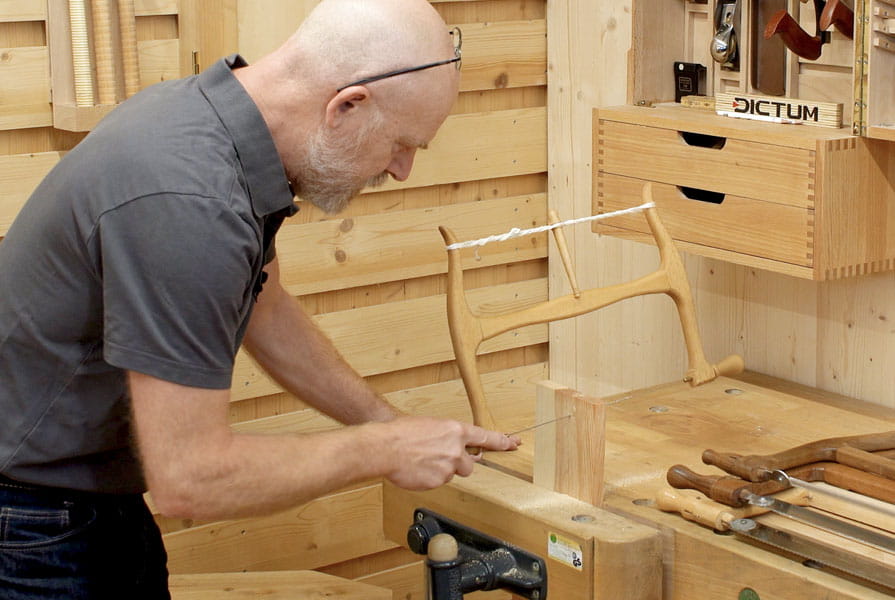
Every carpenter will remember their first cuts with a frame saw. It was certainly one of the first tools that he got his hands on. The large wooden frame with the thin saw blade was a challenge - until you understood how important the correct blade tension is and how to set and guide the saw correctly. In this blog post, we explain the structure and function and provide tips for working with frame saws.
- Why does a saw need to be clamped?
- How is a frame saw constructed?
- What types of frame saws are there?
- How are frame saws sharpened?
- Are there frame saws with a Japanese saw blade?
- How is a frame saw correctly clamped?
- How are frame saws held correctly?
- Is sawing done on the push or pull side?
- How do I start the saw cut safely?
- How can I correct the saw cut?
Why does a saw need to be tensioned?
To minimise wood loss when sawing, the saw cut should be as narrow as possible. The saw blade must be correspondingly thin. However, a thin saw blade can be easily bent. There are various methods to counteract this:
- Back reinforcement. The saw blade is stiffened by metal strips or a profile on the upper side, the so-called back.
- Saw blade tensioning. The saw blade is clamped at the ends and held under tension by a frame or stand.
- Tension load. If the saw cut is made under tension, the saw blade is tensioned automatically during operation (principle of Japanese pull saws)
How is a frame saw constructed?
- Two arms (A)
- Bar (B)
- Two handles, also known as horns (C)
- Saw blade (D)
- Clamping cord, wire or screw (E)
Depending on the shape of the blade and the frame, other small parts such as a saw blade holder may also be required. If the frame saw is tensioned by a cord, a so-called toggle is added. Depending on the intended use, the saws differ in terms of the length, width and toothing of the saw blade. Traditionally, different clamping saws were used in the trade, here is an overview:

What types of frame saw are there?
There are different frame saws for almost every work step, from rough cutting to fine tail cuts. Sorted by size, these are
- Fist saw
- Slicing saw
- Slitting saw
- Set-down saw
- Tail saw
A speciality is the angle and tine saw, which is rarely found today. In the following, we present the individual saw types in more detail.
How does a fist saw work?
Fist saw
Blade length: 800 to 1000 mm
Blade width: 40 to 80 mm
Toothing: coarse, strongly set longitudinal cutting toothing
Application: Trimming boards and planks
The largest of the frame saws with a saw blade length of 80 to 100 cm or even longer. The saw blade width is at least 40 mm. Particularly large saws can have blades up to 80 mm wide. The teeth are filed for the longitudinal cut, relatively coarse and strongly set. Fist saws are used for ripping and trimming wood. Their name comes from a sawing technique known as fist sawing, in which the saw is not held horizontally in front of the hand, but vertically with both hands, from top to bottom, in front of the body or "in front of the fist". To do this, the saw blade is rotated by almost 90° to the saw arms so that the frame can run past the edge of the board.

What is a scissor saw?
Slicing saw
Blade length: 700 to 800 mm
Blade width: 40 to 80 mm
Toothing: coarse tooth pitch, filed for pull and push
Application: Cutting beams and round timber to length, also damp wood
It is a large clamping saw with a length of 700 mm or 800 mm. Its special feature is that the teeth are filed symmetrically, i.e. for push and pull. The tooth angle is not 60° as with other traditional saws, but 45°. This means that a normal triangular file with a 60° corner angle cannot be used for resharpening. With its coarse tooth pitch, it is used for rough cross-cutting of square and round timber and for cutting firewood and also works well in wet wood.
What is a rip saw used for?
Slitting saw
Blade length: 700 to 900 mm
Blade width: 40 to 60 mm
Toothing: longitudinal cut toothing
Use: versatile, for wood joints and fine format cuts
These "handsaws" are somewhat smaller, with a saw blade length of between 700 and 900 mm. The slitting saw has a saw blade width of approx. 40 mm. Its teeth are also filed for longitudinal cuts, but are less aggressive and have a much weaker set than the fist saw. As the name suggests, it is mainly used for slotting (in the direction of the wood fibre) in the production of mortise and tenon, the sawing surfaces should be "ready for gluing". However, the slitting saw can also be used for all finer cuts and cross-cuts and is always to hand, which is why it is often referred to as a "handsaw".
What is a skip saw?
Skiving saw
Blade length: 600 mm
Blade width: 30 to 40 mm
Toothing: fine cross-section toothing
Use: Cutting frames and mouldings to length, for wood joints
It is usually around 60 cm long and the saw blade is approx. 30 mm wide. The skip saw has fine teeth that are filed for cross cuts. The crosscut saw is used for finer cuts across the grain, mainly for crosscutting mortises and tenons, hence its name. It is also suitable for finer longitudinal cuts, for example for finger jointing.
What do you use a bevel saw for?
Tail saw
Blade length: 300 to 600 mm
Blade width: 4 to 10 mm
Toothing: slightly more strongly set, fine universal toothing
Application: Curved cuts, curved cuts, internal cut-outs
This is the smallest of the frame saws. The maximum blade length is 600 mm and can go down to 300 mm on very fine models. As the name suggests, it is used for curved cuts. In order to be able to cut small radii, its teeth must be set more strongly and the blade must be particularly narrow, between 4 mm and a maximum of 10 mm. Similar to fretsaws, the blade requires particularly strong tension to prevent it from twisting and running. To produce cut-outs in a surface, the blade can simply be unhooked after unclamping and guided through a pre-drilled hole. The hole cut-out is then sawn when the blade is re-hooked and clamped.
How does the angle or tine saw work?
This saw is now almost unknown. It is very similar in appearance to the tine saw, except that its saw blade is not toothed in the front third and is bevelled by 90° in the rear two thirds. These tine saws were used to saw out the waste from the tine. Because the sawing process produces large chippings on the opposite side, they were used almost exclusively in joinery, e.g. for tining door chucks. Accordingly, the workpiece was aligned for sawing in such a way that the cut-outs were concealed when installed - in the case of door frames, on the outer side facing the masonry. Today, however, such saws and saw blades can only be found at jumble sales or antique markets.

How are frame saw blades sharpened?
The frame saw and frame saw were sharpened by the respective carpenter according to his preferences. The saw blade was clamped in a filing clamp and then filed more or less on the joint for a more or less aggressive cut in the longitudinal wood. The bevel angle was also customised - slanted to achieve a fine, tear-free cut for cross cuts or blunter to achieve a longer service life. You can find more information on sharpening in the blog post "Sharpening saws - compact".

Are there also frame saws with a Japanese saw blade?
Nowadays, there are also frame saws and saw blades with Japanese toothing for longitudinal or cross cuts and with universal toothing in the usual lengths. There is even a tail blade or a tail saw with Japanese toothing available. These saw blades are razor-sharp, cut very quickly and cleanly and have an exceptionally long service life. The only drawback is that they cannot be resharpened.
How is the frame saw correctly tensioned?
As a frame saw should be tidy when unclamped, it must first be clamped before use. For saws with a tensioning wire or screw, this is done by tightening the wing nut; for saws with a tensioning cord, this is done by twisting the cord, which is then secured against the bar with a toggle. In order to be able to see the cut on both sides of the saw blade, it is set at a slight angle by turning the handles. Look over the back of the saw blade to check that the saw blade is straight and not twisted. The saw blade is sufficiently tensioned if it does not run when sawing and the saw cut can be made in a controlled manner. If you pluck the saw blade, you should hear a clear, bright sound.
How are frame saws held correctly?
To better control the weight of the saw, it can be gripped by the handles when starting. If you hold the saw by the arm when starting, the handle should rest on the bottom of the wrist for stabilisation. Once the first notch has been cut, the hand may switch to the arm of the saw and you can cut with powerful strokes, utilising the entire length of the saw blade.

How are frame saws sawn - push or pull?
Frame saws with traditional toothing are generally used "on the push". However, the special design of the saws allows the cutting direction to be changed "on the pull" at any time by simply turning them round. Frame saws with Japanese blades should generally be used "on the pull". "However, these saws jump a lot when pulled. The dangers caused by the saw "jumping" will be explained later. This jumping can be countered by using the saw "on push". However, the Japanese serration is then very aggressive and the cut is quite difficult to start. Regardless of how the Japanese blades are used: as they have extremely sharp teeth, increased caution is always required when using them.
How do I start the saw cut safely?
Depending on the aggressiveness of the toothing, some saws tend to vibrate and therefore jump when starting. The first notch should therefore be created by pulling a few times in the opposite direction to the actual cutting direction. As the saw blade is usually guided with one finger of the other hand when starting the saw, there is a high risk of injury when the saw jumps out of the notch. Even worse injuries occur when the saw jumps out if the workpiece is held unnecessarily and the holding hand is below the saw cut. The workpiece should be firmly clamped in the workbench anyway - there is no need to hold it!
Correcting the saw cut
If the cut is misaligned, the cutting direction can be corrected by simply tilting the frame in the direction of the misalignment. However, depending on the thickness of the set and the saw blade width, the possibility of correction is limited. You should also be careful not to overcorrect.

FAQs Working with the frame saw
How do I clamp mortise and tenon joints correctly?
When sawing mortise and tenon joints, clamp the workpiece in the rear clamp so that the cutting direction is parallel to the front edge of the workbench. The workbench edge is then used to gauge the sawing direction.
What to do if the saw frame bumps when making long, deep cuts?
For long cuts along a board edge, the saw blade can be turned almost 90° to the frame. This enables long edging cuts with a width up to the centre of the saw frame.
How do I prevent the saw blade from jamming in the saw cut?
If there is tension in the wood, the saw blade can become jammed in the saw cut. Small wedges - inserted into the saw cut - reliably prevent this. Resin can cause wider saw blades in particular to stick in the saw cut or to saw very stiffly. A little paraffin wax on the saw blade allows the saw to glide more easily again.
Why does the saw blade always need to be unclamped?
When the work is finished, the saw should always be de-centred before it is put away. If the frame saw is not tensioned, the saw arms will warp and the bar, tensioning wire or tensioning cord will stretch. Do as the frame saw does and relax after work.
Are there special frame saws for left-handers?
As most frame saws have a symmetrical design, they can be used by both right-handed and left-handed users. The saw blade can be tilted to either side. However, it is somewhat more difficult for left-handers to clamp the workpiece correctly, as the collets on the workbench can get in the way.
Unsere Top Auswahl für Sie


Who is interested in a frame saw?
Even though there are modern alternatives to the frame saw, such as jigsaws, circular saws or band saws, it is still very popular with fans of traditional craftsmanship. It is and remains the versatile standard saw for carpenters and joiners. Anyone who has learnt and mastered sawing with a frame saw will also be able to cope with other handsaws. It also has some advantages, for example when it comes to somewhat larger projects, it is superior even to Japanese saws. If you are looking for high-quality frame saws, you can find detailed information on the different saws in our "Frame saws" shop category.

