
Thinning tools: handling sickle, scythe and machete
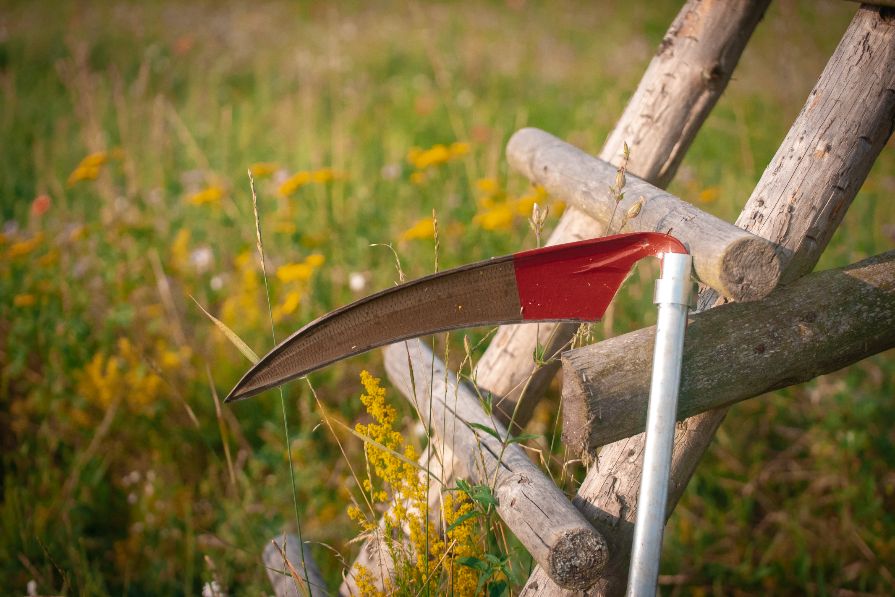
While in spring every sprouting leaf is cherished and every new blade of grass is tended to, four weeks later gardeners can already be thinking about pruning, mowing and thinning out. Nature can hardly be tamed and requires constant maintenance if the garden is not to become a jungle. Less well-known but very efficient thinning tools are the sickle, scythe and machete. They can be used to prune, thin out and shape grass areas, meadows and shrubs.
Handling a sickle
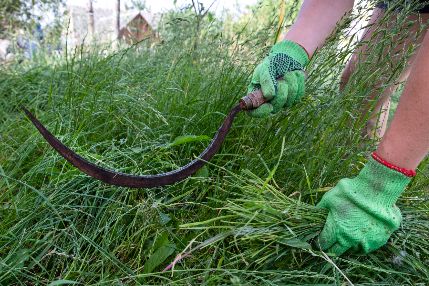
The sickle is used in agriculture and is particularly suitable for cutting tufts of grass, grain or small branches. To do this, hold the clippings with one hand and pull the sickle through with the other hand. Leather gardening gloves are highly recommended to avoid injuries. There are different sickle models depending on the area of application. The most common is the scythe sickle. As the name suggests, it is a mixture of scythe and sickle. The cutting blade is long and curved - like a scythe - and the scythe blade is attached to a wooden handle so that precise mowing work is possible. Sickles are also popular with small animal owners who like to use the hand sickle to harvest dandelions and grass for their rabbits, guinea pigs and other pets.
Environmentally friendly mowing with a scythe
When it comes to more than just a few tufts of grass, the scythe comes into its own. The scythe has always been used in agriculture and is still popular with gardeners: scythes are quiet, environmentally friendly and kind to nature at the same time. In principle, they could be used to mow entire meadows - just like our grandparents did. Today, gardeners tend to use the scythe to remove wild growth where the lawnmower cannot reach so easily or would fail. Under hedges and between fruit trees is the perfect place for long-handled scythes.
The handle of a scythe is called a scythe tree. Gardeners should focus on an upright working position - this protects the back in the long term. In order to mow as ergonomically as possible, the scythe arm is 20 to 25 centimetres shorter than your own height. High-quality scythes also have adjustable handles so that the mower can be precisely adjusted.
Mowing is done by swinging the scythe in a semicircle over the ground. Swinging is the magic word here: the gardener gains momentum from the hips and mows the grass - no special effort is required with the right technique. The scythe always swings forwards and backwards - around the gardener's axis. If the tip of the blade points slightly upwards, mowing is particularly easy.
Sharpening or dening scythes and sickles?
Scythes and sickles are sharpened differently depending on the model. Models with blades made of normal steel are sharpened using the dengeling method. This involves thinning the blade by lightly tapping it to sharpen the cutting edge again. The best way to do this is with a dengelling anvil and a dengelling hammer. Of course, this is not easy and a real challenge for beginners. A denging tool is much easier to use.
The grinding method is used for Japanese scythes and sickles or so-called grinding scythes. These garden tools have a thicker scythe blade that is given fresh cutting power with a whetstone, which is repeatedly dipped in water to grind smoothly over the curved scythe blade. Gardeners who mow large areas with a scythe carry the whetstone in a water-filled whetstone container on their belt.
Sharpening the scythe and the round sickle is of course an art in itself that requires years of practice and is less likely to work well at the beginning. Nevertheless, regular sharpening is very important in order to cut the blades of grass as easily and effortlessly as possible. If this is no longer the case, gardeners often try to cut the grass with more force - but this increases the risk of injury enormously. The Scythe Handbook is a worthwhile introduction to the technique of scything, explaining in detail not only how to use the scythe optimally, but also how to sharpen and sharpen with the whetstone.
Removing wild growth with a machete
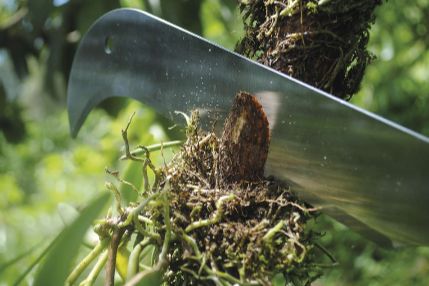
Gardeners can use a machete to remove coarse wild growth such as overgrown raspberry bushes, shrub jungles and stinging nettles that have grown far too large. The machete is considered a garden tool for rough work and is no longer widely used. Meanwhile, the bush knife, formerly known as a cleaver, was a popular thinning and, above all, shredding tool. Branches can be removed much more quickly with a machete than with loppers. Aim, align, lunge and chop - that's how quickly thinning can be done with a machete. Admittedly, it takes a bit of practice to get the right swing and aim accurately, but with a bit of practice, it's really fun to use after just a few minutes. Gardeners work in a similarly quick and energy-saving way with the garden hatchet - also known as a scythe.
Thinning tools at a glance:
- Sickle: Used to cut tufts of grass, small animal fodder and smaller wild growth. The clippings are held with one hand while the other guides the sickle.
- Scythe: The scythe swings over the ground in a semi-circle to cut the grass, but the scythe arm should be 20 to 25 cm shorter than your height so that it is gentle on your back.
- Machete: The tool for rough work. This cleaver is used to chop down branches and remove wild growth.


