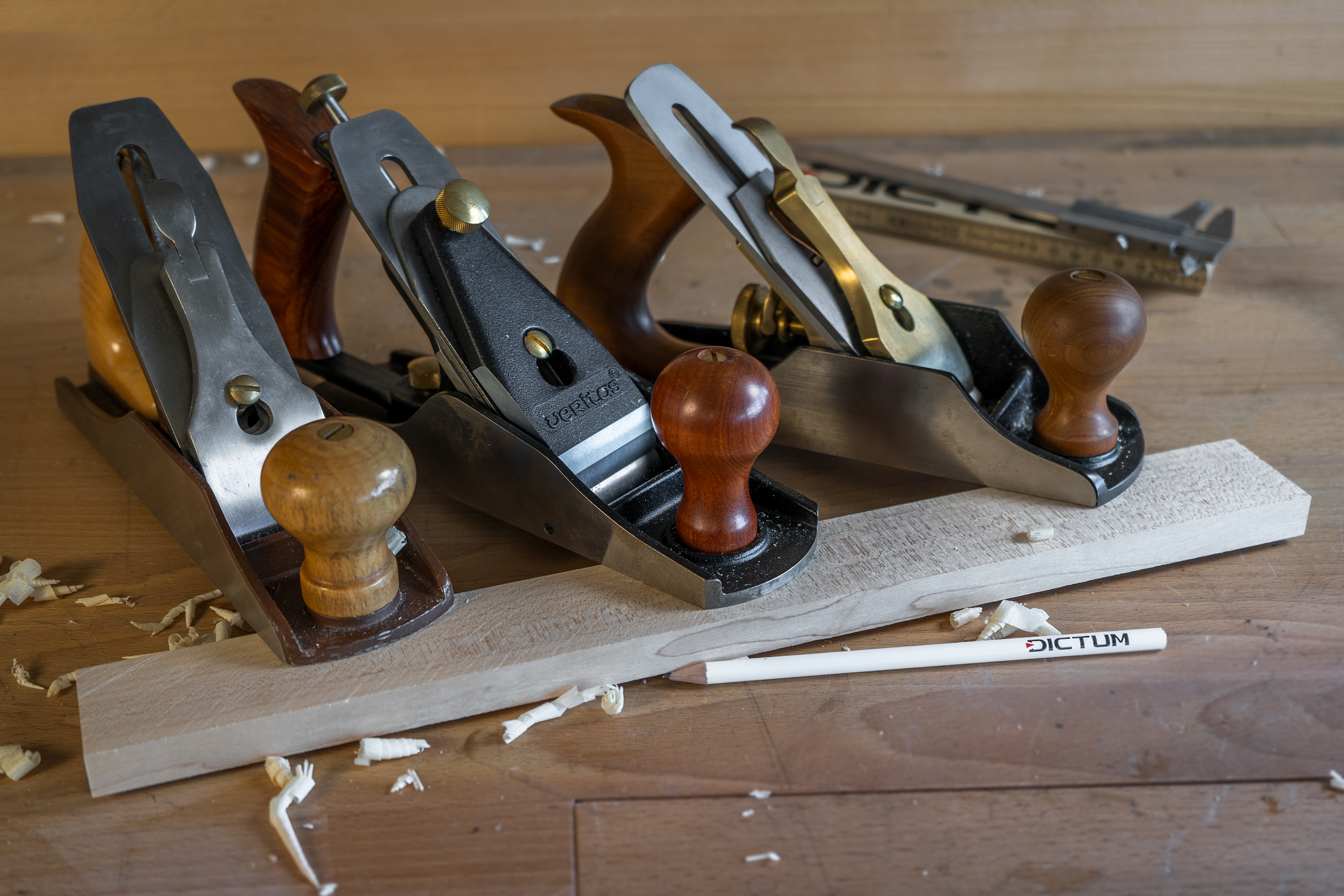
Steel types for DICTUM® plane irons
With numerous DICTUM hand planes, you have the choice between different planing tools made from different steels. We explain the differences.
Properties
It is not sufficient to judge a plane iron solely on the basis of its specified hardness. The hardness of plane irons is specified in Rockwell (HRC) and is usually between 61 and 64 HRC. The hardness depends on the steel grade and the hardening process. Depending on the type of steel, different hardening processes can give it different properties - from soft to hard, from brittle to tough. When it comes to plane irons, there are three properties to consider: Sharpenability, edge retention and impact resistance. "Sharpenability" refers to the properties that the steel exhibits when sharpened. Can it be sharpened well on water stones? Is it suitable for grinding with machines and dry grinding (e.g. on grinding blocks)? What is its stock removal behaviour? Then there is the behaviour during work. The term "edge retention" refers to the resistance of the cutting edge. How long does the plane iron stay sharp? How a plane iron reacts when planing into very hard, small branches, whether it then possibly breaks out or resists this, depends on its "impact resistance". In the case of cutting steels for plane irons, it is important to find an optimum combination of the three properties. The resistance of the cutting edge is also influenced by the cutting edge angle. A Japanese plane iron has a cutting edge angle of 29-30°, a Western plane iron usually has 25° (possibly a 27° micro bevel).
Options for DICTUM planers
SK4
The standard blades on our DICTUM planesare made from SK4 . This carbon tool steel has a hardness of approx. 61 HRC and therefore has good sharpening properties as well as a good service life and edge retention. It has an excellent price-performance ratio and is often used for other tools such as hatchets, knives and chisels.
Ply steel with cutting layer made of blue paper steel
Two-ply steel with a cutting layer made of blue paper steel has proven itself over generations in Japanese planes, chisels and knives. The cutting steel has the highest possible hardness of 63 HRC. These DICTUM plane irons combine exceptional properties such as outstanding sharpness, long service life, edge retention and ease of sharpening. The two-layer steel structure of the plane blades has a vibration-damping effect, especially when subjected to high cutting loads.
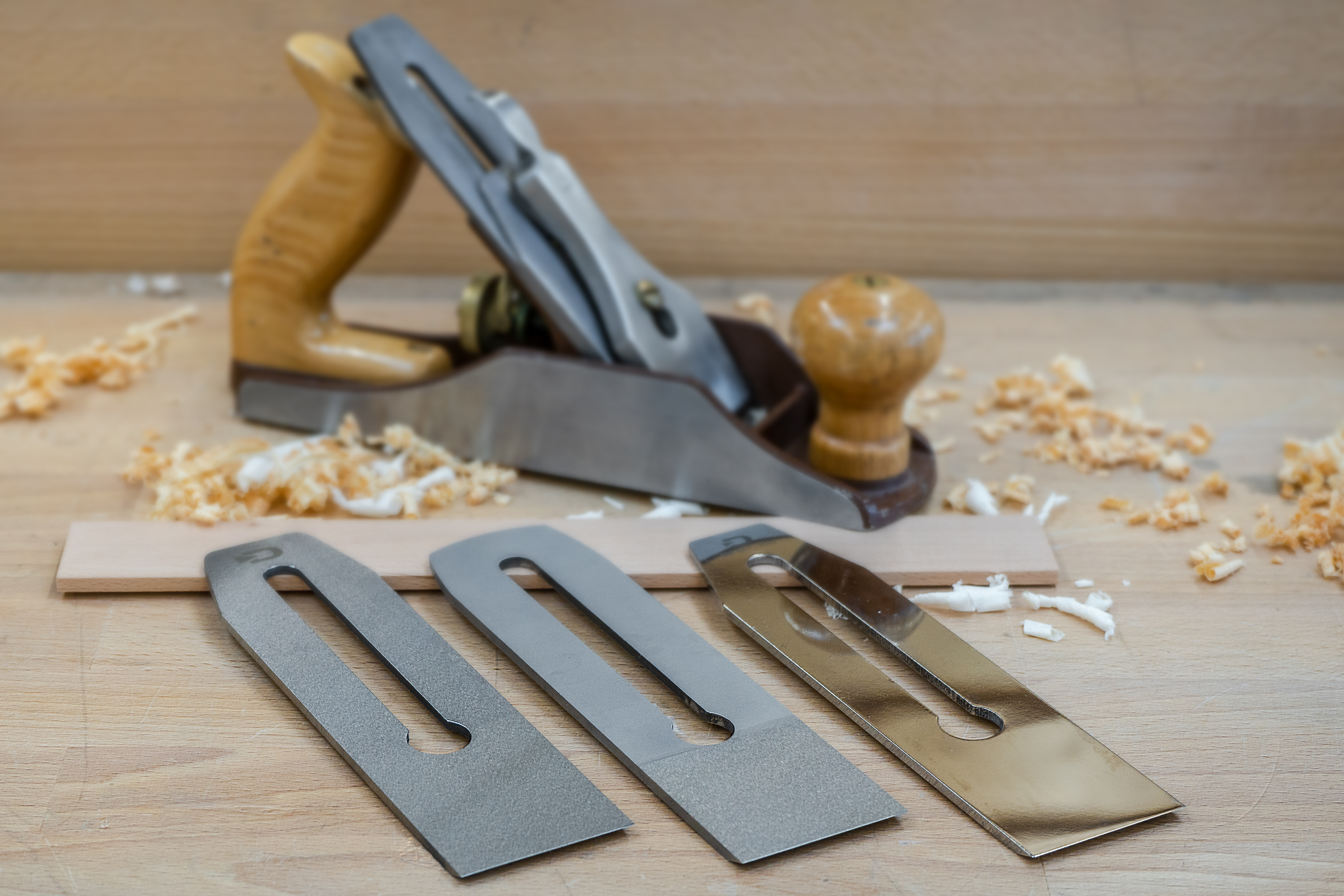
One plane, three plane blades to choose from: SK4, Japanese layer steel and HSS Cryo
Cryogenically treated HSS Cryo
The plane irons made of high-speed steel (HSS) are extremely cooled down during cryo treatment in a complex process with liquid nitrogen (-196 °C). This has a positive effect on tool life, cutting edge formation and sharpenability. The mirror sides are machined in a special process to produce precisely flat surfaces with minimal grinding marks. Both processes together (cryo and mirror side grinding) enable the hard steel to be sharpened in a minimum of time. Thanks to the high hardness of approx. 64 HRC and toughness, these plane irons are insensitive to rough handling, which is often unavoidable in everyday workshop or assembly work. This steel can also withstand dry grinding with machines without any loss of hardness.
Other steel types
A2
A2
The standard for plane irons from Lie-Nielsen Toolworks and Veritas. A2 steels are relatively easy to machine and easy to forge. For use in planes, A2 steel is hardened to 60 to 62 HRC and also undergoes a special cryogenic treatment (Cryo) for a finer grain. The result is a high-strength plane iron with excellent sharpening properties.
PM-V11™
PM-V11™ steel is made from a powder metallurgical steel alloy. Thanks to its extra-fine and uniform material structure and high hardness of 61 to 63 HRC, this steel achieves twice the service life of A2 steel. PM-V11™ plane irons can be ground razor-sharp and are extremely wear-resistant, even with a bevel angle of less than 20°. Nevertheless, plane blades made from PM-V11™ steel are relatively easy to sharpen on standard water stones.
Well-known manufacturers such as DICTUM, Vertias and Lie-Nielsen offer planes with so-called cryo-irons
PM-V11™
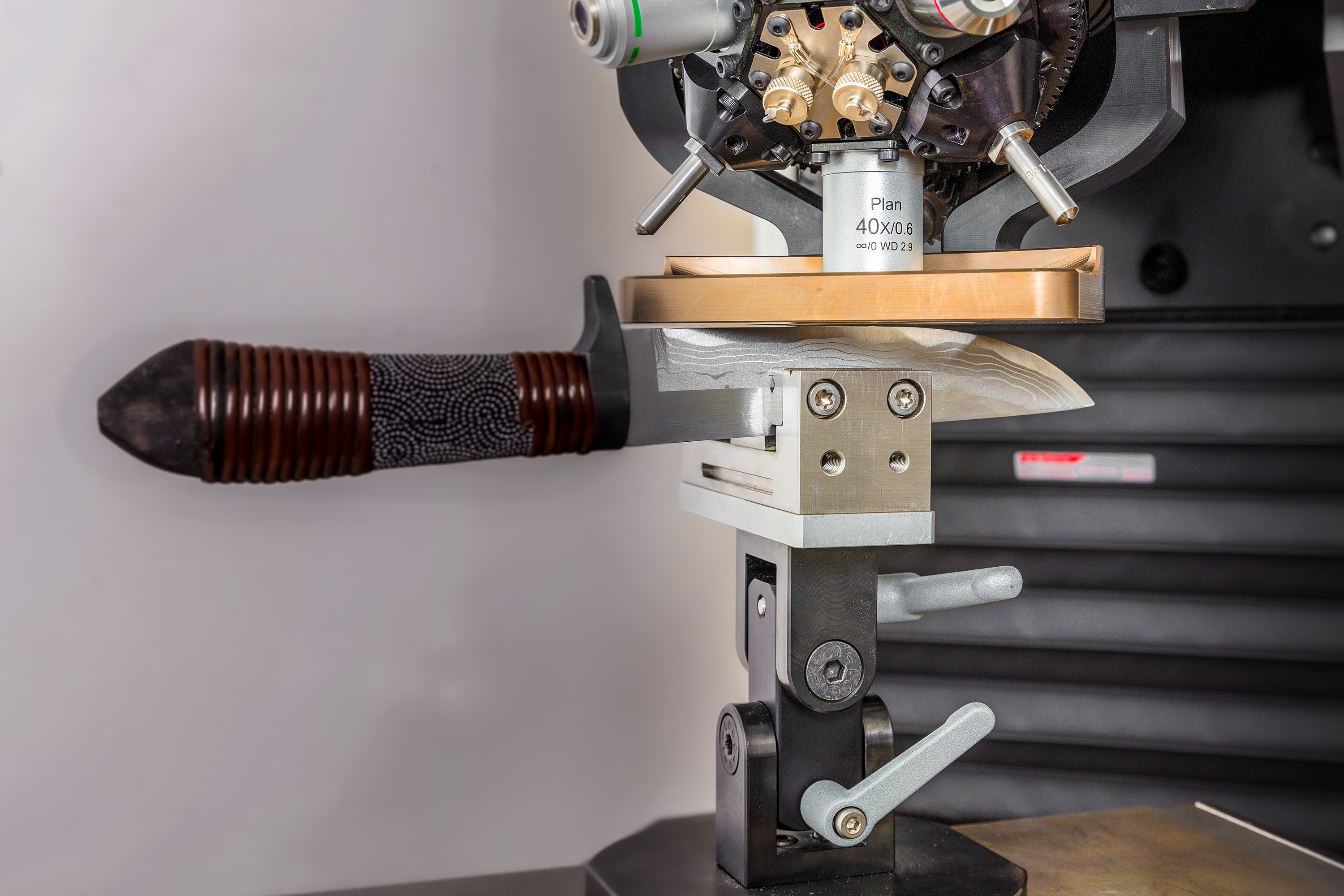
DICTUM tests plane irons
Hardness: We are able to test the hardness of almost any tool blade directly on the cutting edge. The non-destructive test using the Vickers hardness test method (HV) is then converted to corresponding Rockwell values (HRC) in accordance with DIN.
Steel determination: We have spectral analyses carried out to determine the alloy components of a steel and draw conclusions about the steel quality (e.g. sulphur content).
Microsection of steels: The causes of material and production defects can be very diverse. In the event of suspicion, we take micrographs of steels in order to be able to draw conclusions about the defects.
Roughness measurement of the mirror side: We can determine the roughness of a surface using a roughness measuring device. High roughness values lead to long dressing times on the mirror sides of mortising and planing tools.
Practice: In our course workshops, all tools, including our planes and plane irons, are used by our course instructors and workshop participants to test their suitability for practical use.
Hardness testing at DICTUM using the modern Vickers method