
Alternative grinding discs for wet grinders
- When you should replace grinding discs
- Advantages of different grit levels
- Alternatives to the supplied sanding discs
- DICTUM® Ultra-Speed sanding discs
- Grinding disc for coarse work
- Grinding discs for turning tools and HSS
- Fine discs with 200 mm diameter
- Advantages and disadvantages of diamond grinding discs
In addition to the usual replacement discs, grinding discs with different grit sizes and abrasives are also available for wet-grinding machines. By choosing the right sanding discs, you can speed up the sanding process and optimise the sanding result.
When should the grinding discs be replaced?
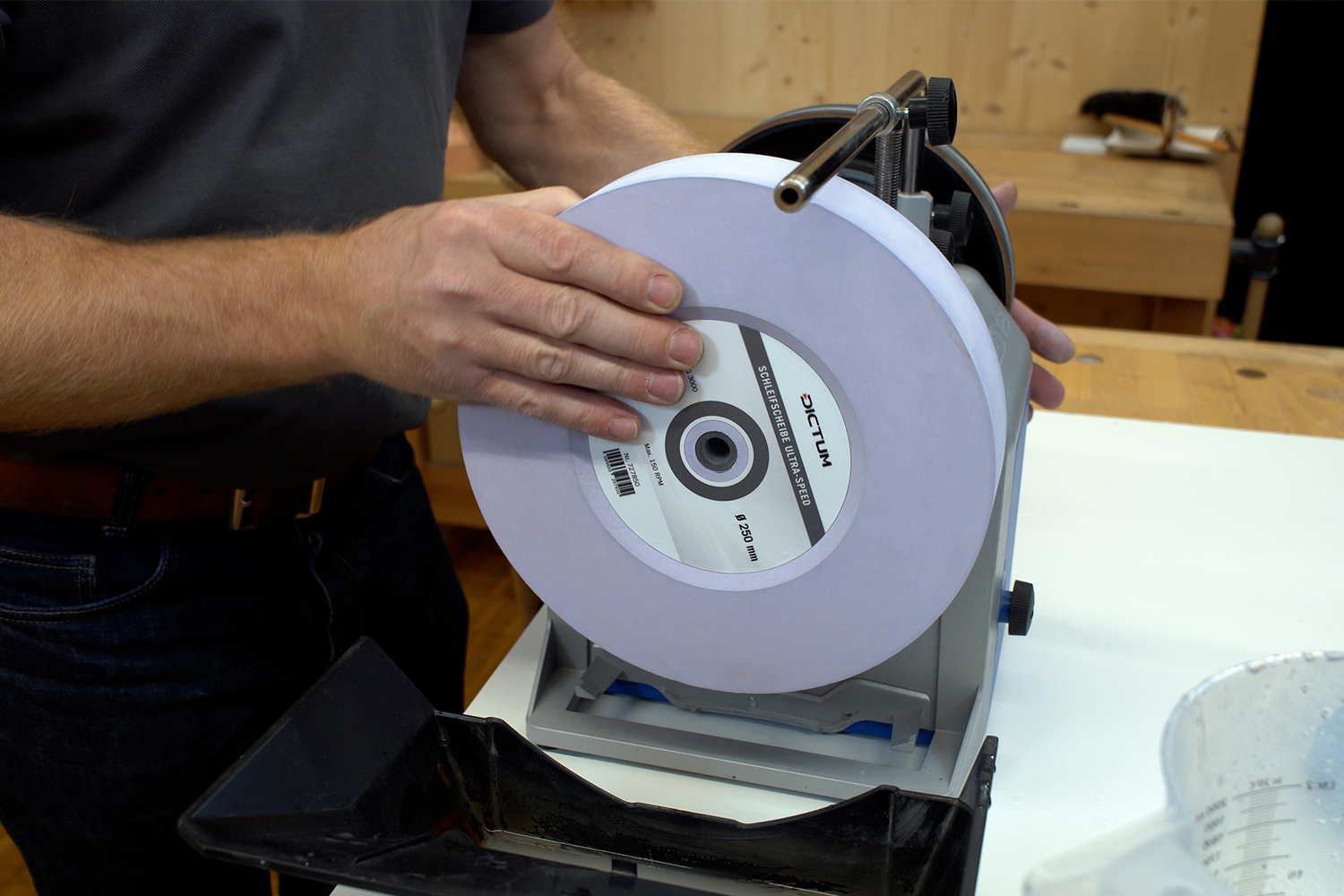
The smaller the diameter of the grinding discs, the greater the hollow grinding on the cutting bevel. If the hollowing is very deep, the cutting edge is weakened and loses its stability. The service life of the cutting edge decreases and chipping increases. In addition, the grinding speed decreases as the diameter decreases. The grinding process takes longer and longer. For wet grinders, we therefore recommend replacing the grinding disc as soon as its diameter is smaller than 150 mm.
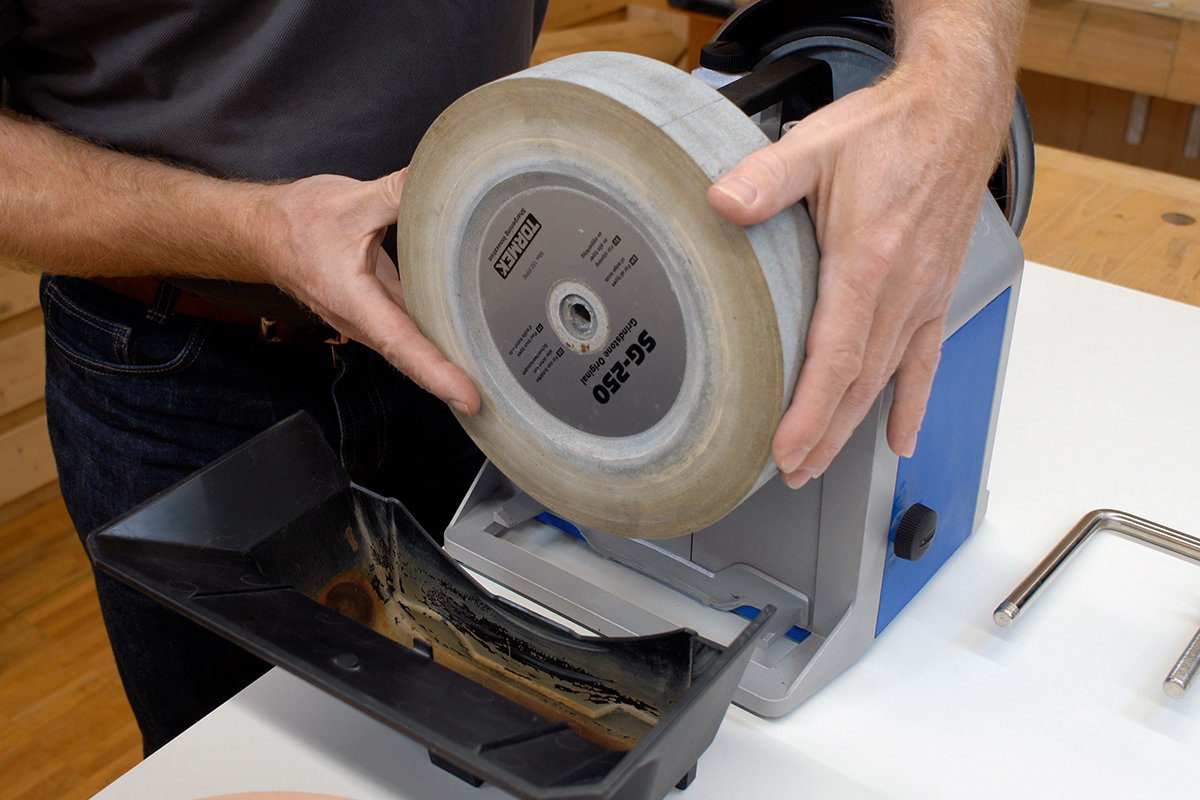
Replacing the sanding discs on wet sanding machines is usually quite simple
What are the advantages of different grit sizes?
The grit level of the supplied sanding discs is usually around 220 grit. Using a so-called stone preparator, the whetstone on Tormek wet sanders, for example, can temporarily simulate a finer grit level of approx. 1000. The grit is not actually increased, but the abrasive crystals are only softened in their aggressiveness and sharpness. This makes the grinding pattern appear finer, but grinding or polishing takes a little longer and the wear on the stone is significantly increased.
Grinding discs with different grits, on the other hand, always work effectively and deliver a consistent grinding pattern over the long term. The purchase and change of different grit levels - from coarse to medium to fine - is particularly worthwhile if many tool cutting edges are ground regularly.
What alternatives are there to the grinding discs supplied?
In the following, we would like to introduce you to a few grinding discs as an alternative or supplement to the conventional grinding discs from Tormek, Record Power, Jet and others.
DICTUM® Ultra-Speed sanding discs in three grit sizes
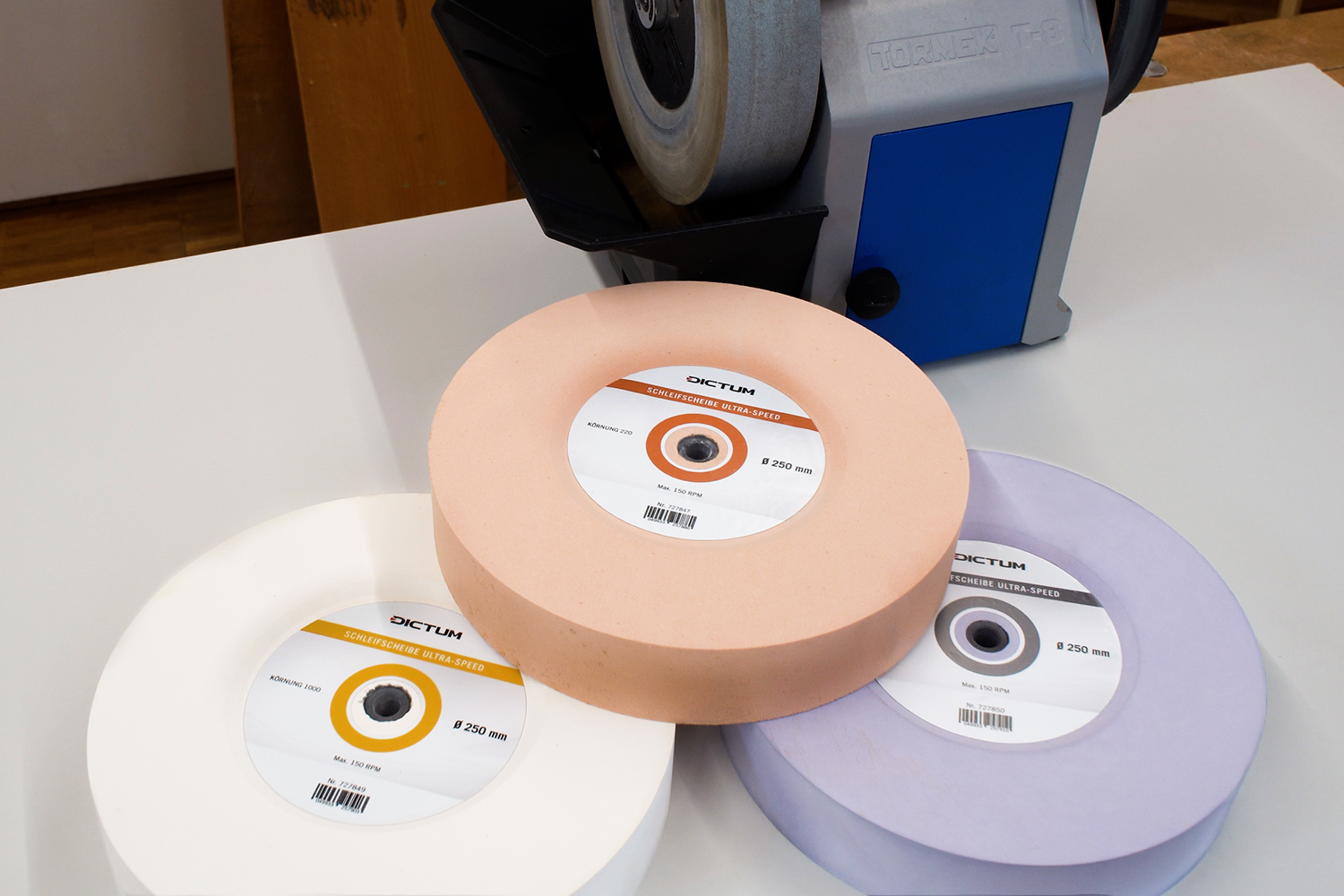
For the DICTUM Ultra-Speed grinding wheel (220 grit, 1000 grit, 3000 grit), we use aluminium oxide manufactured in Germany on a single crystal basis, one of the most effective ultra-fine abrasives on the market. You can use it to grind double-layer blades, chrome/vanadium steels and HSS. With a stone diameter of 250 mm, the Ultra-Speed grinding discs fit numerous wet grinding machines from well-known manufacturers such as Tormek, Record Power and Jet. In extensive tests with microscope images, we have optimised the composition of the grinding wheels to achieve the best compromise between a fine grinding pattern and fast stock removal. With Ultra-Speed sanding discs, you can sand faster and achieve a finer sanding pattern than with conventional sanding discs of the same grit size.
Grinding disc for coarse grinding
The DICTUM Carbon Cut grinding disc has the right coarse grit for coarse form grinding in the manufacture of cutting tools (knife making, self-made planes, etc.) and for repairing damaged cutting edges. The 80 grit aluminium oxide used as an abrasive ensures rapid stock removal on double-layered blades and carbon steels.
Grinding discs for turning tools and HSS
The black silicon carbide of the DICTUM grinding disc Black Carbide is particularly suitable for hard materials such as HSS but also carbon steels. Woodturners in particular appreciate the fast stock removal and long service life of the abrasive.
Fine discs with 200 mm diameter
For wet grinders with a 200 mm stone diameter such as Tormek 1200-1206, T-3 and T-4, we offer this Japanese grinding disc with 1000 grit. It is suitable for sharpening HSS as well as carbon steels and double-layer steels. Its hard bond ensures a high polishing effect with low stock removal.
What are the advantages and disadvantages of diamond grinding wheels?
Grinding discs with a coating of industrial diamond or CBN (cubic boron nitride) usually have a solid cast body that offers high concentricity. These grinding discs are always flat and do not need to be dressed after sharpening. Diamond or CBN abrasive grains wear much more slowly than conventional abrasives, but they are also subject to a certain amount of wear - even diamond grinding discs do not last forever. Compared to diamond, CBN is somewhat more robust and less sensitive to temperature. It is therefore more suitable for grinding hardened steel.
The side of the DICTUM® Black-Crystal grinding disc B54 is also coated with CBN
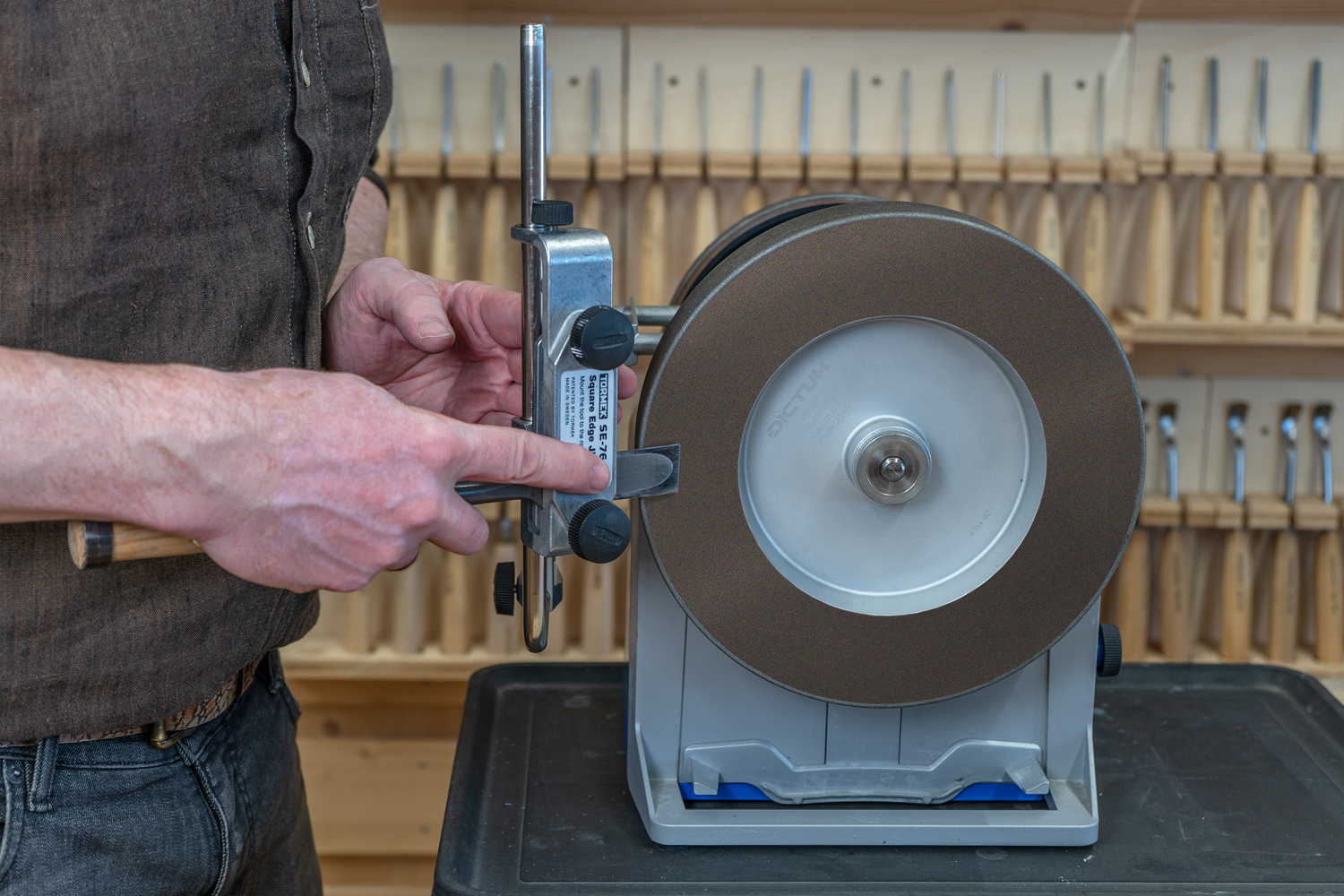
Thanks to the additional grinding surface on the side, you can grind a straight bevel without hollow grinding on tool cutting edges with diamond grinding discs from Tormek (1200 grit, 600 grit, 360 grit). To do this, you also need the Tormek MB-100 multi-holder with the appropriate grinding attachment for the tool in question. With Tormek diamond grinding discs, we recommend that you always use wet grinding, as this extends the service life of the disc and produces a smoother surface. However, you can also grind dry with Tormek diamond discs.
With the CBN grinding discs Black Crystal from DICTUM, however, you can grind permanently without water or coolant. This saves time and keeps the workplace dry. The DICTUM CBN grinding wheel B54 also offers a lateral coating so that you can also use it to grind a straight bevel on cutting edges.
If you want to learn how to use a Tormek correctly to sharpen your tools, we have just the thing for you with our online course "Sharpening on the Tormek: Complete course". .


