Measure correctly with the roller tape measure
- What are the advantages of tape measures?
- How accurate is a tape measure?
- Why are tape measures more accurate than metre rules?
- What are the differences between tape measures?
- What do the many numbers on a tape measure mean?
- How do you use a tape measure?
- How can errors be avoided when measuring with a tape measure?
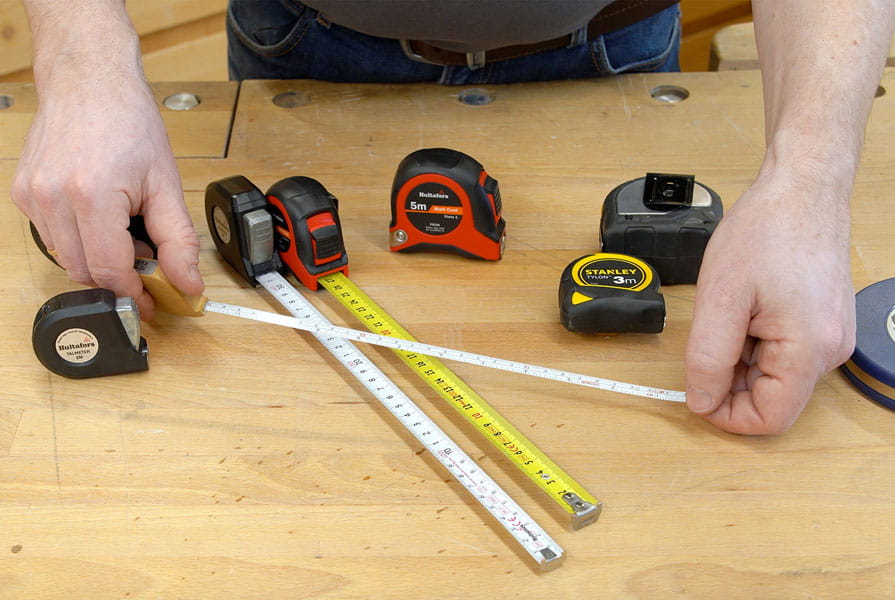
The roll tape measure, also known as a tape measure or roll metre, is a compact and versatile measuring tool. Due to its large measuring width, it is ideal for measuring and marking out larger workpieces. It also has a number of advantages over other measuring tools, which we would like to present to you in this article.
What are the advantages of measuring tapes?
Compared to other measuring tools, measuring tapes are more compact, have a larger measuring range, are always ready for use and are more accurate.
With the same measuring range, a tape measure is significantly smaller than a folding rule, for example. It fits in almost any trouser or jacket pocket and does not protrude. A normal metre rule is at least 22 cm long and usually sticks out of a normal pocket.
Rigid measuring instruments such as rulers and folding rulers are limited in their measuring range. The classic school ruler reaches up to 30 cm, in the workshop rulers of 50 to 70 cm are common. Conventional metre rulers have a maximum length of two metres. Roll tape measures for everyday workshop use have a length of two to six metres, measuring tapes for (garden) construction or sporting events range from 20 to 100 metres and beyond. Only electronic measuring tools such as laser measuring devices offer comparable measuring ranges. The simple advantage of measuring tapes over laser measuring devices: their battery does not run out!
How accurate is a tape measure?
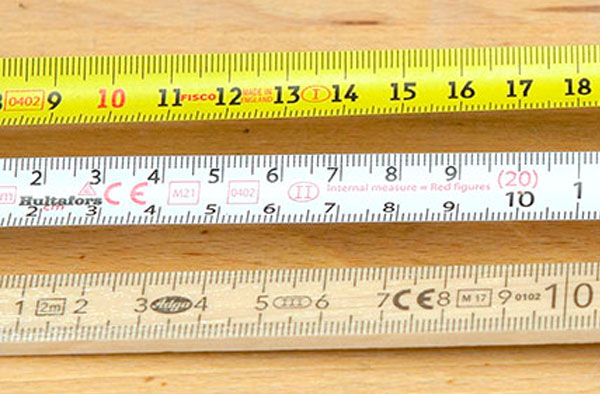
Tape measures are more accurate than metre rules, but usually not as accurate as a good steel ruler. The accuracy of measuring tools is specified in classes. In Europe we use the accuracy classes according to the EC standard, in Asia JIS (Japanese Industrial Standard) is common. The accuracy class is usually indicated as a Roman numeral in an oval at the beginning of the tape. Metre rules usually have EC class III, most measuring tapes are assigned to class II. There are also tape measures with class I accuracy, e.g. the Hultafors Ergonomic rolling tape measure.
Accuracy classes are indicated on measuring instruments with Roman numerals.
Tolerances of the classes
JIS and EG classes have the following tolerances:
| Class | JIS I | EG I | EG II | EC III |
| 500 mm | ±0.15mm | ±0.40mm | ±0.80mm | |
| 1000 mm | ±0.30mm | ±0.20mm | ±0.50mm | ±0.100mm |
| 1500 mm | ±0.25mm | ±0.60mm | ±0.120mm | |
| 2000 mm | ±0.40mm | ±0.30mm | ±0.70mm | ±0.140mm |
In practice, this means that if two different metre rulers with EG III are used, the measurement determined over 2 metres can deviate by almost three millimetres (2.8 mm). With measuring equipment with EG II (normal tape measure), the deviation is only a maximum of half (1.4 mm) and with EG I even less than one millimetre (0.6 mm).
Why are tape measures more accurate than metre rules?
A tape measure consists of fewer parts than a metre rule. A standard folding rule with EC class III consists of ten wooden strips that are connected to each other by riveted bearings. This number of mechanical parts means that a metre rule cannot be as accurate as a tape measure, whose measuring scale basically consists of a single long steel strip. High-quality tape measures also have a movable head or stop. In order to be able to measure internal and external dimensions accurately, the stop slides inwards or outwards by the exact thickness of the material, so that the measurement always starts exactly at the zero point.
What are the differences between measuring tapes?
In addition to the different lengths, measuring tapes differ in numerous features and quality characteristics.
- The material from which the tape measure is made determines how accurate the tape measure is. Inexpensive tape measures are often made of plastic, which can be stretched. High-quality rolling tape measures are usually made of steel tape or spring steel, while long tape measures are usually made of fabric tape reinforced with fibreglass.
- Curved measuring tapes remain stable for a certain distance when pulled out and do not kink as quickly as flat tapes. This makes it easier to attach the stop at the measuring point and to measure internal dimensions.
- Soft (textile) tapes are more suitable for measuring curves (e.g. measuring the circumference of pipes, tree trunks etc.) and are easier to wind up. Very long measuring tapes are therefore usually made of flexible fabric tapes.
- Roll tape measures can be easily attached to a belt or trouser pocketwith a clip and are always ready to hand. For measuring and marking out on ladders, scaffolding or roofs, some tape measures have a hand strap to prevent them from falling.
- A clamp/brake enables the tape measure to be locked in place. This is practical when measuring long distances and for repetitive measurements.
What do the many numbers on a tape measure mean?
Many tape measures have two or more scales. Some, for example, have a metric and an inch scale next to each other. Such tape measures are practical for those who work according to English/American building instructions, for example. Other tape measures offer additional markings (e.g. diamonds) for standardised measurements, e.g. in drywall construction. On the "Right Gear" tape measures from Shinwa, you will find a small red arrow mark every 455 mm. This unit is the distance between two posts in a traditional Japanese house. Hultafors valley metres in the two and three metre versions have a scale on the underside which indicates the diameter when measuring the circumference.
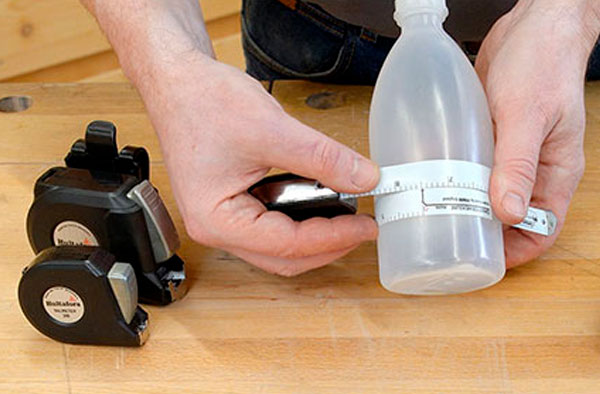
Tip: When selecting a tape measure, pay attention to the quality of the print and the legibility of the scale. This can vary even within the same batch. A matt coated surface ensures good legibility. Black numbers are easier to recognise on a yellow background than on a white one, as the contrast is greater.
How do you use the tape measure?
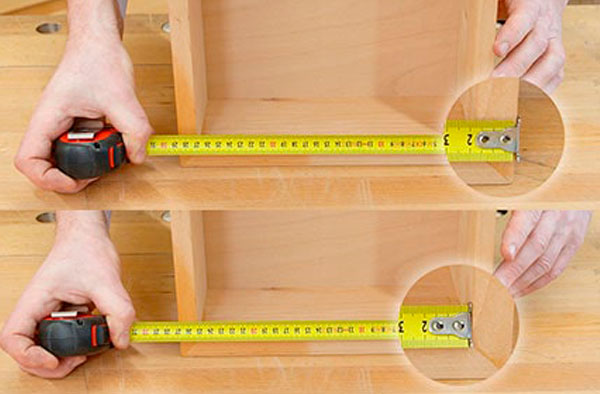
You can use a tape measure to measure long distances and internal and external dimensions as well as to mark radii. When measuring external dimensions, attach the head to the edge of the workpiece and read the distance directly from the scale. With some tape measures, you can also attach the front edge of the housing to the opposite edge of the workpiece and read off the measured value from a pointer. When measuring internal dimensions or clearances, you must press the head against the inside edge of the workpiece and pull the tape measure to the opposite side. You can then either read the value directly on the scale or you can strike the inside with the outer edge of the housing and add its width to the displayed value (often indicated on the tape measure).
Depending on the measurement, the head of the tape measure slides inwards or outwards.
With the Hultafors Talmeter with two and three metre lengths, you can slide out an additional measuring tongue on the housing and then simply read off the value on the red marked scale. With some measuring tapes, you can read the measured value for internal dimensions in a viewing window in the housing. To measure radii, many tape measures have an opening in the stop, the so-called eye, with which you can hang the head in a screw or nail. The aforementioned Hultafors valley metres have a small hole in the tape measure at the 10 cm mark through which you can insert a thin nail or tack.
Tip: To prevent the head of the tape measure from accidentally slipping off when measuring long distances, you can fix it in the eye with a nail or a pin.
How can errors be avoided when measuring with a tape measure?
Keep the tape measure taut and clean.As always when measuring, you should always use the same measuring tool or tape measure to minimise tolerances between measurement and marking. When measuring, you should pull the tape measure tight and avoid sagging. High-quality steel measuring tapes are tested with a tensile force of 50 newtons and can withstand some tension. Keep the tape measure clean and avoid kinks.