
Sharpening carving tools

Sharp carving tools are essential for several reasons. A sharp edge cuts the wood fibres in a controlled way, while a blunt tool tends to tear or crush the wood — especially when working fine details or cutting across the grain. A sharp tool also requires significantly less force, allowing for more precise work on figures, ornaments and fine transitions.
What may sound contradictory at first is that blunt tools are often more dangerous. If you have to apply more pressure, you are more likely to lose control; the tool can suddenly slip or jump. Sharp carving tools also leave smooth cut surfaces that often require little or no further finishing. During longer carving sessions, the difference is clearly felt in the hands, arms and shoulders.
Many carvers therefore say: “It is not force that does the work — it is sharpness.”
Gouges and carving tools
The outside of a gouge is sharpened on conventional bench stones using a rolling motion. This technique requires a little practice, but produces good sharpening results. Depending on the degree of wear or the presence of nicks, the tool is either pre-sharpened on a coarse stone or simply honed on a sharpening and honing stone.
- Place the tool bevel-side down in the centre of the bench stone, as shown in the title image.
- Roll the tool over the bench stone with a combined lengthwise movement. To reduce the risk of cutting into the relatively soft stone, work across the cutting edge with a slight rotating motion while maintaining the existing bevel angle as accurately as possible.
The inside surfaces of gouges are usually polished by the manufacturer. Honing with an 8000-grit multiform stone is therefore sufficient.
Hold the tool with one hand and guide the multiform stone with the other, working from the inside out towards the cutting edge. Keep the stone in contact with the inside surface and use straight strokes.
Gouges, like turning tools, are often polished on leather on both the inside and outside, either by hand on a paddle strop or by machine.

V-tools / parting tools
V-tools are placed on the outside bevel and guided along the sharpening stone in a similar way to chisels. It is important that pressure is applied only to the bevel, so that the bevel angle is not altered. Make sure that the same amount of material is removed from both sides to maintain an even edge geometry.
The inside is honed with the multiform stone, as with gouges. If the edges of the multiform stone are not crisp enough, the sharpening stone can be dressed beforehand.
When sharpening a V-tool, a small point often forms in the centre of the cutting edge. This is because the blade is thicker at this inside corner than along the two side walls. To avoid this unwanted point, slightly round off the corner before sharpening.
Stropping
Carving tools are often additionally stropped on leather. By shaping a piece of wood and gluing leather to it, you can make stropping blocks in any desired profile. When stropping, make sure that the sharp cutting edge does not cut into the leather.

Recommended for you


Related articles


Ziehklingen schärfen
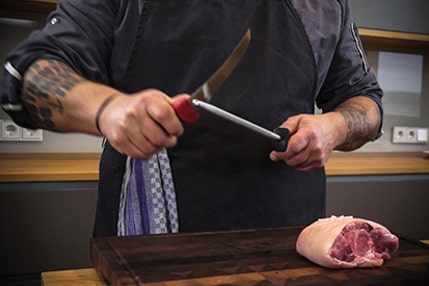
5 Methoden Messer zu schärfen
Beim Schärfen von Messern gibt es kein Patentrezept. Was zählt ist das Ergebnis. Das Messer muss hinterher scharf sein. Wir stellen Ihnen fünf Schärfmethoden für Messer vor.
