
Sharpening axes

When sharpening axes, it is important to maintain the correct edge angle according to the type of axe and its intended use. Axes designed for cutting, for example for felling or limbing, have a slim blade ground on both sides and a relatively acute edge angle of 20–25°. Axes designed for splitting, by contrast, have thick, heavy blades with a relatively obtuse edge angle of 25–30°. The edge geometry is also important: axes exposed to high loads, such as felling axes and splitting axes, have a convex edge, while axes where precision is required, such as carpenter’s hatchets or carving axes, have a flat bevel.
- Hold the axe firmly with one hand, or clamp it securely, and guide the folding sharpener over the cutting edge either from the front or from the back. Working from the back reduces the risk of injury.
- Maintain the existing edge geometry, whether convex or flat.
- The curvature of the cutting edge is matched to the intended use and should be preserved.
- Sharpen axes ground on both sides from both sides.
- After rough pre-sharpening, hone the edge, for example with a 1000/6000 combination stone.
Recommended for sharpening axes


Related articles


Werkzeuge für den Baumschnitt
Der Baumschnitt ist bei Obstbäumen notwendig, um ihre Vitalität zu erhalten. Ein optimaler Schnitt ist nur mit sehr scharfem Werkzeug möglich!
Go to blog
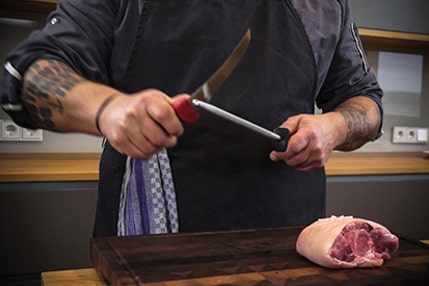
Schärfwerkzeuge: 5 Methoden Messer zu schärfen
Beim Schärfen von Messern gibt es kein Patentrezept. Was zählt ist das Ergebnis. Das Messer muss hinterher scharf sein. Wir stellen Ihnen fünf Schärfmethoden für Messer vor.
Go to blog
