
Sharpening tools: 5 methods for sharpening knives
There is no one-size-fits-all recipe for sharpening knives. What counts is the result. The knife must be sharp afterwards. We present five sharpening methods for knives.
With the honing steel
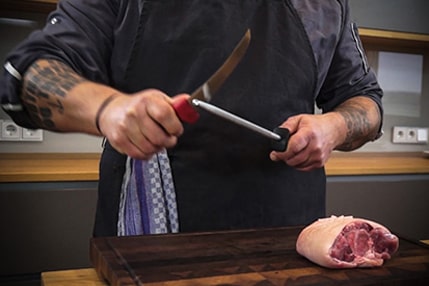
This sharpening technique only works with relatively soft blades (52-56 HRC) and is typical for butchers and chefs. With this method, the knife blade is alternately guided along thehoning steel (link to search "honing steel") at an angle of 15° to 20° and only a small amount of material is removed. Instead, a fine burr is created or an existing burr is straightened. When cutting, this burr folds over again relatively quickly so that the knife has to be constantly resharpened.
Sharpening knives with a sharpening steel
With the knife sharpener
A quick sharpening method for at home is offered by so-calledknife sharpeners (link to search "knife sharpener"). The blade is simply pulled through a slot on the sharpener. The abrasives are positioned at a defined angle to the blade and remove material from the cutting edge accordingly. However, the cutting angle cannot be adapted to the geometry of the blade. The abrasives used are usually quite coarse. The blade sharpened in this way initially looks sharp, but the result is more of a "plucked cut". The coarsely sharpened cutting edge usually does not have a long service life and dulls quickly.
On bench stones
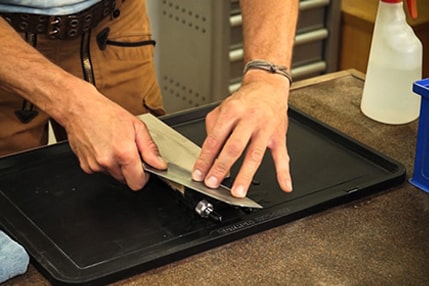
This sharpening technique is the most time-consuming, but also the best method for giving high-quality knives the right edge. When sharpening by hand on water stones or diamond plates (link to category "Sharpening stones/grinding stones") , a geometrically correct cutting edge is formed. The process starts with a coarse grit and the cutting edge is gradually ground with finer and finer grits and finally polished. The result is a smooth cut and a long-lasting edge. However, sharpening by hand requires some practice. In ouronline course Sharpening high-quality knives ku405o , you will learn in detail and with many illustrative videos how to sharpen your high-quality knives precisely with the help of bench stones.
Knife sharpening on bench stone
With knife sharpening systems
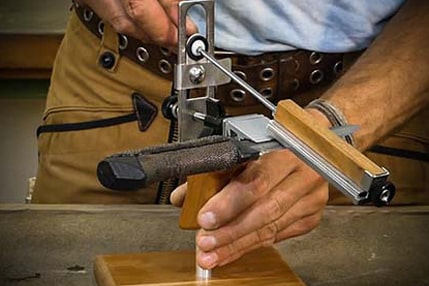
The exact term is actuallyabrasive-guided knife sharpening systems (link to category "Abrasive-guided sharpening systems"). The sharpening process is similar to sharpening on bench stones. However, the knife is fixed in a holder and the abrasive is moved over the cutting edge. This sharpening method can be learnt without much practice, as the abrasives are also clamped and are always moved over the blade at the desired angle. This technique also produces a geometrically correct cutting edge. With simple sharpening systems, however, only larger cutting edge angles (> 25°) can be realised.
Knife sharpening with a sharpening system
With water-cooled sharpening machines
These machines (link to category "Sharpening machines") are cooled with water to prevent overheating caused by the rotating whetstone. The cutting edge angles can be reproduced exactly with suitable grinding guides. Machines that grind on the round outer edge of the stone (e.g. DICTUM® DS 150 L 720782 or Tormek (link to manufacturer's page "Tormek")) always produce a hollow grind, which should be avoided with high-quality Japanese knives. Machines that sharpen on the flat side of the stone or grinding disc (e.g. Shinko or Tormek with diamond disc) are therefore better suited for knife sharpening. To complete the sharpening process, we recommend honing on the leather disc or by hand on a whetstone.
Knife sharpening on Tormek
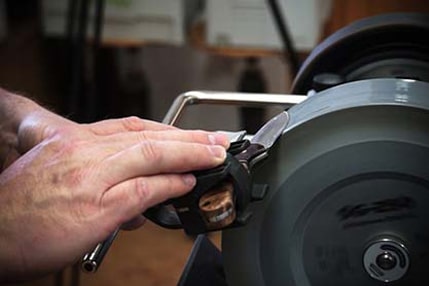
We show you how to work correctly with water-cooled sharpening systems in our online course Sharpening on the Tormek: Complete course ku404o.
If you would like to delve deeper into the subject of knife sharpening, visit one of our numerous sharpening courses (link to "Sharpening" courses) in the DICTUM® workshop centres.


